

The complexity of reacting to multiple challenges: the convenience year of 2022

They say that when the going gets tough, the tough get going. Well, in 2022 convenience retailers did just that.
Having surmounted the Covid-pandemic, the sector’s leading retailers didn’t even wait to let the dust settle. Instead they were straight out of the blocks launching new concept stores and formats, unveiling innovative fresh food offers and grocery propositions and channelling their energy (literally) towards EV.
Even the war in Ukraine, which has seen food and energy prices spiral and created a cost of living crisis in many world markets, doesn’t seem to have phased them. Instead, they have doubled down, doing what they do best – please the customer.
Here’s how the year unfolded through the eyes and lens of Global Convenience Store Focus and the key trends that have emerged.
Autonomous stores and new tech

There’s no doubt that the pillar that has supported the latest convenience store format innovation in 2022 has been digitisation and new tech.
And nowhere is this more apparent than in the launch of unmanned or autonomous stores, which remove friction points and smooth the customer’s convenience journey. By the end of 2022 most big name retailers (like 7 Eleven in Denmark pictured) were playing impressively in this space.
Back in February OMV, the international, integrated oil, gas and chemicals company, headquartered in Vienna, Austria, opened OMV Fastlane, its first unmanned petrol station and convenience store format offering OMV’s premium, best in class fuels plus lubricants. Contactless and completely digitised, the site offers a 24-hour self-serve pizzeria concept and self-serve convenience store.
The pizzeria offer, developed in partnership with start-up BistroBox, is based on vending machine technology and allows customers to bake an oven-fresh pizza via touchscreen ordering. According to Gernot Gollner, head of OMV’s petrol station business in Austria, it’s great quality and the vending concept has been well designed and implemented – it resembles a traditional pizza oven but with digital displays. In addition to providing stone-baked pizza in just two minutes, the vending concept offers snacks, drinks, coffee and tobacco products alongside.
The UNIBox convenience store has been created with the Austrian supermarket chain Unimarkt and software company Syreta. Shoppers register via an app to gain access to the shop, where they can select from a range of over 900 products for their daily needs plus organic lines, and then checkout via the app.
Digital technology is driving business transformation at Galp, the multi-national, integrated energy operator headquartered in Lisbon and Portugal’s leading service station retailer. Galp opened its first unmanned, self-checkout smart concept store this year. Located in the Lisbon area, the Galp smart store is testing an autonomous store solution in a controlled environment. The solution provides a check-out free service through an integrated system that comprises a network of proprietary cameras, sensors, computational units and computer vision algorithms. Joao Diogo, who leads Galp’s B2C commercial business in Iberia and is country manager for Galp Spain, said the goal is to empower stores to be autonomous and check-out free thus unlocking a seamless shopping experience.
The pilot includes features that are new to both Galp and its customers. The data generated using this technology will improve the retailer’s engagement along the customer journey, Diogo told Global C-Store Focus.

While OMV and Galp are testing the autonomous store waters, Żabka, which launched its digital transformation in 2016 and today employs 20% of its workforce in IT and digital innovation, is almost an “old hand”. In Żabka Nano, the retailer operates the biggest autonomous store chain in Europe with 47 stores.
The store experience is totally seamless, said Żabka Polska’s EVP and managing director, Dr Adam Manikowski. Customers enter either via an app or credit card, take products from the shelves, exit the store and then receive a receipt on their phone.
There are three unmanned store formats: Nano Indoor, a shop-in-shop solution for hypermarkets, larger stores and big office buildings; plus Nano Outdoor and Nano Brick-and-Mortar, which are both standalone concepts.
According to Dr Manikowski, this format flexibility and an average store area of just 20sq m allows Żabka to unlock other locations, where it normally could not be present.
The format is also targeted at the younger population and designed to promote a fun shopping experience, Dr Manikowski said.
“The assortment we are selling is slightly different but the technology is also technology that could not be easily replicated by competitors,” he added.
“Other retailers are opening unmanned stores but only one or two because it’s difficult to replicate. The beauty of our concept is we have a solution, which we can replicate and guarantees high economic success of the stores,” Dr Manikowski said.
“We will continue to open them because they are working and we are satisfied with first results but especially with NPS and customer satisfaction. The Nano stores also work much faster as a loyalty builder because customers can’t find this experience elsewhere.”
Further endorsement for the Nano concept came earlier in 2022 at the NACS Convenience Summit Europe event in Berlin when Żabka was awarded the NACS European Convenience Retail Technology Award.
In May, George Zheng, the NACS relationship partner for China, pinpointed the success of Convenience Bee, a Chinese internet retailer turned offline player, with more than 2,000+ unmanned stores. It has brought its big data and internet technological expertise into the c-store sector deploying electronic pricing, which enables it to change prices across all stores and regions to respond to a promotion, for example. It also uses operational monitoring and identification systems to broadcast highly targeted offers and promotions when a customer enters the store, such as promoting new deals on beauty products to women or specific food products to men.
But 2022 also showed new tech is no longer the preserve of big convenience store operators.

In November, leading independent UK retailer Guy Warner shared the development of the new co-branded concept store he has opened with Morrisons in Upton-upon-Severn – Warner’s Supermarkets – Together with Morrisons.
Warner has pushed the envelope in new tech and product ideas at the site and he revealed why technology is now a ‘need to have’ versus ‘a nice to have’.
“In the independent sector, IT has always been seen as an unnecessary expense rather than an investment that can make the operational model more efficient and customer experience slicker,” he said.
So at Warner’s Supermarkets – Together with Morrisons, Warner has plumped for the best tech he could buy – be that NCR for self-scan or a new VME EPoS system that is integrated with Gander, the app that connects a retailer’s reduced food to a local audience of shoppers; as well as delivery companies and the store’s loyalty program and app providers.
“We’ve made five to six times the amount of usual investment but now I look at the tool kit we have: the app we have, the integration from the forecourt through to back office, through to customer, through to store, for both marketing and operational reasons and it’s the difference between a motor bike and pedal bike,” he said.
Elsewhere, Global C-Store Focus highlighted the trend for Rapid Grocery Delivery (RGD) or quick commerce, where food and groceries are delivered to consumers in less than one hour and often sub 30 minutes. Paul Boyle, CEO at Retail Insight, suggested convenience retailers in urban centre sites are under threat from the new ultra-fast grocery model but there was an opportunity to carve out a piece of that action.
“C-stores have undoubtedly been impacted by the growth of ultra-fast delivery and, although not all of these ultra-fast businesses are going to last, they will take shopping trips away from physical stores. Hence, C-stores are creating their own, or partnering, to offer this service,” he said.
“If c-stores harness the technology and take advantage of what we can offer they should be able to unlock some of that growth. Instead of pulling from Gorillas, that order could be coming from grocers with a convenience offer,” he said.
Fresh foods innovation

As well as developing new store formats and concepts, convenience retailers continued to innovate in fresh foods and proprietary grocery offers during 2022.
Nouria, the New England family-owned and operated convenience store and fuel retailer, revealed how the business has looked to differentiate its product offer with a focus on quality food, freshly made in-store. This included the launch of the nouria’s kitchen brand for grab and go healthy meals.
“It was the biggest differentiator,” said Joe Hamza, chief operating officer, retail and marketing, at Nouria Corporation. “Everybody else was doing hot dogs, pizza or mostly frozen stuff, if it was made to order. Even today, although companies are doing fresh food, they are not doing it to the scale that we are doing it,” he said.
Nouria keeps on the front foot with regards to innovation. It contacts vendors directly and works with producers to find a way to bring healthier options, new protein products or wholesome snacks and beverages into its stores.
“We bypass the traditional c-store network and we are winning in that space,” Hamza said. “If customers want something new or different, they know that nouria is the place to get it.
“Whatever we see that’s trendy on Instagram or TikTok, we get in straight away. Some products don’t work but many do and we score big with our target customers ie young adults,” he added.
The focus on innovation and new products is paying off in terms of performance with Hamza revealing that 70% of the business’s growth comes from the new items and products in its stores.
Westmorland Family, operator of the award-winning Tebay and Gloucester Services, has a similar approach to Nouria when it comes to providing a point of difference.
“We make the food ourselves and in the farm shop we work with small, local craft producers who are willing to partner with us and create something different,” stated Sarah Dunning, Westmorland Family chairman. “We are always looking for the producer who you don’t see everywhere and is doing something different and unique.”
As a vertically integrated business, Westmorland Family makes the food that it sells in its own kitchens. “We love the fact we curate our offer from end to end and don’t use external agencies or designers,” Dunning said. “It’s an in-house offer – it may not be perfect but it’s an expression of us. We are authentic to ourselves and locality – even if it’s not always 100% polished there’s power in that.”
One recent retail innovation created by this approach is the introduction of flatbread stations at Tebay and Gloucester Services. While flatbreads are not new, the retailer makes its own in front of the customer and the lamb in the flatbreads is from its own farms and the salad is homemade in its kitchens. “The flatbread is unique to us. That’s how we like to approach innovations. If an idea is born out of what makes us unique, it will be innovative. And we don’t need to tell people they are homemade, they can see – it’s show not tell,” Dunning said.
Over in Ireland, Applegreen is pushing the envelope when it comes to new food and drink options too.
While the retailer partners with leading branded QSRs: Burger King, Subway, Chopstix Noodle Bar, Freshii (bowls and burritos) and Bueno (the Irish ice cream brand), it also operates its own deli brand, Bakewell, and has recently launched its own coffee brand, braeburn coffee, in Ireland.
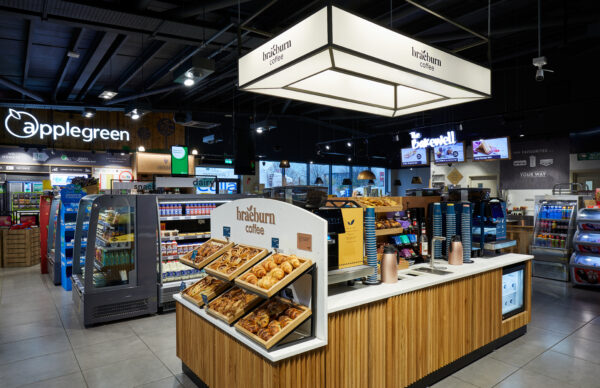
Provenance is a key component of the Bakewell brand. “It’s important to Irish consumers and we source local where possible, for example 100% Irish chicken in our chicken fillet rolls,” managing director Fiona Matthews reported.
The new braeburn coffee is being rolled out to Applegreen sites. “We are very excited to bring it to market. We’ve spent a considerable amount of time in researching what the customer wants and taken on great strength and depth in the coffee team.
“We are working with market-leading partners to develop the brand, which offers really high quality coffee on-the-go from a self service machine. Coffee is a key category for forecourt retailers so it’s important to make sure it is the highest quality offering it could possibly be.”
The offer also includes plant-based alternatives plus iced coffees, which Matthew states is pioneering within Applegreen’s sector in Ireland.
“Iced coffee fans have embraced the product and we’ve managed to go viral via user generated content, We could not have asked for much more for the launch of braeburn coffee,” she says.

A traditional deli is central to the new Spar store opened in Ireland by Thomas Ennis in July 2021. He described the new format as a “back to old school” approach featuring good quality, fresh, locally sourced food. The store also features a new Spar concept – Food Junction – offering hot and cold food. It has been a big hit and will be introduced to two further stores next year as a part of a revamp programme; along with a further “surprise” in one of them, Ennis reported.
EV

The energy transition accelerated in 2022 with convenience and forecourt retailers extending their capabilities to take advantage of alternative energies and particularly the growth in e-vehicle charging.
In Austria, OMV is investing more than EUR 400 mn and will offer more than 2,000 e-charging points at highway and transit route filling stations, plus around 17,000 office wall-box charging points by 2030.
“We want to be the leading integrated supplier for sustainable fuels so we have to do more. As the market leader in our country, we are investing in EV charging, which is important for the convenience business,” Gollner.
Parkland USA, the subsidiary of Parkland Corporation, Canada’s largest and one of North America’s fastest-growing independent marketers of fuel and petroleum products and a leading convenience store operator, is looking to leverage the EV charging expertise won by its Canadian parent across its own operations down the line.
President Doug Haugh believes the future for convenience stores will be heavily reliant on electrification.
In British Columbia, Canada’s westernmost province, EVs account for almost 12% of all new car registrations. That’s on a par with California.
Parkland operates 250 stores in British Columbia and is currently installing its first 100 ultra fast EV charges in the province. Haugh reported the market is Parkland’s ‘lab’ for EV, where it will aim to figure out the optimum marketing, pricing and servicing strategy.
“People think you just put EV chargers in and people simply plug their vehicles in – but there’s far more maintenance and support. Customers also need to know they are reliable and that they can depend on them to work and provide high speed charging.”
Haugh anticipated the business will trial different charging models and even subscription-based offers, which are already popular for car washes.
“We will experiment with all of those models,” he said. “We’ve not seen anyone that says this particular model works – everyone is in a discovery mode.”
In the meantime, British Columbia provides a marketplace with real demand and a growing number of customers to help the business learn really fast, Haugh adds.
“We will also be integrating EV into our loyalty program so customers can earn points and redeem them with EV. That’s how seriously we have taken EV development, we have built into every facet of our strategy,” he says.

Applegreen is also focusing on the future of mobility and EV in particular.
The company has done a lot of research and investment into EV to ensure the right customer experience, Matthews reported; and it launched the Applegreen Electric brand earlier this year.
“EV is coming, there’s no doubt. Adoption is growing all of the time. While currently 96% of vehicles on the road in Ireland are fossil fuel, there’s a greater appetite for EV and it will continue to grow over the next few years. We are very keen to embrace that change and larger motorway service areas will be key locations for EV charging,” she said.
In Ireland 17 sites currently offer EV charging but it has a stronger network in the UK, where it is the second largest provider at motorway service stations; and the Applegreen Electric brand has just launched in US.
“We are on a journey and are actively supporting sustainability initiatives where we can have a positive impact, such as our commitments to becoming net zero in our own operations by 2030, continuing to source 100% renewable electricity and evolving our fleet to EVs.
“There are great synergies to be won in offering quality and choice in food and coffee alongside a fossil fuel offer or EV charging,” Matthews stated.
In Iberia, where Galp is the second-largest solar power producer, the company has committed to direct half of its capex in the coming years to renewable energies and to low-carbon businesses. It plans to invest heavily in green hydrogen, which will allow it to produce a wide array of zero and low-carbon fuels, while also kick-starting a lithium battery value chain with Northvolt.
This path is already visible at the retail network, as Galp is the leading operator of electric vehicle charging stations in Portugal. Many of its sites in Iberia are also generating the electricity they consume through autonomous solar plants – a concept that Galp is also already offering to many households, companies and energy communities in Iberia. “We are truly committed with the energy transition in our journey to regenerate the future,” Diogo said.
Current challenges: labour shortages, the cost of living and energy crises

While labour was cited as a key issue for convenience store operators in the front half of the year, the cost of living crisis, driven by rising food and energy prices, was quickly added to their list of operational challenges by the second half. Despite the turmoil, retailers have shown remarkable resilience and drive; reflected in responses at Nouria in the US (“If you can’t manage in a difficult environment you’ve no business being in business”) and Thomas Ennis in Ireland (“We’ve become smarter and recessions are great for sharpening yourself”).
Matthews at Applegreen said labour was the single biggest challenge across all territories. “We have to be very creative in navigating [the labour crisis] and recruitment. I’ve never seen anything quite like the shortages, which are continuing as we come out of the pandemic,” she said.
“Our teams have been through a lot – they were the front line workers in very challenging times. People are tired and we need to ensure they get the right breaks and support. We’ve introduced far more flexibility in hours and rostering. As a sector we’ve had to adapt and be open to a different mindset – the typical roster does not really work any more,” Matthews explained.
Hamza at Nouria suggested the US situation is as bad, if not worse than Europe due to the country’s immigration policy plus the gig economy, which means the same pool of people it seeks to recruit also work for the likes of Uber of Uber Eats – the shrinking workforce is an urgent problem.
“It’s the most challenging labour market in over 30 years and our biggest competitors in New England are closing stores. We have not closed one store and that’s a credit to the commitment our people have to serving their communities. We’ve also done a good job in making sure we are rewarding our people and paying for extra labour to keep stores open. We may not make as much in the short term but hopefully customers will reward us for loyalty,” Hamza said.
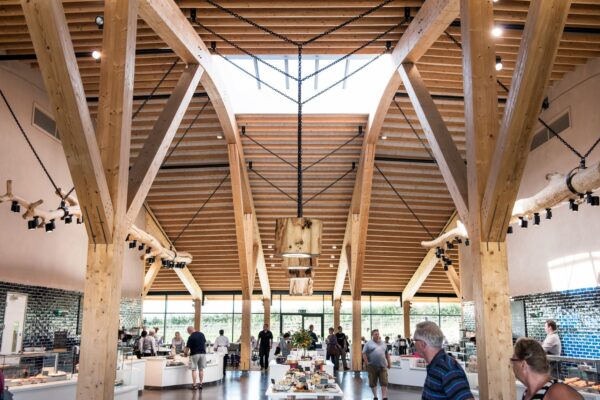
For Dunning at Westmorland the impact of the cost of living crisis on the business, which is compounded by rising inflation and escalating energy costs, was very difficult to judge. “There’s the complexity of not just reacting to one crisis. There’s a number of big movements in our business, which are not easy to separate out,” she said. Plus, there’s been significant behavioural changes due to Covid, which still haven’t settled, she added.
Westmorland Family, for instance, has found that the number of transactions is down but average spend is up. Summer 2022 was busier than pre-pandemic times, due to staycations, but quieter than last year.
Work from home policies have also changed the shape of the business, which is quieter in the week but busier at weekends.
“Pre-Covid our industry was quite stable and predictable but Covid has brought so many changes and we are still watching to see what will stick and what will be temporary.”
Warner said the customer reaction to the new co-branded store had been positive and welcomed his partnership with Morrisons in the current climate.
“The store looks good and the pricing and positioning definitely works because we are very competitively priced at a retail level. Historically, we’ve not been as competitive as we are now, which in today’s market is key,” he said.
“We’ve not ended up in a scenario as a big convenience store that does a bit of top up if there is no alternative. The Holy Grail is for people come to you out of choice for that bigger basket. That’s why this partnership has been key – it’s given us more of ability to get into the supermarket space than we’ve ever had before.”
For Ennis, sticking to his knitting his also vital.
“We’ve traded through a recession already but never reduced prices but offered something extra for free such as a piece of fruit or snacks. Yes, people are watching what they are spending but they still have to eat and they appreciate good quality foods. We’ve never changed supplier or the quality of ingredients. There is value all around the store and every two weeks we are refreshing the offers but the quality of food will never dip – once that happens you can never come back,” he maintained.
Despite rising energy prices, keeping stores and colleagues warm remains a priority in the winter months, Ennis added.
“Whatever we are dealing with under the water, consumers can’t see anything but quality food, a warm store that’s well lit and colleagues looking after them. We use our skills as an independent retailer to keep consumers happy,” he said.
