

The Foodvenience Revolution: Why 2026 is the year convenience stores redefine quick service
By Alex Considine Tong, CPO, Retail Insight
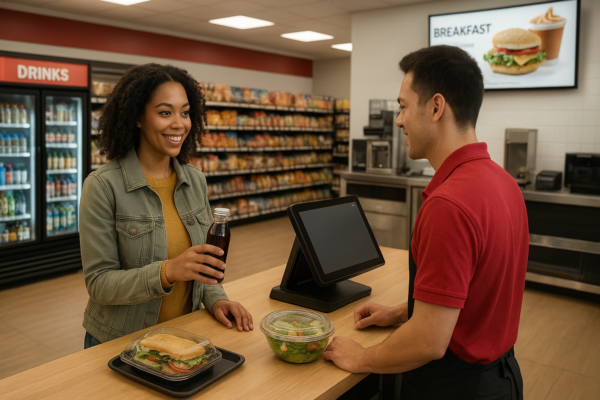
The lines are blurring. Walk into a modern convenience store today and you might find yourself ordering a made-to-order breakfast sandwich, customizing a fresh salad bowl, or grabbing a craft coffee that rivals your neighborhood café. The question isn’t whether convenience stores are competing with quick-service restaurants anymore – it’s whether quick service restaurants (QSRs) are adequately prepared to compete back.
Welcome to the era of “foodvenience,” where the humble convenience store has evolved from a destination for emergency snacks and fuel into a sophisticated food retail environment that’s rewriting the rules of quick service entirely.
Meeting the Perfect Storm of Consumer Demand
The transformation didn’t happen overnight, but several converging trends have accelerated dramatically. Consumers today expect speed without sacrificing quality, convenience without compromising choice, and value that extends beyond just price. They want fresh, healthy options alongside indulgent treats, and crucially, they want it all available when and where it suits them… whether that’s 6 AM or midnight, at home or on the go.
Traditional QSRs, bound by labor-intensive operations and fixed locations, struggle to meet this demand for ultimate flexibility. Convenience stores, meanwhile, have reimagined their value proposition entirely. With their extended hours, ubiquitous locations, and increasingly sophisticated food programs, they’re positioned to capture what might be the most valuable commodity in modern retail: time.
What’s Driving This Sophistication?
Technology sits at the heart of the foodvenience revolution, enabling convenience stores to punch well above their weight. The most successful convenience retailers are no longer just stocking shelves. They’re leveraging data analytics, supply chain optimization, and customer insights in ways that were once deemed impossible.
Consider the operational complexity of running a successful fresh food program in a convenience setting. You need to understand local taste preferences, predict demand patterns, manage inventory with precision to minimize waste, ensure food safety compliance, and maintain quality standards across multiple locations – all while keeping labor costs sustainable. This isn’t the convenience store model of five years ago; this is a sophisticated retail operation requiring advanced store technology that mirrors innovations shaping the future of grocery retail.
The convenience stores winning in 2026 are those that have embraced technology not as a nice-to-have, but as fundamental infrastructure. They’re using predictive analytics and store-level retail data to determine which fresh offerings to prepare each morning, dynamic pricing to optimize margin while reducing waste, and real-time inventory visibility to ensure the right products are always available. At Retail Insight, we’ve seen our retail intelligence platform enable operators to increase sales simply by having better visibility into what’s working, what’s not, and why.
Menu Innovation Meets Operational Reality
The expansion of convenience store menus has been remarkable. Where stores once offered pre-packaged sandwiches and roller grill hot dogs, today’s leading operators feature chef-crafted offerings, globally-inspired flavors, and genuinely fresh prepared foods. Some are partnering with local restaurants, others are building proprietary food brands that create destination appeal.
But here’s the challenge: menu innovation without operational excellence is a recipe for disaster. The stores succeeding aren’t just those with the most creative menus but those who can execute consistently across locations, manage food costs effectively, and respond quickly to shifting consumer preferences.
This requires a level of operational maturity that many convenience stores are still building toward. Category management, once focused primarily on packaged goods and beverages, now extends into the complexity of fresh food programs where waste, quality, and speed-to-market determine success or failure. The technology infrastructure to support this sophistication, from field execution tools to performance analytics, has become non-negotiable for operators serious about competing in the foodvenience space.
The Margin Opportunity
Let’s talk about what matters to operators: margins. Prepared food typically delivers significantly higher margins than traditional convenience store categories, but only when executed well. Waste can quickly erode profitability, and customer disappointment from inconsistent quality can damage repeat visits that make food programs worthwhile.
This is where operational intelligence becomes crucial. Understanding performance through store-level data allows operators to optimize their food programs systematically at a granular level – identifying which products resonate in specific markets, and where execution gaps exist. It’s the difference between hoping your fresh food initiative works and knowing exactly what’s driving results and what needs adjustment.
What Does the Future of Convenience Look Like?
As we move into 2026, the trajectory is clear. Convenience stores aren’t just participating in the food retail space, they’re increasingly defining it.
Technology is the enabler of this sophistication. Not technology for technology’s sake, but purposeful convenience store technology that helps operators make smarter decisions, execute more consistently, and understand their business more deeply. The convenience stores thriving in this new era are those that recognize technology not as an expense but as the infrastructure that makes foodvenience possible at scale.
The question for every convenience store operator is simple: are you equipped to lead this revolution, or will you be left behind as the industry you thought you knew transforms into something entirely new?
The future of convenience isn’t about selling snacks. It’s about redefining quick service entirely.
