

SPAR’s blueprint for global convenience: scale the intelligence, keep the human smile
At Forecourttech in Alicante today, Zsuzsa Hordai, Head of Strategic Projects at SPAR International, set out the balancing act now defining convenience retail: deploying shared global technology at scale while keeping every store relentlessly local and never letting frictionless service tip into faceless service.
Three shifts hitting convenience retail at once

Zsuzsa Hordai at forecourttech
“Basically what we are seeing today is one industry with three simultaneous shifts,” Hordai told delegates. The first is what customers expect from a convenience store in the first place. “It’s not about emergency top-up shopping anymore,” she said. “It’s not about just quickly stopping at a fuel station to get a pack of cigarettes.” Missions have broadened, and customer expectations keep rising.
The second shift is generational. Thanks to longer life expectancy, Hordai argues, more generations are shopping side by side than ever before, up to seven of them, from traditionalists in their eighties through to Gen Z, Gen Alpha and now Gen Beta. Their relationship with technology differs sharply: younger shoppers treat self-checkout as freedom and autonomy, while older customers often still want a person to do it for them.
The split shows up regionally too. In Europe, SPAR’s data puts larger segments of customers on the older side of that generational divide; in Africa, where SPAR also operates, a majority sit on the younger side. Food-to-go take-up follows the same pattern: 42% of Gen Z say they buy it at least once, against 12% of baby boomers.
The third shift is technology itself. Store systems, Hordai said, are “not silent” anymore; they talk to each other, increasingly via AI, and the pace of learning from that data is accelerating fast. Her argument: “the winners of today and tomorrow are the ones who can integrate” all three shifts at once, rather than treating convenience as one format serving one customer on one mission.
A Dutch brand, claimed by everyone

“I haven’t introduced myself,” Hordai said partway through, before explaining who she actually works for. SPAR is a Dutch brand, dating back to its founding in 1932, “although if I talk to some of the people in Austria, they would claim it’s an Austrian brand. If I talk to someone in South Africa, they would say it’s a South African brand.” The company’s purpose, she said, is simple: to be the local food choice by meeting the needs of the communities it serves. Last year the SPAR retail network generated a turnover of €50.9 billion across 50 markets.
The newest market to operate stores under the SPAR brand is Iceland, where the first stores opened this summer. The appeal, despite a population of just 400,000, is 3 million annual tourists who find eating out eye-wateringly expensive- Hordai cited an €80 fish and chips for two – and so buy more through convenience and food-to-go instead.
SPAR runs a deliberately multi-format strategy: hypermarkets, supermarkets and convenience stores, with more than 2,000 small-format sites globally. Operating in 50 countries, Hordai said, gives the group “huge diversity of insights” into what works and what doesn’t, which it tries to track and respond to in a common way across markets. Partnerships contribute to the growth of small-format stores: Orlen in Central Europe, Maxol in Ireland, Barista Bar, a Northern Irish coffee brand that now outsells Starbucks locally in that market, EG Group on Dutch forecourts, and the SPAR Express brand across multiple forecourt partnerships in Switzerland.
What travels globally, what stays fiercely local
Localisation, Hordai argued, now has two dimensions rather than one. The first is geography in the traditional sense: market conditions, competitors, economics. The second is generational, the same seven-generation split that shapes expectations within a single market, not just between them.
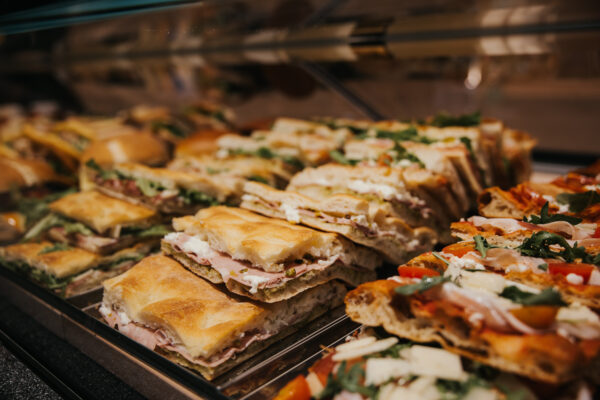
What SPAR International tries to make sure travels across all 50 markets is the common core: data platforms, digital ordering, AI-enabled insights, cybersecurity, and food service concepts and standards. Loyalty and reward infrastructure travels too, even if the rewards themselves don’t. What always stays local is the menu. “The people who are consuming pizzas in Italy would never buy the pizza that we would prepare in Ireland,” Hordai said. “They would just say, oh, come on, this is not a pizza.” Coffee is no different: “Even the shortest espresso you can get in Germany is too long of an espresso for an Italian consumer.”
The same logic extends to the customer journey itself. Self-checkouts land well in markets with younger, more tech-ready populations; elsewhere, SPAR country organisations keep more staffed checkouts running in parallel, rather than forcing a single format on every market.
Dublin: checkout without the scan
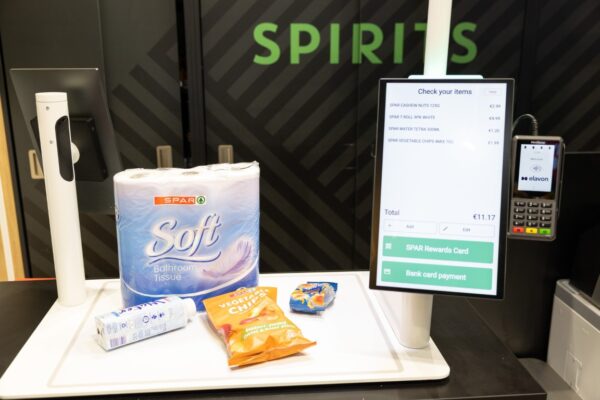
Hordai’s first real-world example came from the SPAR KCR store in Dublin, a refitted site run with forecourt partner Maxol Group. It’s SPAR Ireland’s first trial of Deligo’s machine-vision self-checkout: customers place their items on a table, cameras identify everything selected, and payment follows without a single item being scanned. Traditional staffed tills and conventional self-checkout both remain alongside it, she said, “because we have very different customers shopping there”, giving choice, not a single mandated format.
The SPAR KCR site leans hard into sustainability: a living wall irrigated entirely by rainwater rather than mains water, a turbine supplying renewable energy, and air technology that keeps food cool while using less energy. AI-based demand forecasting and replenishment sits behind the scenes, cutting food waste, a response, Hordai noted, to a food industry in which roughly 30% of everything produced globally ends up wasted. The store has also picked up an unplanned following on social media, with influencers filming its sustainability features and technology. Recipes and food offers, true to the localisation principle, stay distinctly Irish.
Riyadh: betting on convenience over hypermarkets
Saudi Arabia, Hordai said, is “a very urban, very young, very affluent, and very rapidly changing market.” The SPAR licensed company used to run hypermarkets there; it closed every one of them. She said online grocery and gridlocked traffic, including traffic jams in Riyadh at two in the morning, made the format irrelevant, while an explosion of food-service options meant fewer people wanted to shop in hypermarkets at all. The retailer switched to convenience formats in high-footfall urban areas instead, under the SPAR Express brand, a move which she said “seems to be working extremely well.”
The standard technology – self-checkout, payment systems, electronic shelf labels- travelled over largely unchanged. What’s been rebuilt locally is the food mission: menus built around dishes such as zatar manakish (Arabic-style pizza), changed through the day as customer habits shift. One flagship sits inside the newly opened King Abdullah Financial Center metro station. Designed by Zaha Hadid Architects, the store’s interior incorporates the same wave forms as the building around it. Hordai said the focus now is discipline, not overstretching, and choosing locations deliberately rather than taking every site on offer.
Malta: the bakery that broke TikTok

SPAR’s third example was personal. One of SPAR Malta’s stores was shortlisted last year among the top 12 foodvenience stores in the world, competing against retailers from across the globe. “The term ‘foodvenience’ (invented by Insight Research) is now engraved in everyone’s mind,” Hordai said of the site.
She used it to tell a story about people rather than technology. The store’s manager, Kanchan, joined SPAR Malta eight years ago as a store associate after moving from Nepal. He worked through every training programme on offer, grew familiar with the store’s technology and ordering systems, and helped make those systems more colleague-friendly. He now manages the store and was recently named FMI Store Manager of the Year 2026 by the US Food Marketing Institute, one of grocery retail’s leading awards.
The store itself has gone viral on social media for its food, not its gadgets: a full bakery and patisserie, fresh pastizzi, wraps, bagels, sandwiches and baguettes made in-house. Shoppers film the store unprompted, effectively free advertising generated by the food alone. Behind that quality sits the same AI-driven forecasting used elsewhere in the business, keeping ingredients fresh and waste down.
Keeping frictionless from becoming faceless

Hordai closed with a cautionary story from her own travels. On a recent trip to Asia, she went back to a tea chain she’d visited a year earlier, wanting to reorder a herbal tea whose name she’d forgotten. Where a person had once taken her order, she found only a menu screen and a QR code. The staff member nearby could only repeat “scan the QR code” when asked for help; in the end, she described the tea to Gemini and asked it to identify the flavour. “That’s definitely, definitely not where you want to get to with tech,” she said. The ordering technology itself was excellent, she stressed, but with no human left in the interaction, the experience felt wrong enough that she wouldn’t go back.
It’s why, she argued, having AI is no longer the point. “Everyone has AI. It’s not a big deal anymore,” she said. What matters is the speed at which it helps a business learn, combined with keeping a human accountable in the loop. “We want to make sure that frictionless never becomes faceless.”
She ended with three sentences which she said sum up SPAR’s approach to every market it operates in: scale the intelligence, personalise the experience, and preserve the human smile that, in her words, “makes the difference in every retail store you go into.”
