

Q8 Denmark raises the bar in c-retail with Noahs Global kitchen concept

The future of foodservice within convenience retail was explored in a recent webinar featuring Martin Stilhoff, strategy & innovation food manager at Q8 Denmark, and Daniel Baven, Noahs Global CEO.
Co-hosted by Dan Munford, Insight Research CEO, and Craig Philipson, Shopworks MD, the webinar explored this game changing partnership, which is creating significant interest throughout the convenience retail industry.
In their joint presentation, Stilhoff and Baven explained the strategy and concept of Noahs kitchen, which they refer to as ‘the Spotify of food’. The technology is the enabler, which allows Q8 to significantly broaden its existing customer base; while the concept provides multiple branded offers all from within one multi-purpose kitchen located in a refitted store at Q8’s Rødovre site in Denmark.
Effectively it’s a ‘dark kitchen’ for customers who order via aggregator delivery apps while, for customers visiting the site, the in-store experience is modern and vibrant with a personal touch including a view into the kitchen.
The quality and variety of the menu raises the bar, and extends the offer into the evening, beyond the more traditional breakfast and lunch trade where convenience retailers are often strongest. Of the more than 5,000 customers, in the first three-months since opening, more than 50% have ordered after 16:00 – either via a delivery service or directly from the store.
Stilhoff shares the results in his presentation, which are as impressive as the retailer’s ambition, as it plans to roll the Noahs Kitchen concept out to more sites. Baven talks about the technology, the kitchen and menu concept.
Service station and food expertise

The duo kick off with a brief introduction to their backgrounds and the Q8 and Noahs Global kitchen businesses.
Stilhoff reveals he was “born and raised at a gas station”, as his father franchised a number of Shell gas stations when he was growing up. Stilhoff also decided he wanted to change the traditional gas station concept, pushing the boundaries of what was on offer in his career moving forward.
Baven’s background, meanwhile, is in food and specifically as a chef with a culinary degree from Copenhagen’s Hotel and Restaurant School. He then transferred to Thailand and worked as a head chef and went on to launch a sandwich franchise chain with 15 locations. Then covid hit and he created the Noahs kitchen project – a rethink of how the restaurant business will look in the future – collaborating with large conglomerates. It’s a new type of company but very innovative and with a small team, he adds.
Q8 operates both manned and unmanned forecourts with 106 manned sites serving 19 million transactions per annum and offering shop, fuel, car wash and EV charging and 137 unmanned sites serving 7.7 million transactions, offering fuel and car wash only.
In terms of key categories, 26% of total sales are generated by kiosk products, while food and bakery accounts for 17% of business and has been growing year-on-year. Stilhoff reveals it will become the biggest category in the whole shop.
In coffee, Q8 has a partnership with Starbucks on the go and revenue is growing annually. Tobacco still accounts for 51% of gross sales but driven by the high cost of packaged products.
In terms of the market, Q8 has four key competitors: Shell, Circle K, 7-Eleven and OK+. Q8 is not the market leader, Stilhoff says, but it’s trying to get there and do things differently to get closer to the market leaders. He likens Q8 to the ‘bad boy’ in business.
Changing customer perceptions

In terms of future challenges, Stilhoff says the company is trying to make a difference. He believes gas stations in the Nordic countries are standing on a ‘burning platform’ and have not really competed because customers have always been visiting stations for fuel. However, in the future, there will be 100+ competitors for EV charging so Q8 needs to consider its relevance moving forward and how to get customers into its shops. Food will be a key differentiator, Stilhoff maintains. However, it poses a challenge since customers don’t think forecourts offer high quality ingredients etc. Q8 will need to change that perception, he adds. People will still move from A to B and will need to stop at a Q8 station when they are hungry so offering more and better food is imperative, Stilhoff says.
Sites will still require a certain level of convenience such as in drinks and beverages, Stilhoff says. However, changing consumer mindsets of what to expect from a gas station in future will be key, he adds.
Facilities, including toilets, are extremely relevant too, since customers will remember those stations where these services are best in class, as well as those that are not.
In terms of future opportunities, Stilhoff reports sustainability is fundamental and every time the business looks at a new product it considers four pillars: whether it is organic, if it is plant-based, the animal welfare standards and if it is Danish produced.
“We always look at this – that’s what customers will demand in the future,” he says.
Q8 is also looking to tackle food waste with its partnership with Too Good To Go.
Takeaway opportunity

Recent research and analysis has identified a key market opportunity, Stilhoff reports. Q8 found customers were not shopping its store offer into the evening and that 80% of the evening market in Denmark is in takeaways. “We needed to get into that market. It’s a game changer – the convenience store food market is worth €268 million whereas the takeaway and eat in market is worth €2 billion.”
Further, the takeaway market is growing, Stilhoff adds. In 2023, for example, 24% of all meals in Denmark were takeaway and, since 2015, 260,000 evening meals in Denmark have moved out of private homes and kitchens every single night.
The trend to takeaway is largely down to the loss of generational cooking skills. “If you want better food for yourself at home, then takeaway is actually the option you have in the future,” Stilhoff says.
Stilhoff expects future takeaway growth of 10-15% a year.
Q8 has explored Danes’ preferences for takeaway food and found there was a broad spread including pizzas, burgers, sandwiches, salads and Mexican meals so it didn’t make sense to focus solely on one concept. At this point, the retailer began talking with Noahs since it could offer a range of food options versus just pizza, for instance.
Noahs’ concept suited Q8’s analysis of how we think the takeaway market would look in the future, Stilhoff says.
Noahs: brand platform, technology and architecture
Baven goes onto explain the Noahs concept, which is present at Q8 but also at supermarket kitchens, railway stations, shopping centres and food courts.
It’s a platform with a lot of activity in the market because existing solutions were not meeting the demand and growth in takeaway food, driven by digital transformation. Baven claims the restaurant market has an outdated operating model and is unable to scale to accommodate the new aggregators who are coming into the market with their food delivery apps.
New thinking was necessary, Baven says. Noahs has changed the way the overall restaurant model operates and who it operates with.
Instead of operating a single brand, Noahs offers an open marketplace of its own, as well as third party brands to fit into a business’s franchise.
“We are not building what we want, we are building what Q8 needs,” he explains. “And we are doing it with a white label platform that we named Noahs or ‘the Spotify of food’, offering a suite of different brands that can integrate in different combinations, based on market demand; and we can create them in a very digital-born way, so it’s very efficient. We combine it with a technology stack and a technology operating system with a best of breed mentality and we have invested a lot into creating our own VR solution and operating system for the restaurant operator to allow them to run the restaurant from their phone,” he says.
On top of the platform and tech, Noahs has also created the architecture to enable it to customise product offerings to local tastes at minimum cost.
“We are building future proof kitchens and running a new type of operating system with all the cutting edge technology and digital-born brands,” Baven says. “It’s a whole different way of building kitchens. Normally, you build a kitchen after what a brand needs but we are building the brands based on our modular kitchen set ups, which is much more transformational.”
Ghost kitchens and dark kitchens, which were spawned during the covid pandemic, have evolved into today’s Smart Kitchens, Baven says. Going forward, every single kitchen will need to have ‘Smart Kitchen’ technology to reach all the relevant digital channels. Baven believes that in the future operators will have hundreds of different sales chancels because they can sell through WhatsApp, Instagram and TikTok etc.
“The future will be so digital that you will even have AI ordering systems,” Baven says, and he reveals Noahs is working on an implementation so that kitchens are ready for this next transformation.
The service station of the future
Working with Q8, Noahs is working to totally digitalise the service station of the future, Baven reports. It’s not all about Noahs or the food but how the company creates a digital and physical space that is coherent and that suits the market around it. As such, there will be different concepts eg city and highway versions and different size footprints. Highway versions will be more physical and experience-focused, while the digital city hubs will have a raft of trading options that you can’t even imagine today, Baven says.
Different size kitchens, meanwhile, enable operators to extend a food offer into the suburbs in a modular way, starting small and increasing over time. Kitchens can be built to accommodate up to 15 brands, Baven says.
Service stations, in particular, represent a huge opportunity and Baven expects onsite kitchens to become a global phenomena, driving convenience and new revenue channels.
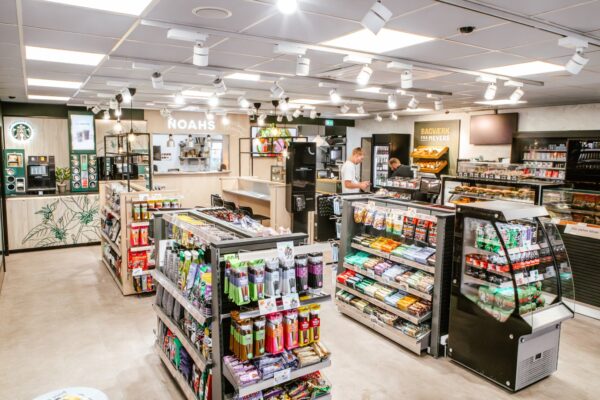
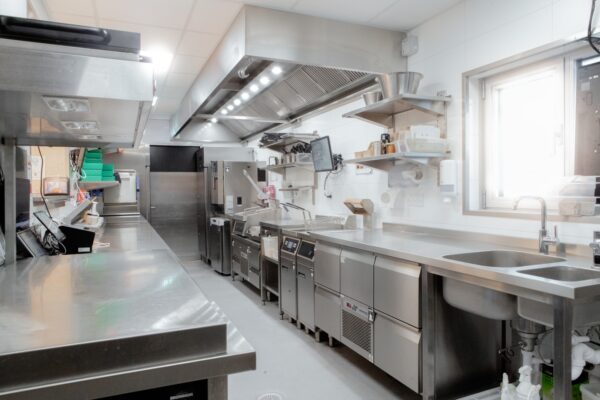
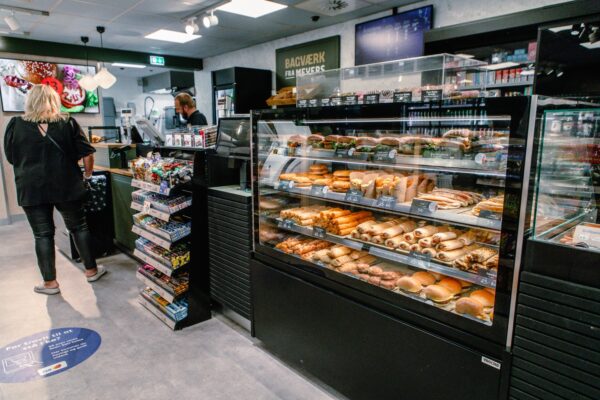
Stilhoff presents the Q8 food offer which is created from a 22sq m kitchen, developed with Noahs. On top of bakery and hot dogs, Noahs enables Q8 to cater for 69% of Danes’ takeaway needs including burgers, pizzas, Mexican options, salads and a kids’ menu.
He showcases the consumer view of the new look store, which has a kitchen fitted towards the far right hand side of the building, a space that was previously used to store drinks and had little customer footfall. The dividing kitchen wall features a window so that customers can see food being prepared and made on demand.
The assortment in the rest of the store has remained the same but has been fine tuned, according to best sellers, Stilhoff adds.
Outside the store, takeaway boxes have been installed for aggregators who are collecting orders for delivery. This minimises the interruption of the customer flow in a small store. It also means there’s no personal interaction with anyone at the store and the kitchen is more efficient.
For food that is ordered by customers within the store, there is face to face interaction with kitchen staff via the window and serve over area.
In terms of equipment, the kitchen is optimised, Bevan says. Ovens, for example, are pre-programmed to heat product to the required temperatures/time, which simplifies operations for store staff and training.
“There are so many benefits,” he says. “We simplify operations for the actual people and limit the labour exposure so the team is generally less than half of what we would normally have in a restaurant. For this kitchen to run, you need one or two people,” Bevan says.
Results and next steps
The partnership has exceeded expectations, Stilhoff reports. The Noahs kitchen concept has driven a four-fold increase in food revenues, he says.
It’s a whole new market opportunity, Stilhoff says. “The Danish market is in front of food today but this will change the game of how we are looking at food and looking at new markets and competitors.”
Crucially, Noahs has boosted evening sales significantly, and the evening has become the biggest revenue generator.
In addition, there’s cross selling opportunities for drinks etc in store and for online ordering too.
Q8 intends to extend this level of convenience by introducing new dessert items like ice cream, example.
Around 70% of total sales are online sales, Stilhoff reveals. “That’s a whole new channel we are looking into and it’s only possible because of the tech and knowledge that Noahs is delivering to us right now,” he says.
“There were no digital sales prior,” Bevan adds. “This is a whole new thing – the fact you are suddenly becoming a digitalised service station and it leads into so many other things such as what can you do by digitalising the rest of the station and what else could you offer within these square metres that you could also be selling digitally,” he says.
Stilhoff concludes by revealing Q8 is aiming to double its food business within three years. “It is possible to do that and look at your business in a different way and do something dramatically different to change your business,” he says.
