

“Choice creates confidence”: inside 24-Autohof’s multi-CPO forecourts
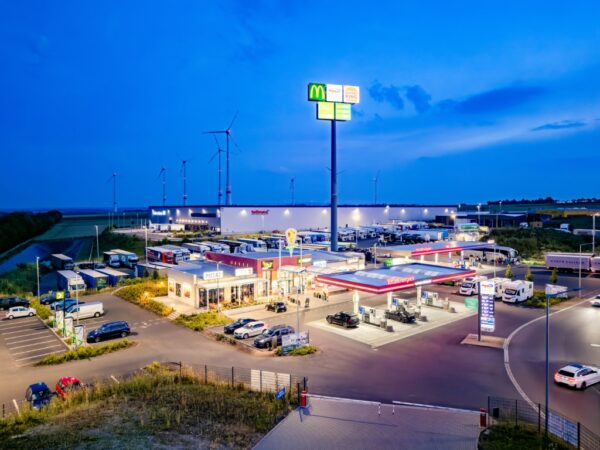
Germany has one of Europe’s deepest high-power charging networks and one of its smaller pools of EV cars. Roxanne Ruscheinsky of 24-Autohof explains why Charge Point Operators (CPOs) are building well ahead of demand, why her sites host up to six of them at once, and why the grid connections, not the chargers, are determining what gets built.
Most of the companies we speak to about forecourt charging are charger operators. 24-Autohof is not. It is a property developer that builds Autobahn service areas and rents space on them to CPOs, fuel brands and food partners, without owning a single charger of its own. Its answer to charging has been to put several competing operators on the same forecourt and let the driver choose.
Fifteen sites, several hundred charge points

Roxanne Ruscheinsky
24-Autohof operates 15 locations across Germany. “We have several hundred high-power charge points overall in operation, many more under construction and in planning,” Ruscheinsky says. “Typically we have three to four CPOs per location, as a good rule of thumb. Where there’s the demand, we host five to six CPOs, which roughly sums up to 40 to 50 charge points at a single site.”
The traffic behind it is substantial. “Over the entire network we welcome roughly 10 million guests a year, so on average it’s 2,000 per site,” she says. “We also see strong seasonal patterns, so June, July, August being holiday seasons.” Those are the busiest months of the year on a road network well-traversed by long distance holiday-makers. What makes the charging numbers striking is how far ahead of the market they sit. Only 4% of German cars are full electric, although a healthier 35% of newly registered cars now are *according to the Federal Motor Transport Authority*. ” CPOs do not shy away from competition. They voluntarily choose our locations, where they compete directly with other operators, because they already achieve above-average charging volumes today and expect even greater demand in the future.,” Ruscheinsky says.
Operators are setting up now as the best locations will already be taken later. “It takes quite a long time for the whole planning process, because there are so many different stakeholders,” she says. “Many CPOs, many planning offices, the municipalities, the energy distributors. It’s really sometimes a year long, multi-year process.”
Borrowing from the shopping centre
The multi-operator model did not come out of the charging industry. It came out of a retail heritage. “I would definitely say it’s part of our DNA,” Ruscheinsky says. “Our founder developed shopping centres, business parks, event spaces, sports arenas – all of these being high-footfall public real estate. We borrow from his experience wherever it fits.” Every site is built to combine several reasons to stop: energy, food, retail, parking, facilities and services.
Applied to charging, that thinking had an obvious target. Early charging was built around closed ecosystems – Tesla chargers for Tesla cars – so hosting a single operator meant turning away everyone else. 24-Autohof went multi-CPO from day one back in 2013. “Shoe-shoppers know that if they want a good pair of shoes, they’d rather go to the mall where there are three or four shoe stores,” Ruscheinsky says. “Charging works for us the same way. Choice creates confidence.” Drivers can stay with the network, tariff or app they already trust, and they have an alternative if a charger is occupied, under maintenance or unavailable.
The retail side is structured differently. Inside the Autohof building, a single franchise partner runs the whole operation, including concessions such as Subway or Coffee Fellows. The large fast food brands – McDonald’s, Burger King – usually sit in freestanding units next to the site, independently operated, trading on the proximity to the large mobility hub and, in particular, from the signage on the Autobahn, into which they are often integrated.

Prime position for new technology
Where the chargers physically sit is treated as a strategic decision rather than a layout one. On most older forecourts, charging ended up wherever there was spare tarmac. At 24-Autohof it goes next to the building.
“If you want to establish a new technology or a new retailer, the location should be the most attractive,” Ruscheinsky says. “Only if it’s most attractive will customers start using it. You’d have this for anything – a new food brand, whatever it is.”
The payoff shows up in utilisation. “Positioned close to the building, the charging stations are particularly convenient for customers. Once guests have an overall satisfying charging experience, they remember it and are more likely to return when travelling the same route,” she explains. The strategy has paid off. Charging demand quickly exceeded that of comparable sites, encouraging existing CPO partners to expand their operations, while also attracting additional operators to the locations.
The same principle is now being applied to what comes next. Working closely with its partners, the company is expanding its electric charging infrastructure to accommodate trucks across all locations, further developing its lower-emission bio-LNG network, currently available at eight sites, and planning its first hydrogen refuelling station for trucks
“Our ambition is to be a one-stop energy and mobility provider serving all road users, regardless of which technology they choose,” she explains. As global oil price uncertainties and growing climate awareness continue to drive demand for alternative fuels, the company expects the energy mix in road transport to become increasingly diverse.
Trucks change the equation
Truck charging is where the next phase of investment is going, and it tightens every constraint. A driver has to complete charging inside a legally fixed rest period. “It’s even more important that the charging bay is close to the building, within short walking distances,” Ruscheinsky says. “He needs this time for recovery as well, and the rest.” Space is the limiting factor: “This won’t be possible at every site, because the area size is just much bigger than for EV passenger cars.”
One site has been live since 2024. A French energy group has announced it will join two further sites on the A7, Germany’s most important north–south route, starting with four 400 kW charging points and one megawatt charger. More sites are under construction and many more are in the approval process. “We plan to see large truck charging facilities at all our locations.”
“Megawatts are here, and will also come in for the passenger cars,” Ruscheinsky says. Germany has roughly ten such sites today, she estimates, with the first 24-Autohof installations expected this year and many more from next.
But the hard parts of truck charging are not electrical. Trucks need drive-through bays and large turning areas. They need security: Germany is short of roughly 40,000 safe overnight truck parking spaces, leaving both drivers and cargo exposed. A parking management system is equally essential, as charging points must not be blocked by trucks that have already finished charging or by diesel trucks simply looking for a place to park overnight. “Humans on site 24/7 who can intervene is a big plus,” she says.
Then there is the human side. German road traffic is getting harder to handle on long journeys – roadworks, congestion and delays are daily – so drivers arrive needing a genuine break. “It’s important that you have the personal contact, really the food and the reliable services for them, places to shower, places to relax,” Ruscheinsky says. “We even have fitness equipment on our site.”
The grid bottleneck

Ask what governs where new sites get built and the answer is not land or traffic. It is the grid connection. “Two weeks ago there was the largest charging infrastructure conference, organised by the government for transport,” Ruscheinsky says. “That made it very clear again that grid connection, and the lengthy, very complex process involved in securing it, is the key bottleneck for the expansion of charging infrastructure.”
The structural problem is fragmentation. “We have like 850 local grid operators. All of them have their own processes and timelines,” Ruscheinsky says. Charging is not in direct competition with data centres – the two sit at different voltage levels, with data centres on high voltage and charging typically on medium – but distribution grids are facing capacity constraints regardless, and applications are getting slower and more complex for everyone, including the operators processing them.
“Electricity demand continues to grow in Germany across all sectors,” she says. “Limited grid capacity is the status quo, so we do have competition, and this will intensify over the coming years. It raises the question of what is going to be prioritised and allocated.”
What changes next is how the industry approaches sites. When capacity was plentiful, CPOs built as fast as they could and avoided bespoke engineering. “The easiest and most attractive locations have already been secured,” Ruscheinsky says. “To enable further extensions, everyone in the industry needs to think more holistically.” That means technology built around a constrained connection – satellite charging systems, battery-buffered stations – alongside flexibility and co-location concepts, and regulators building the frameworks for them. “It’s just the beginning of the transformation,” she says. “We’re excited to see what’s happening.”
On policy, she is clear that recognition has improved: government now understands the bottleneck. What is still missing is strategy at national level. Some states offer noticeably better incentives than others, but the overall direction, she says, is set by the state.
What brings customers back

One pattern 24-Autohof sees consistently is that EV drivers are more loyal than fuel customers. Ruscheinsky is careful about how firmly to claim it – it comes from operator feedback, site staff and personal experience rather than a hard metric. “We cannot measure it,” she says. But the mechanism is easy to describe. “It’s a reliability-first principle. As an EV driver, after one bad charging experience you’ll think twice about going back. The second time, you lose trust in the whole network.” So drivers memorise the places that worked: was the coffee tasty, did I feel safe, was the experience good?
The hierarchy is clear. “The good charging experience and clean toilets are still the most important factors,” Ruscheinsky says. “Food offer, pleasant place – super important, but they come second.” Within that, the company treats its retail offer as something to experiment with. It was among the first to put Subway self-order terminals directly in front of the fresh counter, and at some sites more than 90% of guests now order that way. The same terminals have been rolled out across its own gastronomy, alongside as many as six separate coffee points of sale at a single site. Its own food concepts do the heavy lifting: a German-style döner is the best-selling product across their network.
Asked for the success criteria for tomorrow’s stations, Ruscheinsky does not reach for technology. Every site is treated individually, and every one has to get a little better than the last. “Clean facilities, safety and hygiene always have to be right. No compromise,” she says. “Variety and convenience is part of our company DNA.” The ambition for the next generation of sites is a softer one. “I would love us to become even more a bakery and coffee meeting point in the future,” she says. “We have great new sites in the planning, and maybe we will implement new concepts that add up on our existing ones. We’ll see and learn a lot.”
By Josh Munford
