

Spotlight on leading Irish convenience and roadside retail operators

In the latest episode of Shop Talk LIVE, Dan Munford and Brian Reid, CEO of food-to-go specialist manufacturer, DELI LITES, discuss fresh food-focused formats and the energy transition in Ireland with Thomas Ennis, owner at the Thomas Ennis Group, and Brian Donaldson, CEO of Maxol Group.
Munford introduces Reid’s business, which now boasts 250 employees, and is focused on innovation and quality ingredients. Reid and his wife and co-founder, Jackie Reid, have built the business together and people are at the core of the operation, he says.
DELI LITES was inspired by a trip to New York, The couple brought back the deli concept from their travels to their existing sandwich bar business and also started making products for other customers.
“As Irish people we are naturally curious, we like to travel and hook out new ideas around the world and bring them back to the market that we supply and our customers here in Ireland,” says Reid. “That is one of the big reasons why the business has grown because we have focused on high quality and our customers want world flavours, inspiration and innovative products back in the Irish market,” he adds.

The business has been at the forefront of the food-to-go market for the last 20 years and has expanded from Ireland into the UK and also Europe.
Reid says the company is all about exploration and finding new things. “It’s about innovation and discovering those products that customers want to see and bringing them to life in-store to inspire customers with colour and vibrancy,” he says.
The business continues to develop and evolve but the team is heavily focused on bringing those new ideas to market as effectively as it can for its retail partners, Reid says.
Sustainability is important to the business too. DELI LITES achieved B Corp status in December 2022, following a two-year project to win the coveted certification. They are the world’s first sandwich company to achieve the accreditation.
“I would consider myself a conscious consumer and I am an EV driver also. B Corp gave us a framework for sustainability in the business,” Reid says. “It allows us to look at social environmental performance, transparency and accountability and really it’s about benefiting the people, community and the planet that we operate in.”
Being an EV driver, Reid said he needed to learn what his customers of the future would be looking for in terms of food, as well as the customer experience in a retail format that is transitioning from fuel to EV. “It’s about walking in the shoes of the customer,” he says.
Munford moves on to reference Global C-Store Focus’s interview with Thomas Ennis, one of the most read interviews on the platform, in which Ennis shares his ‘life story’ and retail career.
Ennis picks up the tale from the point when he opened his first store on Merrion Row, possibly one of the most influential and visited stores in Europe, on 5 December 2005.
Ennis recalls working behind the scenes with Spar Ireland to pull the shop together, melding his ideas with the symbol group’s concepts. “It was a bit different compared to all the other convenience stores that were out there,” he says.

“We didn’t want to have pre-packed sandwiches back then,” he smiles, “we wanted to make our own and we wanted to have our own – we didn’t want to be like everybody else.”
So the business decided to make and create its own Spar-branded product – signature sandwiches. The retailer was also the first to feature the Insomnia barista coffee offer and the first with touch screen ordering. “We were first to market with a lot of stuff at the time,” Ennis says.
For Reid, Ennis’s point of differentiation is key and is true of the DELI LITES business too. Bringing products to life in store is also crucial and Reid credits Ennis for creating retail theatre also.
Ireland’s reputation for providing high quality, fresh food-to-go comes from taking chances, Ennis maintains. “We are not afraid to make mistakes,” he says, recalling how the business lost money in the first quarter after opening Merrion Row because the store took chances. “But we didn’t let the failures define us,” he continues. “We are willing to take that chance and back ourselves. If it works, brilliant. If it doesn’t work, it’s not the end of the world – you will always get learnings from your failures as well and you just move on.
“We were lucky in that store,” he adds. “I had great people with me and our business is a people business. I could come up with the best ideas but if you don’t have the right people to execute them, you are wasting your time.”
Munford gives a shout out to the key influential people on the Ennis team: Sandra McCormick, general manager; Joanna Staron, operations manager; Anne Carter, fresh foods manager; and Gary Carolan in finance.
“They are still with me,” he says, “and you let them be involved and come up with stuff and we all travel as well – we’ll be in New York quite a bit and in London and we look at what’s going on in the market and in Ireland also. We’ve got some really, really good retailers. One of the best retailers is Tom McAvoy from Milestone Rathfriland – another Maxol retailer. “That is probably one of the best stores I have been in globally,” he says.

Munford questions if Ireland’s special retail powers and willingness to take a risk is in the blood.
Donaldson says he believes it’s in its DNA but is also a function of the size of the population of the island of Ireland. “In so many markets where you have a big population, people would focus more on the website of the business in terms of the forecourt. But we have to sweat the asset and try to drive more revenue and make our sites become destinations,” he says. “The level of competition across the island of Ireland is also extremely intense. We are very ambitious and we are not scared to invest and, if we make a mistake we change it, but it does not stop us going back again and looking at new concepts and new ideas.”
Ennis, who currently operates 11 sites but has a twelfth in the pipeline, recalls the learnings from the opening of his second store in Cellbridge in 2008, at the start of the recession.
“Everything and anything that could go wrong with that site went wrong – I’m still scarred by it because I’ve not made that mistake again,” he confesses. “The timing was wrong – the country wasn’t in a great place and consumers were being advised to go to the discounters. I just didn’t do my due diligence – I just let my heart rule as I couldn’t wait to get a second store. I sold the lease in 2010 and was still paying off the debt in 2011. But it didn’t define me, I kept going.”
In hindsight, Ennis says he should have made the decision to pull out of the store six months earlier than he did. However, at the time he was concerned about how that would look on the outside and being viewed as a failure following his success at Merrion Row. While the worse decision was going into it, the best decision was recognising that he could not fix it and getting out, Ennis adds.
Despite the cost of living crisis, Ennis maintains that as a fresh food operator, who uses the best ingredients, you can’t cheapen the product proposition. The consumer is more educated on fresh food and well travelled, he says. They know what food should look and taste like and they even know the value of it now, he says. People will pay for quality food and ingredients and they want to eat quality, healthy food, he maintains.

“We need to stand over what we sell – we sell good quality food. That’s it. If you stand over that and build your business on that, your customers are, as Feargal Quinn would say, like a boomerang and will keep coming back.”
Reid agreed. The consumer is very aware about the quality of ingredients and if businesses compromise, customers won’t return.
The LIVE focuses on Ennis’s latest store, Spar Waterloo Exchange, which packs a lot of content in a small space. Ennis credits the Spar Ireland team for the format development, which utilises every inch of space. The store screams fresh food and quality. Consistency is also key, Ennis says.
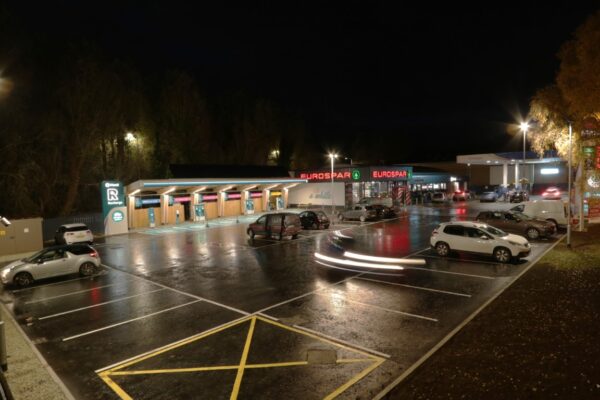
The LIVE moves on to feature Maxol’s new EUROSPAR EV Hub in Kinnegar, Northern Ireland, which represents an investment of £2.4m and is the first ultra rapid EV charging hub on the island of Ireland.
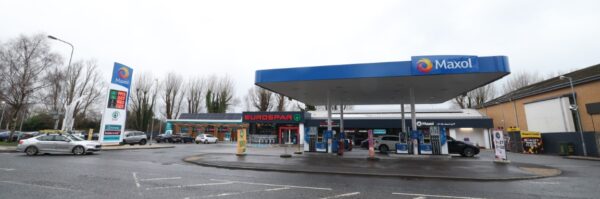
The site has more than doubled the number of customer car parking spaces to 41. The size of the building has also doubled to 208sq m of retail space, including 157 shop bays and the first Delish deli in Northern Ireland; while the entire back wall of the store is fresh food, featuring locally produced pre-packed butchery, locally produced ready meals and locally produced food-to-take home plus national brands.
From an environmental standpoint, there are solar panels on the EV hub and store building and there’s an energy monitoring system in the shop to review how energy is being used throughout the day.
The larger EUROSPAR format has been implemented since retail space is less restricted in Northern Ireland than in the South, Donaldson explains. The format also suits the local demographic. Kinnegar has a population of around 12,000 and it is an affluent and upmarket area. The location is also very transient and home to the professional golfer Rory Mcllroy, so it’s an ideal location for this kind of investment, Donaldson adds.
Donaldson tells the LIVE the new site is the blueprint for what the consumer will see from the retailer moving forward both in terms of the food offering and the change in mobility.
“It’s been very exciting and a major shot of adrenaline in the arm,” he says.

Both Ennis and Reid believe Maxol is pushing the envelope with the new format store – both in terms of the look and feel and fresh food focus. The EV hub is also the future, Reid adds.
Donaldson reveals some of the new customer behaviours at the new site it has learnt working in partnership with Henderson Retail and Henderson Wholesale. The focus is on upweighting the customer experience because in Northern Ireland public charging is free but the network is in such a poor condition, he says.
Maxol aims to take a lot of the learnings from Norway and other markets to set up a think tank for EV strategy, which includes the development of the sub brand Maxol Recharge at Kinnegar.
People who have been used to charging at home have been very impressed with the ultra fast charging at the new site and the retailer is beginning to see repeat business from the same type of customer, Donaldson reports. Users also appreciate the canopy (“customers are not waterproof because they drive an EV”) and the fact the site is doing its bit for sustainability with solar panels etc, he adds. However, it’s the reliability of the equipment which is proving to be the biggest draw, Donaldson says.
“Reliability is just what consumers expect,” he says. “The convenience and roadside sector has built up confidence with customers in terms of service and consistent delivery in this respect,” he says.
People are getting out of their cars when they are charging and using the facilities such as the Delish deli and coffee facilities, Donaldson reports. For travellers, the site is more about food-for-now and hot and cold beverages but women are also visiting with their children and doing a basket shop, he says. Basket spend has increased, as result, with customers appreciating the increased choice and range of the EUROSPAR format. It also scores well in terms of providing value for money and Donaldson credits Henderson Retail for operating the store and forecourt at Kinnegar to very high standards.
The site has introduced self checkout too and Donaldson reports that over 40% of transactions are going through self checkout, which demonstrates that people want speed of service and convenience.
While it’s still early days (the site only opened in December 2022), Donaldson reveals that over 50% of people using the EV charging hub are shopping in the EUROSPAR store.
The journey to this site was launched in 2012 when the company began to transition from being a fuel retailer to a foodservice and convenience retailer, Donaldson says.
But one shoe doesn’t fit all and it’s about tailoring sites according to the region and targeting the offer to the customer and audience, he adds.
In terms of mobility, electrification is being driven by regulation and government and, while the tipping point to 50% electric cars is uncertain, they won’t necessarily be the silver bullet or utopia, Donaldson maintains. The transition to zero emissions is happening, however. “The big question for everybody with the current cost of living crisis is will it slow down or accelerate the transition rate? Our view is we have to lay down the foundations now and we are doing that in the South of Ireland and the North to be positioned for whatever does turn.”
Roadside convenience has benefited from a Covid bounce in neighbourhood stores, Donaldson says. People appreciated the breadth of range and value of these stores and, as a result, they have become “sticky” customers, he says. To mimic that broader offer in the South of Ireland, where they are footprint restrictions, Maxol is now introducing higher shelves to provide more choice.
Reid agrees. “There’s been a big surge in demand from local customers at lunchtime and in the evenings,” he says. “Consumers can use the 30 minute charge time to do a longer shop. That’s where EUROSPAR comes into its own – offering more products to shop.”
Munford concurs. “It’s an efficient way of using time versus having a coffee. Retail has an opportunity to deliver for that 30 minutes,” he says.
