

Sharing best practice globally key to Shell Retail strategy during pandemic
Shell Retail has leveraged its global footprint to share best practice during the coronavirus pandemic and is hopeful that the company will emerge stronger out of the crisis as new business opportunities present themselves. That’s according to Shell’s Global Executive Vice President of Retail, Istvan Kapitany.

Shell’s Global Executive Vice President of Retail, Istvan Kapitany
Interviewed exclusively for Global Convenience Store Focus, Kapitany said the global pandemic had affected all of Shell’s retail operations but in different ways-at different inflection points and across different parts of the organisation.
However, Shell’s global reach in 80 countries provided an advantage in the company’s ability to learn during the crisis-a crisis unprecedented in Kapitany’s 33-year career with the energy major and one which has caused “serious demand reduction”.

A global response to a global pandemic
Shell was quick to react, forming a crisis operational team at the end of February to ensure, first and foremost, the health and safety of Shell’s staff, contractors and consumers.
“Every market, whether licensed, a Joint Venture or direct operations immediately started to share best practice and to prepare for problems they did not yet have at that time but could potentially face,” Kapitany says. Those operational meetings determined Shell’s approach on things such as PPE, social distancing, floor stickering, plastic shields and masks.
According to Kapitany, this approach has helped enormously, right from the beginning. For example, in China, during the most severe stage of the crisis there in late February and early March, Shell was able to employ its global procurement capabilities to rapidly source masks and other PPE for frontline staff at its 1700 service stations in that country.
Remarkably, Shell has no reported Covid-19 cases among its teams in China, which include operations in Hubei province. Further, Kapitany reports that out of Shell’s whole community of 45,000 service stations worldwide, confirmed Covid-19 cases are, at the time of writing, below 20. “We are very proud of that,” he says.

In addition, the number of service stations Shell needed to close around the world was no more than 150 and those were largely sites that were mandated to shut due to local regulations. Just 5% of sites moved to partial trading (i.e. different opening hours and site staff absences due to lockdowns). This affected 5,000 team members out of a total workforce of 500,000.“We are very proud of the operational capability that we achieved,” Kapitany adds.
Shell has also reported negligible tank stock outs with only 15 out of a total of 45,000 sites impacted, and its convenience stores were all fully supplied in challenging operational circumstances.

“We learnt that by working together, acting quickly and being able to share best practices we could win,” Kapitany states.
New services and behaviours
In China, which has begun to come out on the other side of the pandemic, volumes have recovered quickly, Kapitany reports. Shell has outperformed its competitors by leveraging its loyalty programme, which has 15million members in China, to digitally connect with customers and bring them back to sites.
Naturally, employees were keen to support the local community with many transforming Shell service stations into one-stop-shops for customers offering new products such as fresh produce and many new services as well. For example, in China, where many barber shops were closed due to the pandemic, Shell introduced hairdressing services on its forecourts because new year traditions in China include people getting their hair cut on the second day of the second lunar month.
The retailer also extended its product range across all convenience stores with a further 50 essential products including pharmaceuticals, sanitisers, bleach, toilet paper and staple groceries such as rice, flour, pasta and sugar.
“We realised immediately that customers were worried about going to big box supermarkets but were still wanting basic products to be made available,” Kapitany reports.
And it’s set to be habit-forming behaviour, he adds. “We don’t expect to see this trend stopping afterwards. We anticipate that going forward, customers will be prepared to do more of their normal grocery shopping from service stations,” he says.
That’s set to benefit sites in the UK, where 60 of Shell’s retail sites offer a range of 600 Waitrose products with some even operating as fully-fledged Waitrose stores. Here, an extended grocery range could drive significant growth and change the forecourt store concept, Kapitany suggests.
Another consequence of the outbreak has been the expansion of home delivery into other markets through the likes of Uber Eats and Deliveroo. Kapitany believes Shell’s service stations will remain positioned for home delivery due to their 24-hour opening model and in-demand offer of cold drinks, alcoholic beverages and food.
“Home delivery through mobile operations was one of the topics in our last operational meeting and we are pushing that all through the world,” Kapitany reports. “There are plenty of business opportunities coming out of the crisis…it’s fascinating,” he adds. “In some ways, Shell will be coming out of the crisis stronger than when we went in because it’s pushed us to work more effectively as a global team,” he says.
One service which has seen its rollout accelerated is the innovative fuelService app for disabled customers already offered in the UK, it has also been launched in the Netherlands and is soon going live in Canada. It enables users to book specific time slots to visit service stations in order to fill up and primes site staff to be at the ready to serve them. Kapitany reports it will be rolled out in other countries where self-service sites operate.
Finally, Shell has also been providing front line heroes (nurses, doctors, police, firefighters etc.) with free food, coffee and drinks in 30 countries. This has been very well-received with Shell benefitting over 1m of these essential workers to date.
Fuel volumes
Like many fuel companies, Shell experienced a decline in the volume of fuel sales in April; however there have been variances across regions depending on the severity and duration of individual country lockdowns.

Shell is implementing recovery plans for every single country based on its learnings
Within Western Europe, the UK and Benelux have currently been impacted more than Germany, Austria and Switzerland, Kapitany reports. For instance, strong commercial volumes in Germany rallied Shell’s B2B fleet business, helping to offset the decline in the B2C part of the business there, he adds.
In the US, which went into lockdown relatively late and with different measures in different States, the impact has been similar to that in Europe with major variations between individual states.
Meanwhile, for Shell’s convenience retail business, fewer site visits impacted the number of transactions across the board but the retailer has seen people spending more when they do come to the store, seeing a basket growth of 40-45%, Kapitany says.
“It shows us that the retail business is resilient. We are also proud that the fuel supply chain works well – we had continuous product availability and our refineries and depots were functioning. I’m very proud of the job that our people did.”
Now as countries begin to emerge from lockdown, albeit with phased measures, Shell is implementing recovery plans for every single country based on its learnings.
The company plans to use its large loyalty programme to win back volumes.

The Shell Go+ digital programme in the UK
Shell is one of the biggest loyalty scheme operators in the world with some 50million member customers worldwide. Schemes include Club Smart in continental Europe; the new Go+ digital programme in the UK; Fuel Reward Network (FRN) in the US and the Four in One programme in China.
“When the time is right, we will go back to our customers with the right offer and, I hope, get back to normal operational volumes,” Kapitany says.
Energy transition
Shell’s strategy with regard to sustainability and the pursuit of reduced carbon emissions is undented by the pandemic. The company’s goal of achieving net zero emissions by 2050 or sooner is maintained, while it also continues to seek out new opportunities.
Shell is already the biggest biofuels retailer in the world – 7% of its business is in biofuels, while in markets like Brazil, 50% of the market is ethanol. Shell is also one of the biggest sugarcane ethanol producers and is further developing that capability.
Shell began developing its EV charging network, Shell Recharge, in the UK two years ago and now has a nationwide service similar to the Netherlands. It is launching in Germany imminently, bringing the benefits of its rapid 50kW destination chargers to convenient locations where drivers can also enjoy the benefits of the associated stores and facilities.
Similarly, in China, service station sites feature six EV charging posts, alongside a similar number of petrol pumps.

EV charging is an important part of the offer alongside petrol, diesel and LPG
“The demand is clearly there and EV charging is an important part of our offering to customers alongside petrol, diesel and LPG. A key to future sustainability will be our ability to provide infrastructure that matches consumers’ mobility choices.”
The trend towards working from home, driven by the coronavirus crisis, will no doubt impact travel moving forward, but it has also shown how organisations can adapt and operate virtually.
Future planning
Shell’s operational team will also come into its own in recovery. “We are very strong in scenario planning,” Kapitany states.
“Around the world, multiple scenarios are being modelled as to how the world will recover with either a ‘V’ or ‘U’ shaped recovery. What that means for Shell-the actions we will need to take and how we will deal with costs-will be front and centre as we plan for the future.”
Future solutions will most likely involve an acceleration in digital retailing, and Shell will have the benefit of being a global organisation with a strong central team.
“We are in 80 countries not eight or one, so we are better able to deal with the longer term,” Kapitany says. Shell’s ambitious growth plans also remain. It aims to add another 10,000 service stations in the next six years through acquisition, new build and Joint Ventures.
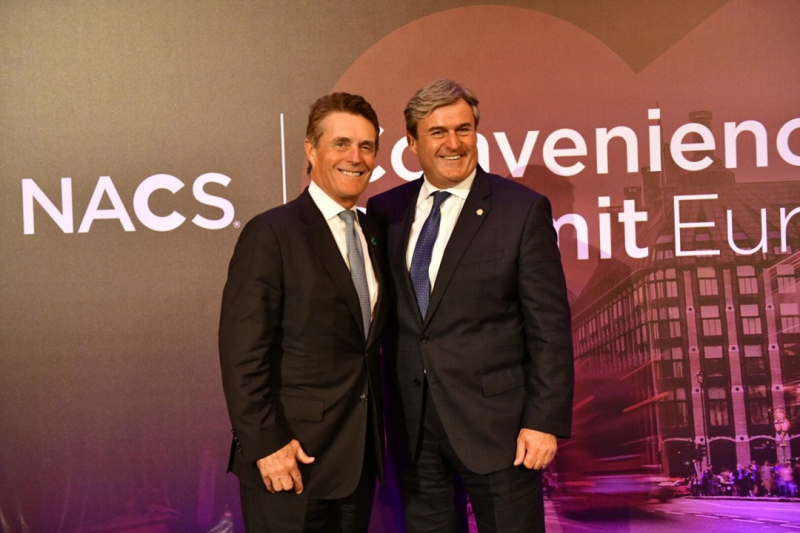
NACS President and CEO Henry Armour (L) and Istvan Kapitany (R) share the stage at the 2019 Convenience Summit Europe
Externally, Shell looks to NACS as a key resource – Kapitany was due to be a keynote speaker at the NACS Convenience Summit Europe in Berlin in June and now hopes to participate during the NACS Show in Las Vegas in October.
“We contribute but we also learn from NACS. It’s the only truly global fuels and convenience retail organisation in the world. There is no other organisation that is really as active and effective,” he says.
“There is no question that in the short term, this crisis has had a negative impact on everyone, including Shell; however, in the mid to long-term, I think the key will be to remain agile and position ourselves to best respond to new opportunities as they arise. We are positive and pleased that we have been able to protect staff and consumers so far, but it’s not over yet and it will take more time before we can put this behind us,” Kapitany says.
