

Schram reimagines mobility in 2030 and urges forecourts to seize the opportunity with EV
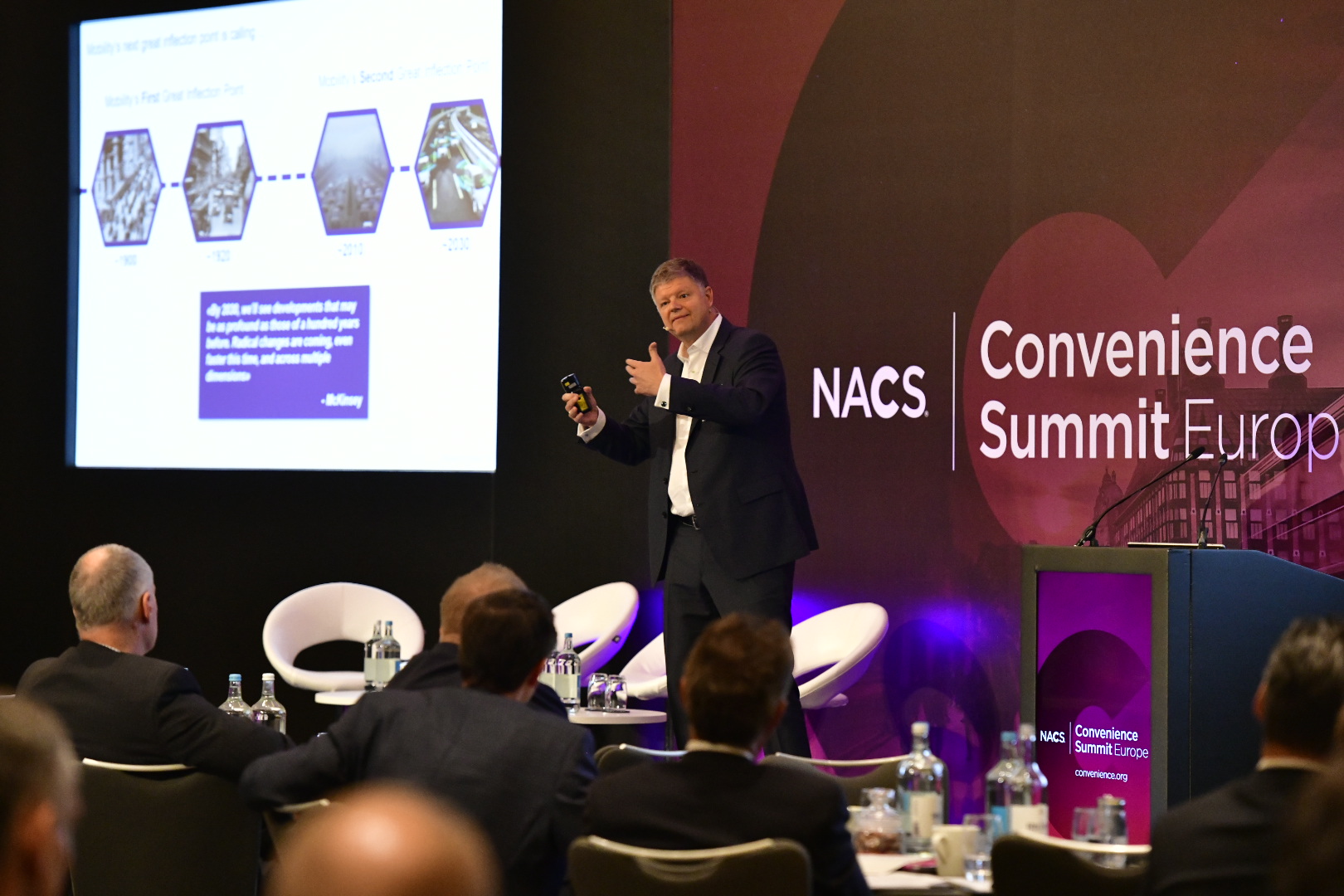
Jacob Schram, senior advisor, McKinsey & Company, and former group president of European operations at Circle K, explored the future of mobility at the NACS Convenience Summit Europe in London, 6 June 2019 and urged delegates to see the opportunities within mobility as a consequence of the four drivers: electric, autonomous, connected and shared.
“You should not look upon it as a threat in fuel and convenience retail but an opportunity,” he said. “There’s no doubt that you will lose a hell of a lot of fuel volume but what you have to consider is how do you replace that.”
A second inflection point
According to Schram, the industry is on the cusp of a second inflection point and that by 2030 there will be developments that may be as profound as the first inflection point 100 years ago when automobiles replaced horses as a means of transport.
Radical changes are coming, even faster this time, and across multiple dimensions, Schram said; and asked delegates if they wanted to embrace it or sit back and believe that it’s not going to happen now.
“If you think that, then you are in the same situation as the people back in 1900 who did not believe in the car,” he warned.
Good for people, the planet and profit

Removing congestion creates new opportunities
For Schram, electric cars, connected cars, shared cars and autonomous cars are the future and he shared why they were good for people, the planet and profit.
Globally, 1 million people die from car accidents every year and more are injured. Transportation is the biggest source of emissions, while removing congestion can free up new opportunities and productivity, which increases GDP.
Big investments are afoot in mobility too, Schram told delegates. Since 2010, $210bn has been invested in mobility start ups while OEMs spent $125bn on R&D in 2017 alone.
“When you you see how much capital is being put into mobility, you start to understand that the makings of a revolution is happening within transportation. Nobody would be pouring that much money into it if they don’t believe in it and they do,” Schram said.
Schram suggested electric cars would become standard in 10 years time but that a new mobility space will be created that will provide new opportunities for operators and fuel retailers. “You need to pay attention as you will lose money on fuel volume,” he advised.
Price parity

At the point of price parity, consumers prefer electric cars
Schram presented projections for electric car sales in the US, China and Europe but reported that every year the numbers changed upwards and he urged delegates to consider when there will be price parity between electric cars and ICEs since that will be the tipping point. “That’s when you will see a shift,” he said.
Schram recommended retailers have a plan. While they will still sell fuel beyond 2030 and 2040 and probably 2050 they will begin to lose same store fuel sales and the losses will be incremental.
Schram highlighted his native Norway as a market where EV adoption has been rapid: it took seven years for Norway to go from almost zero per cent EV of new car sales to 60% in March this year. “Nobody believed that seven years ago,” he said. “Norway has proven that, when it is price parity, consumers prefer electric cars.”
Schram revealed Circle K Norway was now the laboratory for the whole of parent company Couche-Tard.
“It’s a fantastic weapon,” he said. “They have positioned Circle K as the fuel brand that is turning towards electricity. Everywhere you go now people perceive Circle K as the most progressive brand on charging. People love the brand and they see it as being modern and thinking about the future.”
According to Schram, the new positioning also opens doors to new suppliers, another bonus.
Push and pull factors
Schram presented the push and pull factors that are driving EVs. Push elements include a growing list of countries indicating the dates when they wish to ban ICE vehicles plus stricter EU regulations to develop zero-based technology.
Car manufacturers will be penalised for excess CO2 emissions and forced to pay €95 for each g/km of target exceedance. In the case of Volkswagen, Schram said that would lead to a €1 billion premium if the car maker went one gramme over the target, based on the number of new cars registered per year.
Schram also highlighted Volkswagen’s new electric vehicle platform, MEB, and the maker’s plans for eight production sites to be established by 2022. Volkswagen is investing €30 billion in the project by 2023 and aims to produce 15 million vehicles in the first wave, he said.
Pull factors include customers’ preference for electric cars, when there is price parity; range and charging locations.
On the former, Schram said markets like the US were already close to price parity: the average car price in the US is now over $34,000.00 while Tesla’s model 3 is now available for $35,000.00.
Range anxiety

Norway has proven that you can get over range anxiety
The range of new EV models is also improving, even though the average daily driving rate in the US is just 45km, meaning 87% of the country’s entire fleet could, in fact, be electric today. “Norway has proven that you can get over range anxiety,” Schram told delegates.
According to Schram, there is a strong need for substantial charging infrastructure investments, even in Norway where charging capacity is the biggest issue; and he encouraged his audience to step up to the plate in this respect. “Why are fuel retailers not pushing the agenda and letting others take this space?” he asked. “You own it – take it.”
Schram showcased the wireless power transfer business WiTricity and suggested future charging will be wireless and urged convenience stores to get in on the act.
Currently there are three barriers to charging, Schram said: people forget, the different types of plugs and finding a charging location. “Everyone in this room should own this business and it’s made for women, who hate to fill up cars where there’s petrol and diesel involved but also plugs; so when it comes to wireless charging, it’s all taken away.”
AV – Cars will become a cool gadget
Schram said autonomous cars also deliver massive public benefits, exceeding $800bn per year in the US, for example. As well as saving lives from driving accidents, autonomous cars will free up parking spaces and enable businesses to develop their real estate in new directions.
Schram presented the five different levels of focus for autonomous cars: no feet, no hands, no eyes, no focus, no brain; and that delegates should take note. “Its not science fiction, it is happening,” he warned.
Chinese customers have the biggest appetite for autonomous cars, he added. They are not as sceptical and think about cars in the same way as their mobile phones, each with their now unique eco-system. For this group, cars will become a cool gadget, Schram said.
Tremendous opportunity
Schram presented the McKinsey Connected Car Customer Experience framework, which describes five levels of user experience in connected cars, ranging from the most basic to the highly complex and suggested that by 2030 45% of global new car sales could be at level 3 or above in terms of connectivity.
Connectivity will also drive new services, such as advertising and insurance, much as they did in the 1920s. As with autonomous cars, China versus Europe and the US is most ready for connected cars, Schram said.
Shared cars are also a tremendous opportunity, compared with the cost of a human-driven ICE, but are likely to be focused on city locations versus rural areas, Schram said.
A bright future
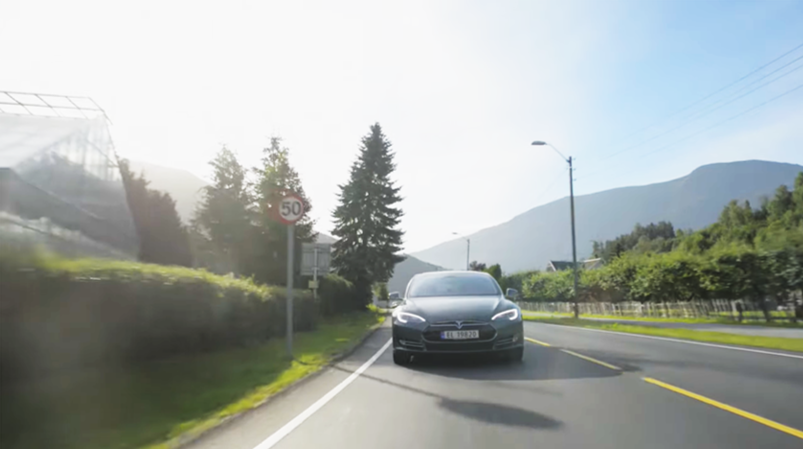
A bright future, if you embrace it and grab the opportunity
Again, it’s not the future, it’s now, he added. Autonomous shuttles already operate in Oslo, for example; and younger people are less concerned about owning their own car. This generation accept shared vehicles, which are about mobility, not ownership.
Summing up, Schram said his key message was for the industry to grab the EV opportunity. “You have a bright future, if you embrace it and grab the opportunity before everybody else,” he said. “Don’t lose your focus on selling fuel – continue to develop fuel because it is cash flow but at the same time think about EV.”
Schram pinpoints three opportunities:
Own the total changing experience: Circle K has decided to be the best total charging experience in town, offering workforce, on the go and home charging, Schram said. One month ago the retailer introduced a home solution charging, for example. At the same time, the retailer is focused on retaining customers via its Circle K app to promote offers such as coffee, carwash and sandwiches etc.
Create urban mobility hubs: The number of forecourts will decline but sites will be centred on key corridors and around cities. Schram advised operators at these sites to buy land and make the locations three times as big as they are today to create relaxation and charging hubs; where you could charge a premium for on the go charging. “There’s a fantastic opportunity to take back the cities and create urban mobility hubs,” he said.
Provide new services: Connected cars will make the car experience really different, transitioning a vehicle from a transport role to a place of use such as for sleeping, eating and drinking or working. This will demand a new fleet to services including charging, cleaning and refreshments.
