

Fresh, sustainable and retailtainment: three factors for c-store success

For convenience and forecourt retailers looking for a clear strategic steer on the key retail trends and top takeaways from Asian marketplaces, Scott Annan, principal at Blue Ananta, is a go-to source.
Having recently completed retail visits in Indonesia, Singapore and Myanmar, Annan shared his top three retail themes: fresh, sustainability and retailtainment with Global C-Store Focus
Fresh
For Annan, fresh must be the watchword for every convenience retailer the world over. “My overarching reason for why retailers around the world go fresh is that every customer eats and drinks at least three times a day – that’s equivalent to 1,000 sales opportunities per customer per year.
And, if you also look at snacking and hydration, that’s 2,000 opportunities per customer per year.”

As a case in point, Annan highlights his recent visit to the Myanmar capital Yangon, hosted by the leading grocery retail chain CMHL.
In just eight short years out of military dictatorship, 45% of the retailer’s sales, across supermarkets, hypermarkets and premium stores are now generated by fresh food for now. Further, Annan was informed that the CHML chief executive expected the ratio between fresh for now/tonight and traditional grocery to be evenly split in a couple of years’ time.
“The business has been launched with a starting strategy that’s all about fresh and it is not replicating a traditional supermarket or convenience store,” Annan says.
It is significant that a re-emerging market with a sizeable 53 million population is targeting fresh in the modern trade, Annan adds. That’s in quite stark contrast to the position in the UK market, he maintains.
While Annan concedes that there are some great quartile one exceptions in convenience retail and operators with fantastic fresh skills, the majority is “still fixated with packets and cans”.
While that’s partly due to terms and conditions with CPGs, that’s not an issue in other countries where stores are not rammed full with packets and cans, Annan says. The supply chain differs greatly too, he adds.
“The supply chain for independents in the UK is more geared up for ambient, whereas in other parts of the world, the supply chain is more about daily fresh.”
The leading Asian convenience retailers from Korea and Japan, who are already established in Singapore and Indonesia and on their way to Myanmar, are reaping 50% of their sales in fresh foods by day part, with three fresh deliveries every day in Japan, Annan reports.
Nisa with Cooperative Food proprietary products has the potential to match this experience in the UK, he maintains. The mindset of independent retailers contrasts greatly between East and West too, Annan believes. While many UK independent retailers are focused on a purchasing or buying strategy, their Asian counterparts are focused on meeting customer needs.
And, while CPGs are important in retail, there’s no need for UK retailers to offer ten different variants of laundry softener or eight different SKUs in bleach, Annan says. “What are we doing here? We are lagging the world,” he says.
Annan recommends some UK retailers take a leaf out of Seamus Griffin’s Londis stores in Dublin, Ireland, where 80% of sales are focused on food for now with a handful of grocery SKUs.
Sustainability
While retailers in all countries are tackling sustainability and looking to take plastic out of the marketplace, they are adopting varied approaches, Annan reports.

In July this year Annan learned how Circle K Indonesia is addressing plastics waste in Bali with their participation in the ‘Bank Sampah’ or waste banks programme.
Consumers are incentivized to clean and separate their waste and take it to convenient centres, where based on weight their waste bank account is credited.
The balance is issued as a barcode voucher, which they can spend in stores. The scheme is government legislated in collaboration with local banks and is underwritten by leading manufacturers including Unilever and Danone, who have a legal responsibility for their packaging.
“The programme is working as the packaging waste has a consumer value. Consumers, retailers and manufacturers are accountable so it works,” he says.

The Retail Leaders Forum visited Mumbai in March this year. Tier one cities such as Mumbai have totally banned single use plastics such as carrier bags and plastic cups, Annan reports.
It’s Government policy to remove these plastics from the marketplace, whilst all remaining plastics are recyclable. As a result, Annan reveals Mumbai, population 25m, is recycling 84% of Maharashtra State’s (114m) plastics, versus in the UK where the figure is just 9%.
Again, Annan suggests the scheme works because it is Government legislated for retailers, manufacturers and consumers and there’s a financial play. “It’s like reverse vending – if you say ‘do it’, then it happens,” he says.
Similar policy should be adopted in the UK, he believes. Scotland has already adopted a deposit-return system with reverse vending machines. Similar ‘plastic-metal-glass’ plans for England are being opposed by some industry lobby groups, which argue they won’t work in convenience retail.
“That simply confuses the issue. Instead, we should be saying ‘here’s the system, just do it’,” Annan says. “Reverse vending is clean and it genuinely recycles things.” Businesses successfully adapt to government policies.
Retailtainment
Annan’s third trend and opportunity for convenience retail is ‘retailtainment’, i.e. making stores and shopping centres true destinations and offering a raft of consumer experiences.
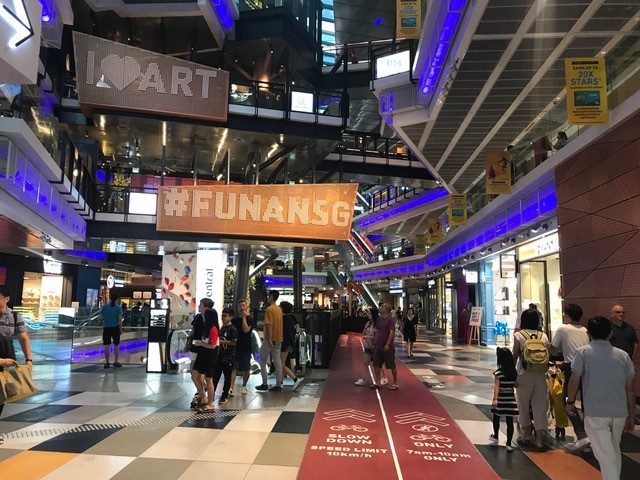
Annan was wowed by a recent visit to the Funan Mall in Singapore, which has been transformed from a routine, small electronic products bargaining centre, into a retailtainment site equipped with cafes, restaurants, stores, an interactive bookshop and climbing wall.
According to Annan, there are cafes and restaurants on every level and they all interlink with stores. There’s even a third party Apple repair shop where every type of repair has a coffee associated with it.
“They’ve made it fun. I visited three times and saw families using the mall as a day out and others just hanging out, eating, drinking and shopping. It is true retailtainment and one of the best I’ve seen,” he says.
Given the crisis on British high streets and with shopping centres being hammered by business rates, it’s a trend we should replicate in the UK, Annan says. “We need to see more of that, whether it’s on the high street or in a mall: becoming a destination for everything rather than simply providing a shop.
At the end of the day, most shopping will all be done online – even flagship stores are becoming just browsing stores. Retailtainment is a big trend and I saw it best in Singapore.”
Roadside retailers such as Wawa, Sheetz and Cumberland Farms in the US plus leading Irish forecourt operators are already great fresh food destinations, which also sell fuel, Annan says.
However, they face fresh challenges with the advent of EV. Annan refers to a conversation with a director of Circle K Indonesia, where sites are usually fuel focused.
The executive questioned the rationale that sites would become e-charging locations versus people charging their vehicles at home.
Annan suggests that prime urban sites, whether in Singapore, Sydney, Mumbai or London, can become high rise apartments with a convenience service centre, providing a hub for food delivery, parcel pick up/drop off, third party services and vehicle charging.
“There’s an assumption among global fuel retailers that their sites will migrate to becoming a destination for electric charging and coffee and food but they may be more profitable by becoming a landlord,” Annan espoused. “The world is changing and just because we visited a site yesterday does not mean that we will visit tomorrow.”
Indeed, Annan suggests stores in future must be transformed. “We all eat and drink, require shelter and need energy to move ourselves. Stores need to link that strategic thinking together, where fresh delivered or retailed food sits in the middle, with sustainability, services and retailtainment around the outside. Then they will be in a very different shape to where they are today.”

About Scott Annan
Annan is a trusted advisor for many in the convenience industry and an experienced global authority on convenient retailing. He is also the founder of The Retail Leaders and The Independent Retailer Owners Forums, two initiatives providing retail leaders and owners with peer-to-peer challenge and learning opportunities.
If you’d like to hear more and would like a presentation from Scott Annan on this topic to help drive retail innovation in your business, please contact us and we will provide details of costs and subject matter covered.
