

Circle K – Exclusive interview with Håkon Stiksrud on World EV Day

As Circle K marks World EV Day, Håkon Stiksrud, the company’s VP of Global eMobility, gives Global Convenience an update on the retailer’s charging network, what customers increasingly expect from the charging experience, and why grid connections (not chargers) are now one of the industry’s biggest bottleneck.
Circle K has become one of the most closely watched players in forecourt EV charging, and the timing of this conversation is no accident: it lands on World EV Day. We sat down with Håkon for a global update on the company’s charging investments, its European network, its cautious approach to fast charging in North America, and the operational realities, from grid capacity to charger power, shaping the next phase of the rollout.
Scaling Up Across Two Continents
Asked for a rundown of where Circle K’s global charging investments and infrastructure stand today, Stiksrud starts with the numbers. “Today we have a little bit more than 4,900 charging points across Europe. Most of them are Circle K branded and operated (approximately 4,250). That’s a significant increase on last year of close to 30%, so we are investing heavily in Europe. In North America, we have more than 1,000 charging points across partners and our own brand. So, in total, 6,000 charge points globally.”
The ambition, he says, is to lead the transition to electric mobility with long-term growth across both continents. “In Europe, our core markets are still, of course, Scandinavia, where we have built a very solid position: strong network, very strong customer preference. In Sweden, EV drivers rank Circle K as their preferred destination and in Norway, we also have a leading position. Then we have Central Europe, where we’re building from a smaller base, but of course they’re attractive markets with great potential for our network. In North America, we will continue to grow the offer, but to a larger extent through partnerships, where we announced a strategic partnership this year with IONNA, the charging joint venture owned by BMW, Mercedes-Benz, General Motors, Stellantis, Hyundai, Honda, Kia and Toyota.”
On which markets are moving fastest, Stiksrud points again to Scandinavia. “The markets that are moving fastest are still Scandinavia, and that’s still core to our focus. Then Central Europe, which is also growing fast; we can see it in the numbers now, for instance Germany is increasing in sales, and we are also seeing a positive trend in Ireland. That’s something we take into consideration when we plan the network going forward.” North America is moving at a different pace. “Generally, I’d say the forecast for that market has been reduced over the last few years, given the change in market conditions. We’ve opted to go to with the partnership with IONNA to grow the offer for the customer in the current market conditions.”
Winning on Experience, Not Just Electrons

With EV drivers becoming more experienced, we asked what matters most to customers today. Stiksrud is clear that infrastructure alone won’t decide the outcome. “I think a key thing here is that the EV transition will not be won by just building chargers. The EV transition will have succeeded when electric mobility becomes a natural part of life. What I mean by that is that all customers need to have 100% confidence that charging will work on any journey they take.”
“We need to deliver a reliable and trustworthy charging experience… it’s about creating a better stop on the journey.”
“So that means we need to deliver a reliable and trustworthy charging experience. At the same time, we know customers are increasingly asking for convenience and simplicity. So, it’s not only about the seamless charging experience, it’s about creating a better stop on the journey; that’s been our ambition all the way, to become a favourite stop for the customer. That’s done through the combination of an easy charging experience and what you want when you take a break (convenience, food, amenities, service, etc.) and combining that into just a better stop on the journey. I think that’s what we see: in new markets, having a charging point to access is most important, but quickly it becomes more of a convenience and simplicity question. We see that across all markets at the moment.”
That reliability comes down to uptime, which Stiksrud describes as a company-wide obsession rather than an EV-specific target. “Uptime is absolutely critical. Connected to what I said, delivering a reliable service: you get one chance as a provider to get the customer. If the charger doesn’t work, it’s a bad experience and the customer won’t return.”
“You get one chance as a provider to get the customer. If the charger doesn’t work, it’s a bad experience and the customer won’t return.”
“We know that customers select a location mostly because of habit: they go to a place where they’ve had a successful experience before. If it doesn’t work, they won’t come back. So, uptime is absolutely key. It’s a critical metric for our company across all our categories, not only electric mobility, but having fuel pumps that work, coffee machines. Everything needs to be there ready for the customer.” On the EV side specifically, he says the complexity of the technology raises the stakes further. “It’s complex technology, so it makes it even more challenging: you need to master everything from technology to good processes. Long term, you want control of those assets; you want Circle K, a brand that customers can rely on and trust on those chargers.” That preference for control already shows up in the numbers: “If you look at our European operation, more than 90–95% of our chargers are Circle K branded and operated, and that’s kind of the long-term view across our markets.”
The Grid Bottleneck
Grid connections, Stiksrud says, are now one of the industry’s biggest obstacles. “It’s a big factor. I think it’s one of the key obstacles to the EV transition, because what we see in select markets is that it’s so pronounced that it’s difficult to build out the offer that’s needed.”, if you take Europe, I’d say all the European countries we operate in are increasingly finding it difficult, with the Netherlands being the most challenged oneand we’re seeing this becoming a clearer, increasingly bigger problem across our markets, not only a Netherlands-specific item.”
The root cause, is more generic societal challenge. If you look at the energy transition, we’re building out sustainable energy sources and trying to increase electricity demand at the same time. With the coming of data centres, etc., the electricity demand is huge. But as a society, we haven’t invested enough in the middle part of the value chain: the grid. Regulators are increasingly seeing this, but it’s going to take time to mitigate the problem.”
On-site battery energy storage systems are part of the answer, but not a universal one, he says. “I think they will be very important to enable us to continue expanding capacity and delivering the reliable, convenient charging experience customers expect. If they were important to every location, I wouldn’t be putting it that way, but in certain regions, they are a key part and enabler in most of our installations at the moment. In other markets, they’re not. So I think it’s market-specific, at least for now.” In the Netherlands specifically, he says, “it’s absolutely key that you use the combination of batteries and software load management to continue to develop the offer, but even with that, developing the large charging hubs that customers prefer is difficult; for me, this is one of the key bottlenecks for the whole transition.”
The Power Race
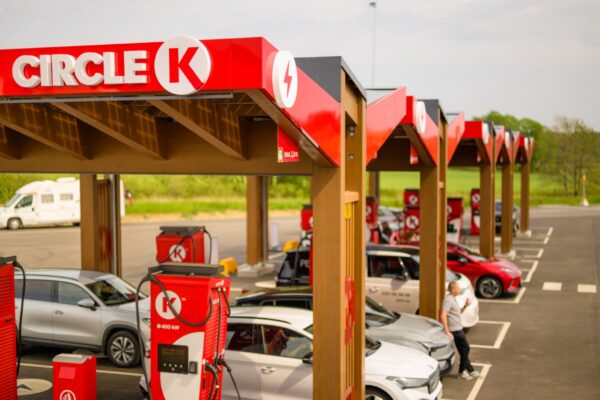
Charger power has also been climbing. “We’ve seen chargers becoming more and more powerful over the last few years, and Circle K has moved up to 400 kilowatts. We’re seeing incremental improvements year by year, both on the car side and the charger side: the capacity is increasing. What used to be the theoretical max of 350–400 kilowatts a year ago is now more like 480 to 600, depending on the make. So, the theoretical output is continuously increasing.” Real-world use is more constrained, he cautions. “In practical, everyday life, we won’t see that output because of the charging curves of the cars, and also grid congestion. I don’t see it as feasible to deliver those high capacities everywhere, continuously, but certainly in some locations and for some car brands, we will see increasing speed and increasing demand for that. The ceiling isn’t reached yet.”
What Keeps Customers Coming Back

What actually brings the customer back: the charger, or the wider offer? For Stiksrud, it is never one or the other. “It’s the combination: I think one without the other doesn’t work. It’s having a reliable and great charging experience, combined with the amenities you can have for a great break. Those together work nicely to deliver value for the customer.” The data backs this up, he says: “We generally see this as a trend: locations with the store and amenities get higher utilisation than standalone charging parks. I think we’ve been able to execute on both the charging and full retail experience, and because of that, we’ve seen successful development of this piece of the business lately, we have great plans and great commitment to this.”
Fittingly for World EV Day, we finished by asking whether the consumer has increasingly warmed to EVs over the past year, and whether that shift is gathering pace globally. Stiksrud’s answer is measured. “The pace will continue to vary by market, but the direction is clear.In Western European markets, we see increased adoption. In North America, for me, it’s still a question mark on how and when we’ll see the acceleration. But generally, when you look at the numbers in Europe, I’d say that clearly over the last six to nine months we’ve seen an uptake, which for me might be the first step of an accelerated phase.”
