

Brent Puzak, VP at Titan Cloud, previously with Circle K, shares his thoughts on approaching compliance holistically to enable growth and efficiency

In February, Brent Puzak, the former head of the environmental shared services at Circle K, joined Titan Cloud Software as Vice President of Solutions Consulting.
We caught up with Brent about his new role, his experiences through his retail career and how he is looking forward to leveraging his industry expertise to help both new and existing retailer customers, as Titan continues to expand their offer and support throughout Europe and Asia Pacific.
“Joining Titan has given me an opportunity to really broaden what I was doing on a much larger scale. We have more than 50,000 sites globally that we monitor and here in the US we work with some of the largest convenience store chains: 7-Eleven, Circle K, Murphy USA and more recently, EG America who we are helping to streamline operations and leverage a single source of data for their fuel site needs.”
Brent’s passion for our industry is evident throughout our conversation.
The journey to Circle K
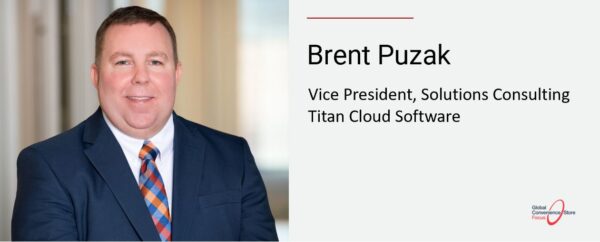
As head of the environmental shared services department at Circle K, Brent oversaw compliance and remediation operations for their tank systems – both above and below ground – across their 9,000 sites in North America.
“That was almost 30,000 tank systems” said Brent, “which included all aspects of compliance; from dealing with regulators, permitting, and release detection through to day-to-day operations, including compliance repairs and maintenance.”
“Additionally, I was responsible for our wetstock management programme across our North American footprint, where we rolled out an advanced analytics programme to better monitor our fuel inventories.”
Brent’s early career experience set him up for success after graduating from college he worked in Jacksonville, Florida.
“At the time, I was a consultant, doing environmental remediation, which involved clean-up work on locations for a couple of years and from that I worked as a regulator for the state.”
“It was an interesting time, back in the late 1990s, as corrosion prevention requirements were hitting the market. In Florida, companies were upgrading their sites, pulling out old tanks and replacing them with new double-walled systems” he added “It was interesting to see what was going on underground, and I was able to really understand how things worked and how everything fitted together.”
In 1998, Brent’s retail career began when he joined Lil Champ Food Stores, who at the time, had around 600 stores throughout Florida. They were subsequently acquired by the Pantry Inc. (Kangaroo Express) and then in 2015, Circle K purchased the Pantry.
“It was during my time with Pantry that I first began working with Titan, that’s going back almost 15 years now!” said Brent.
“We’d had a pretty big issue there with insurance-associated write-offs, we were really struggling to get our insurance companies to reimburse us for remediation claims,” Brent recalled “to address this, we were looking for a tool that allowed us to centralise our data and make it much easier for us to pull that information together and fight those claims.”
“Of course, prioritising internal IT projects within retail companies is always competitive, and compliance related projects tend to be a little further down on the totem pole.”
“That’s when we aligned with Titan, enabling us to centralise everything” said Brent “with compliance and ever-changing regulation, it’s often difficult to find individuals who understand how everything fits together,” he said. “Working hand in hand with Titan we were able to implement a single platform to centralise all of our compliance services at the Pantry.”
A holistic approach
While compliance is often viewed as a cost centre, for companies that don’t do a good job, there can be much greater costs associated with non-compliance and the negativity of bad publicity.
“Many companies see compliance as a necessary evil but at the same time no one wants to be leaking fuel into the ground,” Brent comments.
The best approach is to look at compliance holistically.
“It covers a lot of functional groups within an organisation” says Brent “At Circle K, we interfaced with accounting, repair and maintenance, construction and real estate on the divestiture of acquisitions,” he said.
“Often, when it comes to compliance, companies tend to operate in silos. A significant amount of value can be gained by pulling resources together and having systems that allow you to analyse the data and understand it.”
“This is a real strength of Titan and, a key part of the offer is the ability to help retailers bring all of the pieces together to really understand the issues”.
Take wetstock management as an example.
“Five or six years ago, fuel prices started really spiking up and you started seeing an increase in fuel loss. Accounting teams were struggling – they’d see loss in the system and had no idea what was occurring, often needing to dispatch 10 or 15 service calls to investigate – different companies were going out to do different tests, driving up the costs.”
“With the right systems in place, you’re better able to identify root causes of what is happening in the fuel system and quickly fix the problem.”
“During my time with Circle K, we then looked at companies for acquisition, we’d get a real close view of their compliance processes, I was always amazed that some were operating off of an Excel spreadsheet and pulling that together with physical files in their offices.”
“Surprisingly, few businesses have sophisticated systems.” Brent added “that’s one of the great things Circle K did as business, was to leverage best practice from businesses which they had acquired and implement these across the organisation.”
“At Titan, we’ve recently started working together with EG America, similarly, we’ll be working with them to replace several of EG’s current solutions, so the company can consolidate a majority of its brands onto one SaaS platform to record key compliance and fuel operations.”
“I remember back when Pantry started working with Titan, we were able to save considerable man hours through centralising these processes,” Brent recalled. “In some cases, we even gave regulators remote access, so they could access our system, it made it easy – they could do 10 inspections a day, rather than doing one or two inspections a day.”
“It’s all part of taking a holistic approach, saving time and money”.
A global perspective

Looking at regulatory environments; Brent commented “outside of the US, most countries work to an adaptation of the Environmental Protection Agency (EPA) regulations.”
“A lot of countries in Europe have some very good regulations, but when we’re talking about the holistic approach across the networks, I don’t see that as much as I see in the US.
“From an opportunity standpoint, those are areas where I think Titan can provide a good single platform to help companies, bringing a wealth of knowledge and experience in terms of dealing with and understanding how to best manage regulatory issues.”
In February, Titan Cloud acquired Australian business Environmental Monitoring Solutions (EMS), as part of its global growth strategy, expanding their customer base throughout Asia Pacific and Europe.
At the time, David Freese, CEO and Chief Product Officer for Titan Cloud said, “It became clear early on that the two companies share similar goals and vision for the industry, and our complementary products will enable us to provide even better solutions for our customers.”
While Russell Dupuy, CEO of EMS, commented, “The synergies between our two companies will enable us to grow faster and provide more customers with the digital solutions they need to manage the industry’s toughest challenges. We’re really looking forward to working with such a high-calibre team to deliver more innovative solutions to the global market.”
Managing your business better
Meanwhile, back in the US as EPA regulations have progressed, the impact on operators in the US cannot be underestimated – they are doing two to three times the volume of tests that they’ve historically had to do.
“That’s creating more failure points, more data that they’re having to analyse,” said Brent.
“Historically only a few states required monthly visual inspections, but by the middle of 2021, every state in the US will have to do monthly visual inspections – that will generate a significant volume of additional work, particularly for owner-operators.”
“It’s going to get more challenging for individuals to manage. The volume of data that US organisations are now collecting, from a compliance perspective, is significant.”
“At Titan, we capture millions of lines of data every day from stores. If somebody is going through that manually, it’s impossible for them to find small trends that tell us there are problems.”
“Using AI and other tools, we are able to get down to the root cause, helping the end user to focus on managing their business a lot better.”
