

Why the next decade of convenience retail runs on a different kind of network
Most convenience retailers still think about networking as plumbing. Necessary, expensive, and ideally invisible.
That mindset is becoming a liability.
Between EMV, PCI pressure, rising cyber risk, retail media, AI video, EV charging, and an explosion of connected devices, the network is no longer just keeping the lights on. It is shaping what technology you can deploy, how fast you can scale, and how much risk you are carrying at every site.
Mako Networks was built for that reality. And it looks very different from the traditional approaches most c-store operators are used to.
Not Another Box-and-Carrier Model

Jon Kelly, CRO, Mako Networks
Mako is not a collection of third-party firewalls, routers, switches, and carriers stitched together with tickets and finger pointing. It is a PCI-certified, cloud-managed connectivity platform designed specifically for regulated, distributed retail environments, with petroleum retail at its core.
That distinction matters.
“Everything about Mako goes through PCI certification, top to bottom,” says Jon Kelly, Chief Revenue Officer. “The hardware, the software, the cloud platform, and the way it’s managed. That creates a closed, tightly controlled system that gives retailers and brands confidence they can actually stay compliant, not just pass an audit once.”
Traditional solutions often rely on a patchwork of vendors. Each component might claim compliance in isolation, but the overall environment is left to the retailer to manage and defend.
Mako takes a different approach. The entire platform is built, owned, and certified as one system. That reduces risk, simplifies audits, and limits the number of open doors attackers can exploit.
Reliability Is Not a Feature. It’s the Floor.
Downtime in a c-store is not an IT problem. It is a revenue problem. Fuel pumps stop. Payments fail. Stores go dark.
Mako’s cloud networking architecture has been operating for more than 16 years without a systemwide outage. That track record is one reason it has become the most widely approved networking vendor in US branded fuel.
Retailers do not choose Mako because it is flashy. They choose it because it works, consistently, at scale.
Support is part of that equation. The average response time to Mako’s help desk is just over a minute. 95% of issues are resolved on the first call. For operators running hundreds or thousands of sites with lean teams, that difference compounds quickly.
Built for the Complexity of Fuel & Convenience
Mako’s roots in petroleum retail are not incidental. The company was founded to solve connectivity challenges in highly distributed environments, and early adoption by Chevron set the direction. As other oil majors followed, Mako became deeply embedded in the operational and security requirements of branded fuel.
Today, Mako is approved by virtually every major US oil brand, providing multi-branded retailers with the ability to standardise their portfolios on one consistent network stack.
That approval matters because branded operators’ networks do not just support payments. Operators also deploy CCTV, tank monitoring, back office systems, price signs, digital media, and many other solutions that require secure, reliable internet connectivity.
“Mako allows operators to meet the brand’s security requirements and still use the same infrastructure to deploy their own technology,” Kelly says. “You’re already paying for the network the brand requires. We help stretch the value of that investment.”
For wholesalers and multi-brand operators, that flexibility becomes a strategic advantage. Rebranding a site does not require ripping out infrastructure. Configuration changes happen centrally, without a truck roll.
The 6700: Networking for What’s Coming Next

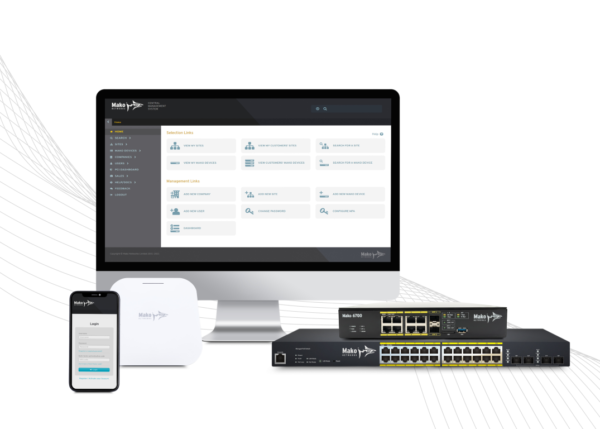
Most networks in convenience retail were sized for yesterday’s use cases. The Mako 6700 is designed for what is already arriving as well as what is yet to come.
This next-generation firewall delivers significantly higher throughput to support video-heavy environments, while also introducing on-device compute and AI processing. That allows retailers to run applications directly at the edge, reducing the number of boxes in the store and the complexity that comes with them.
This is especially relevant as AI-driven applications move into stores. Loss prevention systems that analyse video. Traffic and dwell analytics. Retail media networks. Interactive displays and ordering kiosks.
Rather than sending massive amounts of raw data to the cloud, the 6700 can process information locally, select what matters, and transmit only what is needed. This functionality saves bandwidth, improves performance, and it reduces exposure.
Builtin 5G and fibre capability adds another layer of resilience, giving retailers more options as connectivity demands grow.
The MakoVerse: How Retail Tech Actually Scales
Deploying new technology across hundreds of sites is still harder than it should be.
The MakoVerse is Mako’s answer.
It is a curated ecosystem where Mako pre-certifies applications commonly used in convenience retail, from digital signage and retail media platforms to AI video systems. Those applications are tested and certified in a third-party lab for interoperability, reliability, and security within the Mako environment.
For retailers, the benefit is simple. If it is in the MakoVerse, it works. It can be turned on at one store or a thousand, without reengineering the network each time.
“We believe this is how retail technology will be deployed going forward,” Kelly says. “Retailers want simplicity, security, and the ability to scale without drama.”
Security in a World of 100 Endpoints Per Store
Ten years ago, a typical c-store might have had a handful of internet-connected devices. Today, it is closer to 30. By the end of the decade, projections push that number past 100. Every one of those endpoints is a potential vulnerability.
Mako’s PCI-certified foundation forces discipline. No open windows. No unmanaged access. No silent drift away from compliance. In an environment where cyber-attacks against retailers are increasing, that rigour is no longer optional.
A Platform That Scales Up or Down

Mako serves single-site operators and national chains with thousands of locations. The underlying complexity of a fuel site does not change just because the operator is small.
Plug-and-play deployment, centralised management, and consistent policy enforcement allow Mako to flex across those models without adding operational burden. For large operators standardising across brands, the control and consistency are just as valuable.
The Bottom Line for Senior Leaders
The network is no longer a background utility. It is the foundation for payments, security, data, and new profit centres. Retailers that treat the network as a commodity will find themselves constrained by it.
Mako Networks offers a different model. One built for regulated retail. One proven in the fuel and convenience industry. And one designed to support what convenience retail is becoming, not what it used to be.
If you are rethinking how your network supports growth, security, and new in-store technology, Mako is worth a closer look.
