

The New Attention Economy – Learning from China
Matthew Brennan is an author and internationally recognised speaker who specialises in Chinese mobile internet technology and innovation. I first met Matthew Brennan when he keynoted at the NACS Convenience Summit Asia in Shanghai in 2019.
In an event experience which opened our eyes to the growing sophistication of Chinese retail and consumer internet technology, Brennan helped NACS and the global retailers in the audience, really get under the surface of the ‘brutal, highly competitive battleground’ that is the Chinese Internet and build a picture of the future.
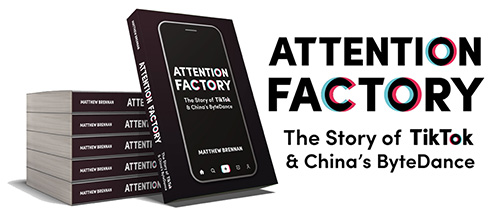
Matthew will be featuring in next week’s Shop Talk LIVE programme and ahead of that I wanted to write about the book he has just published (‘Attention Factory – the Story of TikTok & China’s ByteDance’) and explain why I think it is so important.

Why short video matters to brands
You may well ask how a short video sharing app like TikTok is relevant to retailers? The short answer for me personally is that it was my 18-year old daughter who told me about it.
The longer answer is that it is understanding the technology businesses who control the maximum number of eyeballs on mobile screens which matters to brands. It’s called the ‘Attention Economy’. Between 2018-20, short video grew to become China’s second largest advertising category behind e-commerce and exceeding search.
By contrast to WeChat, which, according to Brennan “is used predominantly by members of the Chinese diaspora and those doing business with China outside of mainland China”, ByteDance’s TikTok has realised much more potential for widespread adoption across the globe. And, this is despite the recent geo-political rivalries which fall outside the scope of this article.
New challengers to Baidu, Alibaba and Tencent
The rise of ByteDance and other new players is well documented in China.
A new term ‘TMD’ has started appearing in the Chinese tech media to describe a group of rising internet stars, challengers to the old guard of Baidu, Alibaba and Tencent (‘BAT’). T stands for Toutiao (ByteDance), M stands for Meituan, the leading online food delivery platform and D stands for Didi Chuxing, China’s UBER.
Brennan is already well respected for his analysis of Tencent, China’s tech giant and WeChat, China’s super app. His opinions have been featured in global media including The Economist, Wall Street Journal, Bloomberg, BBC and many others. He has been based in mainland China for over 16 years and is a fluent Mandarin Chinese speaker.
Brennan’s book about China’s ByteDance is important. The company’s growth since its creation in 2012 has been astronomic, particularly after 2017.
In terms of number of global employees it is now bigger than Facebook and Tencent, probably best seen in the same context as Google and Alibaba and has a valuation of over US$100 billion.

Attention Factory contributes to a broader discussion and understanding around the TiKTok app itself, parent company ByteDance, short video as a content format and a more in-depth insight into Chinese internet firms in general.
One of the key points Brennan makes is that TikTok was the first China made consumer internet product to build a far-reaching global footprint.
Behind TikTok’s rise is a broader global trend; from ecommerce to payments and mobile gaming, China is now starting to lead the world in many consumer Internet services. The era of “copy to China”, Chinese internet firms cloning silicon valley’s ideas appears to be coming to an end. With short videos at least, the tables have turned.
In terms of my learnings from the book itself, I divide them into two parts.
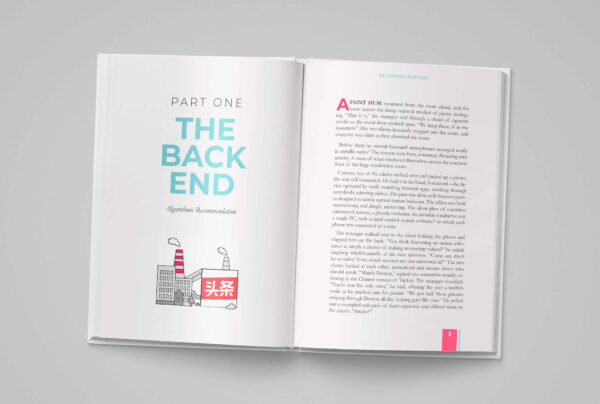
The first part of the book deals with the back end – algorithmic recommendation and then goes onto explain the front end – full screen short video. It charts the rise of Douyin, the Chinese version of TikTok and focuses on reasons for its success and why short video and machine recommendation has suddenly become so important.

One of the most eye-opening chapters in the book relates some of the methods deployed by some brands to ‘get attention’ in China. It’s not simply a matter of making interesting videos.
Hundreds of ‘click-farms’ or ‘attention factories’; warehouses with racks of thousands of smart phones, all conducted by a single PC are constantly switching between apps, scrolling through newsfeeds, selecting videos, mimicking human behaviour. These click farms have a single goal; trick the app’s recommendation systems.
The importance of recommendation
According to Brennan, recommendation, the use of machine learning to infer people’s preferences from content based upon their behaviour alone – sits at the heart of TikTok and is the key to understanding the success of its parent company ByteDance. ByteDance is now a sprawling corporate leviathan. And much like other corporate conglomerates, it has expanded into a myriad of online services from gaming, to education, enterprise, productivity and payments.
One of the many insights Brennan’s book provides is into the ByteDance founder Zhang Yiming who is, according to Time Magazine: “By many quantitative metrics … the top entrepreneur in the World”.
As the book explains, Yiming’s crucial success factor was his decision to go “all in” on recommendation and on the timing of that decision. ByteDance got in on the groundfloor for not one, but two era-defining trends; the rise of the smartphone and the rise of AI.
Yiming’s understanding of consumer needs is very impressive. He divides these needs into three stages. The age of information scarcity came between 1991-1995, then the age of information explosion until 2009, followed finally by the age of information overload between 2010 and 2020. By 2010 we all needed an AI assistant who would assist us with dealing with this overload – in return we reveal all of our preferences to them.
I’m very much looking forward to talking to Matthew Brennan on our Shop Talk LIVE programme on Friday, 20th November at 2pm UK time. Why not join us then and also consider buying his new book!
