

New automated solution to tackle fuel theft – up 62% in a year!

Pay My Fuel is the forecourt retailer’s antidote to fuel theft and it’s needed – fuel theft has surged by 62% compared with a year ago according to new figures compiled by the company for the BBC. There’s little doubt that the higher fuel prices driven by the Gulf conflict have made the problem forecourt owners face much worse.
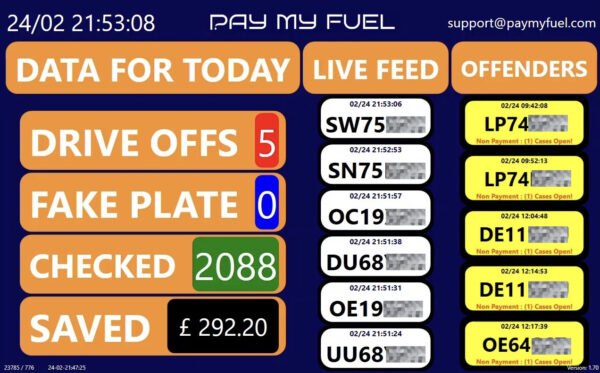
The Pay My Fuel business is automating drive-off recovery with its new intuitive tech, providing live ANPR warnings to protect sites and prevent losses before they happen.
The business was founded a year ago by Ian Woolfenden, a previous Torex EPoS developer, and is chaired by former Applegreen UK managing director, Michael O’Loughlin. Headquartered in Paignton, Devon, the business is helping forecourt retailers tackle the estimated £147m per annum cost of fuel crime.
It has two key weapons in its armoury. The first is a collection model, which costs a flat £250.00 plus VAT fee. For that, the forecourt receives a Pay My Fuel Recovery tablet, a purpose-built reporting device; stickers for the stanchion plus Pay My Fuel accounts. The package allows operators to report as many drive-offs and NMoP (No Means of Payment) incidents for life with no additional fees. Pay My Fuel takes its cut on the penalty fees.

A newer, Driver Alert System was launched a month ago. For £945.00 plus VAT and a £45 monthly service fee, it has everything a forecourt needs to get up running with live ANPR reporting. According to Woolfenden, the model is designed to help customers prevent those losses they wouldn’t be able to recover otherwise.
To date, Pay My Fuel’s recovery model is live with 1,250 forecourts; while the ANPR system has been rolled out to 50 sites and the company is expanding its footprint at pace, targeting new users but also encouraging Recovery tablet users to install the Driver Alert System to couple their reactive recovery with proactive prevention and benefit from complete fuel loss coverage.
Automated solution
Woolfenden launched his career with Torex, the largest EPoS supplier to UK forecourts, 21 years ago. The experienced computer programmer went on to contract for EPoS and oil companies for 12 years, building their forecourt management and EPoS software. It was while he was installing a temperature monitoring system at a forecourt site that he experienced a drive-off incident first hand and its shortcomings.
“The site had a drive-off and they showed me how they reported it, which I can only describe as awful,” he recalls. “They had to do everything – call the customer for payment, print the letter, post it themselves – it was not really a managed system,” he says.
Woolfenden soon discovered other forecourts were using an entirely paper-based system for reporting. This included handwritten witness statements, manually attaching receipts and handling postal services etc. Plus, they were paying a subscription but were not recovering all of the money from drive-offs, he says. Woolfenden, who knew O’Loughlin from his Applegreen days, recognised an opportunity and together, with development director Lee Chantry, launched Pay My Fuel and set about testing a solution.
With the Pay My Fuel model, operators simply upload their CCTV of the car, a receipt image and the technology takes over with automatic DVLA registered-keeper lookup. According to Woolfenden, the process is 90% automated versus competitor tech, which necessitates passing notes to solicitors in order to make a claim.
“It takes 60 seconds to report and you don’t need to be intelligent to do it,” he claims. Traditionally, forecourts may have spent up to an hour to report an incident and, as they’ve won no real results, it’s simply not been worth their while, he adds.

Fuel crime surge
The crime figures show otherwise. Pay My Fuel estimates the UK’s 7,000 forecourts are each clobbered by £21,000 a year in drive-offs.
And, it’s a growing problem but not for the reasons you would expect, Woolfenden reveals.
Rather than being a function of rising fuel prices and a cost of living crisis, fuel crime is driven by the growth of ghost plates, which perpetrators believe will go under the radar. Secondly, it’s a widely held belief by thieves that the police will not prosecute for anything less than £100.00.
“Unfortunately, for the most part they are correct – they are not going to get prosecuted at all,” Woolfenden says.
The number of NMoP incidents, where people are leaving false details versus people who genuinely have no means of payment, is on the increase too.
“We categorise it differently – if they leave false details, it’s worse than driving off but is still counted as NMoP. However, it’s just theft by another name,” Woolfenden says. He suggests this type of fuel crime is rife among organised groups, in particular, and affected forecourts can lose up to £100,000 a year, as a result.
This is where Pay My Fuel’s ANPR tech comes into its own, enabling operators to request pre-payment on high-risk vehicles or stop authorisation at the pumps.
The new product also opens the door to larger customers such as supermarkets, Woolfenden says. Typically, they have needed to invest in the region of £25,000 for ANPR.
“You would assume a £945.00 solution is not as good but it’s better – as it recognises ghost plates,” he says. “It’s using intelligence versus old fashioned infra red technology.”
Woolfenden suggests ghost plates have increased dramatically, as a result of ULEZ and congestion charges. “It costs £30 a day to drive around London – people don’t want to pay it,” he argues; adding that the ‘government’s own goal’ in this respect is now being seized as an opportunity by the private sector.

New market opportunities
While Pay My Fuel is expanding its UK footprint, the business is also targeting Ireland, Australia and California in the next 12 months, Woolfenden reports.
Ireland will pose a few challenges since debt collection services and fines are strictly regulated; but the business is working on a plan to make its model viable in the marketplace.
Both Australia and California have big fuel theft problems and the infrastructure to support Pay My Fuel tech plus few or no competitors.
Like UK forecourts, they will be attracted to the company’s success rate.
According to Woolfenden, Pay My Fuel is the most successful at collection, recovering 52% of drive-offs, while its ANPR solution is reducing drive offs by about 70%.
The business is now growing by recommendations and word of mouth, he adds. “For a commission operator experiencing two drive-offs a day, that’s an entire day’s profit gone. Now, rather than feeling sad about it, they have an opportunity to do something about it as well,” he smiles.
