

Technology transforms small format retail for Philippine Seven

7-Eleven Philippines is harnessing technology and to market-leading effect.
The convenience retail chain, operated by Philippine Seven Corp. was the first 7-Eleven retailer to develop its own digital wallet and, through its CLiQQ Shop and Rewards loyalty programme, is melding online and offline sales.
It’s perhaps no surprise to learn that Philippine Seven Corp. is led by a one-time technology entrepreneur, who was crowned NACS Asian Convenience Retail Leader of the Year in March 2019.
A quantitative approach to business
Jose Victor Paterno, president and CEO at Philippine Seven Corp., is a mechanical engineer by education who fell into retailing when he joined the company at his father’s invitation as construction and maintenance manager in 1993.
Although the position was supposed to be temporary, Paterno was intrigued by the complexities of retailing and stayed on longer than planned. He was appointed president and CEO in 2005 by majority shareholders President Chain Store of Taiwan.
Paterno says his background drives a quantitative approach to business – one that is more focused on self-governing and perpetual motion systems versus an emotional, ‘cheer leader style’.
Most recently, his efforts have been focused on attaching digital to the store front, he says. However, long before digital wallets emerged, 7-Eleven has been dominant in providing convenient locations for people to transform paper cash into digital cash with a range of e-payment and top-up services.
According to Paterno, 7- Eleven’s reliable systems and first mover advantage in this field has ensured the convenience chain has a substantial 70% share of that market. “We are taking more in payments than in sales,” he says.
The CLiQQ programme
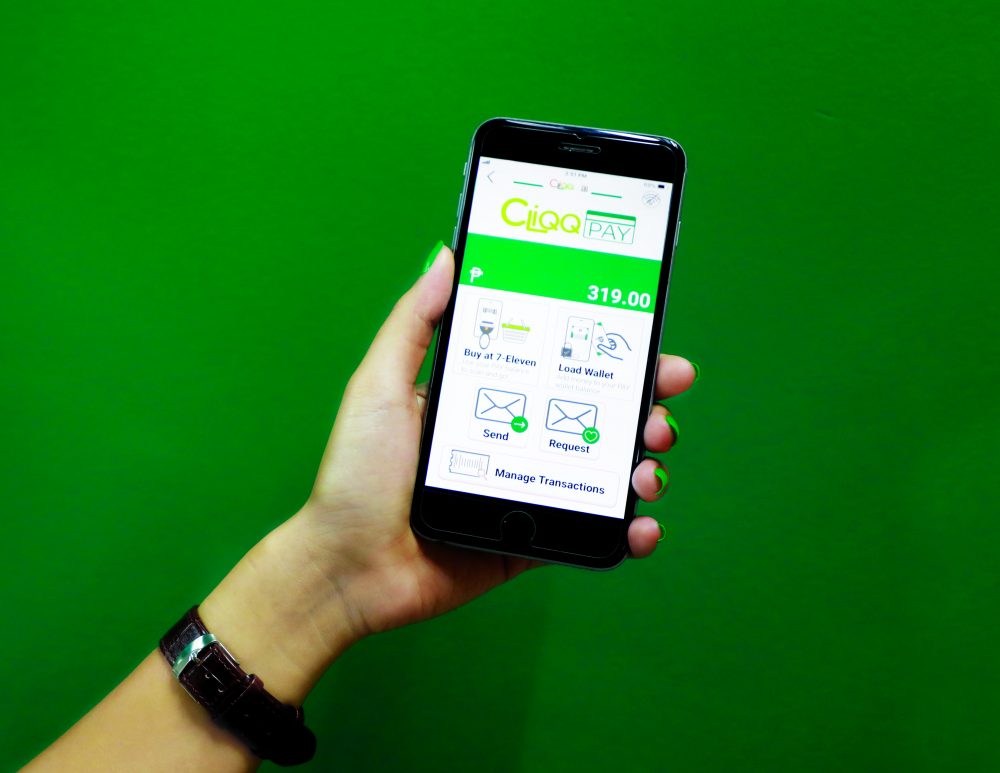
The CLiQQ loyalty/wallet platform and e-commerce business has been a natural progression for 7-Eleven.
Launched two years ago, the latter enables the retailer to leverage its 2,600 store network to offer pick up points for items ordered through the CLiQQ programme.
For Paterno, the emphasis has been on building an eco-system in digital, with the store at the foundation of the business. “Loyalty is the first point of contact and you have to offer loyalty, it’s table stakes,” he says. However, 7-Eleven takes that one step further, modifying loyalty with three key touch points:
- Through the digital wallet customers can spend loyalty points in-store, where 2 points = 1 peso
- A rewards catalog to incentivise trial, where 1 point = 1 peso eg if a customer has never bought a coffee, one might appear in their catalog
- An online store where 1 point = 1-5 pesos, with the balance in cash
According to Paterno, that eco-system ensures the business makes money from loyalty and that it’s not simply table stakes.
E-commerce sales, while low in value per item (they focus on lower priced items where their low logistics costs give them an advantage), are growing and the business is number three or four by package volume, says Paterno; who says he is happy with the progress made to date.
Currently only available for 7-Eleven orders, the business is in discussion with other providers to use the retailer’s stores as collection points for other inline retailers.
The worldwide trend for foodservice in convenience is apparent in the Philippines too and has been established at 7-Eleven for the last 10-15 years, Paterno says. The offer includes a unique just in time fried chicken business, with products delivered to store by motor cycles several times a day from a nearby kitchen.
It’s a terrific footfall driver for the business but the economics would not work if they fried in store, Paterno says.
Optimising the offer per store

While seating for dining is available in all stores, Paterno reveals the company is now moving in the opposite direction – contracting dining and becoming more competitive on general merchandise.
“We are facing mini mart competition so we have to step up on the general merchandise offer and we are looking at price and assortment,” he says.
7-Eleven is currently trialling an assortment aimed at fulfilling more customer needs in 400 stores. Selected from the universe available in its warehouses, the offer is optimised per store with AI according to demographic, POS, and loyalty data. “No two assortments are alike,” Paterno says.
Pricing is also on the radar but is “irreversible and the riskiest thing we will have done, if we even do it,” Paterno says. He believes only three retailers in the world – 7-Eleven in Japan and Thailand and OXXO in Mexico – have cracked being a convenience retailer and providing value in general merchandise.
Store expansion is also on the cards, provided GDP per capita keeps growing, which Paterno believes it will. It is opening 350 stores this year, and plans 400 the next. When Paterno took over in 2005, the retailer had only 200 stores. Thailand, by comparison, has 12,000 stores already.
A point of differentiation

The tech focus and recruiting technical expertise will continue too, it seems. 7-Eleven is widely considered to be the most technologically focused retailer and it’s a big point of differentiation, Paterno says.
“Other retailers do not have the systems to do the top-ups at scale, for instance. However, it’s a difficult balance because digital people are expensive and offline people are not.”
Strategy will also determine the next technological developments, Paterno adds.
“It’s about adding value versus introducing another me-too, which is key when you are playing against people like Alibaba that have got money to burn.”
Yet Paterno believes in the potential for technology to transform small-format retail, which helped single him out for the NACS award.
“It was very gratifying to get it,” he says. “We operate in a difficult market, not just with competition from micro retailers but we are in an archipelago and we have had to adapt to that.
We operate more DCS that probably everybody else – we average around 200 stores per DC versus around 1,000 stores for everybody else because of the archipelago.”
