

New industry report: Petrol Station Market Germany 2015

Christian Warning, NACS Insight Representative for the German speaking markets, reports from the press conference of The Federal Association of Independent Petrol Stations in Germany (Bundesverband Freier Tankstellen, BFT).
The so called BFT represents the interests of the independent petrol station market in Germany. About 2,400 independent, unaffiliated gas stations are amongst the member companies represented by the Association. Therefore, BFT constitutes a market share of around 15 per cent.
Industry Report
The industry report entitled PETROL STATION MARKET is regularly updated for the benefit of the BFT members and adapted to the existing economic and organisational framework.
The objective of this unique study is to give a detailed presentation of the retail market and to identify opportunities and potential risks from the perspective of the brand-independent stations. The study presents, in close detail, the industry-specific success factors- by which petrol station owners increase their business opportunities, which allows them to reduce or avoid risks.
The present study serves market participants, banks and insurance companies- to assess an individual company with a higher precision against the background of the entire industry.
Statistics from 2014-2015 indicate that the UK has the lowest density of service stations in the EU, followed closely by Germany with 14,531 sites in total. This might be because the German service station market is already one of the most efficient networks in Europe.
The companies that have survived the wave of consolidation in Germany are expanding their business to complementary goods and services. While only half of all service stations in Europe have a retail shop, only a single digit percentage of stations in Germany continue to rely exclusively on fuel sales for their revenue.
Germany hits a new record
Germany hit a new record in 2015 when statistics showed that there are 61.5 million registered vehicles on the country’s roads, an increase of 900,000 from 2014 figures. In 2015, 44.4 million cars were registered in Germany: 67.2% run on petrol, 31.2% on diesel, and just 1.1% on liquefied petroleum gas (LPG) and 0.18% on natural gas (CNG). There are 7,047 service stations in Germany offering LPG, an increase of 116 stations over the previous year.
Aral remains at the top of the German service station market. Judging by the number of stations, the retail networks of the two biggest companies Aral and Shell have barely changed. At the start of 2016, the Aral network had 2,354 service stations, a drop of 23 stations over the previous year (39 leaving the Aral network and 16 new stations).
Despite this slight reduction in its network, the Energie Informationsdienst (EID, Energy Information Service) expects Aral to see its share of the fuel market increase by half a percentage point to 21.5%.
Shell has made a strong leap ahead to second place, with 2,012 service stations at the beginning of the year, even while cutting its network by 28 stations. Shell’s share of fuel sales is approximately 20%.
Shell focuses on quality rather than quantity: “success is not defined by how many stations a company has, but instead whether the stations it has are high-volume, attractive locations that can stake a claim over the long term in a highly competitive market like that in Germany”, said Patrick Carré, Shell’s general manager for retail in German-speaking Europe.
In the future, Shell will continue to make further investments and modernise its stations. Total has been adding a lot of stations to its network since 2014 and remains in third place at the beginning of 2016 with 1,126 stations, followed by Esso with 1,000 service stations.
Total managing director Guillaume Larroque
Total has added 140 stations to its network in the past five years, with a net gain of 17 in 2015 (nine of the stations added were new builds and 22 were new partner stations). Total managing director Guillaume Larroque told EID, “Our goal remains to reach a market share of 10 per cent in Germany by 2018.”
The French company is focusing its new location placements especially in Germany’s economically strong south and also in the north-west of the republic.
Although the number of independent stations in Germany has increased significantly, the number operating under the bft (Bundesverband freier Tankstellen) private label has remained constant at 1,000.
Bft’s continued market strength shows that small operators continue to play an important structural role in the country’s service station network, maintaining its market share.
They are also able to benefit from the wave of consolidation taking place among the corporate stations. AVIA announced a joint collaboration with Münster-based Westfalen AG to issue tank and fleet cards.
Since last year, the 200 Westfalen petrol stations except in north-western Germany have been accepting the AVIACARD for cashless payment of goods and services. This latest venture increases AVIA’s acceptance to 2,400 stations; the new Westfalen card can now be used at 5,500 stations nationwide in the Westfalen, Markant, AVIA, Agip, Aral, OMV and Total brands.
This year saw another rise in the number of motorway service stations. The two new fuelling and rest stop facilities at Thüringer Wald Nord (Esso) and Thüringer Wald Süd (Aral) brings the number of motorway service stations to 355.
SMEs gain the advantages associated with the brand
Other differences relate to corporate positioning along the supply chain. The availability of additives produced by the oil companies had previously been reserved exclusively to their own distribution channels.
But they are now being supplied to some SMEs that have taken over the stations let go by the major brands, so that they could continue to operate without a brand change.
By acquiring the brand, the SMEs gain the advantages associated with the brand, including the available product range. In return, the oil companies, for which the sale of refined products is of primary importance to their bottom lines, continue to enjoy cost-effective access to an existing distribution channel.
The smaller station operators may in turn benefit from expanding their additional business tanks to their different cost structures.

In order to increase competitiveness in the long term, the major fuel corporations are either completely closing down smaller stations with weaker sales or selling them to SMEs.
Stations with adequate sales are being modernised with their shops upgraded to the group standards, however. This consistent focus on size and location is creating an opportunity for smaller operators of fuelling stations to expand their network in a targeted manner. They are thus able to benefit from the pressure that larger stations place on them to consolidate.
Smaller stations with weak sales have now been largely sold off or closed down and replaced with stations at better locations and with greater potential for sales.This has led to an overall improvement in the efficiency of the German fuel station network.
Even though the relatively tight margins in the fuel business have recently begun to rise, the companies left standing in a less crowded market are especially those that have been managed to generate positive results, even from those tight margins.
In addition, a few smaller station operators remain, tied as they are to long-term property contracts and previous investments in equipment.
The margins for diesel and Euro Super (premium unleaded) in Germany dropped in 2015 to 8.4 cents/litre and 9.67 cents/litre, respectively. Diesel is especially under pressure, posting a decline of 12.8 per cent, while the 2.5% drop experienced in Euro Super margins was still moderate.
The companies operating the service stations saw gross margins (the price per litre at which the fuel is sold less wholesale cost and energy taxes) for German Euro Super and diesel of less than 10 cents on average in 2015.
In the current Wood Mackenzie comparison of 16 European countries, Germany’s margins for Euro Super were in 13th place at 9.67 cents/litre and in 15th place for diesel at 8.40 cents/litre.
It also shows, however, that despite Germany’s relatively low density of service stations compared with the rest of Europe, the relatively high costs in comparison with European competitors still led to low margins. Because of strong competition on the German petrol station market and low gasoline prices, margins are very narrow.
Great fluctuations
Since the market transparency mechanism was introduced in December 2013, the price at the pump has experienced fluctuations of +/- 20 cents. The fuel price at the pumps has changed as often as 14 times a day, with great fluctuations being seen; especially in 2015. The average price of a litre of super petrol in January 2015 was €1.292. The price peaked at €1.503 in the summer and was back down to €1.249 in January 2016.
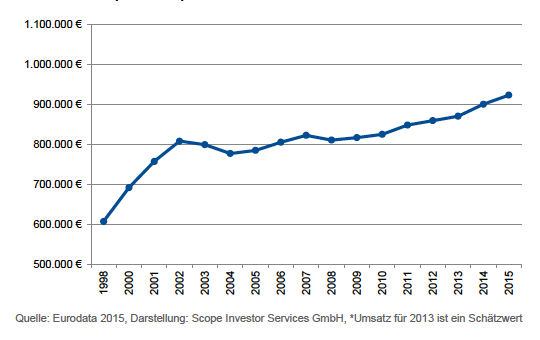
The average Non Fuels Retail turnover at German service stations has increased from €600,000 p.a. in 1998 to above €900,000 p.a. in 2015. The most important product category in the stations’ retail, non-fuel sales remains tobacco, which accounts for 62% of store sales across all station size categories.
This is followed by beverage and phone card sales. The car wash remains in fourth place among the non-fuel retail sales. According to the statistics portal Statista, 23% of Germans wash their vehicles between 6 and 10 times a year.
