

NACS Convenience Summit Asia highlights retail need for adaptability and agility

The NACS Convenience Summit Asia, held virtually on 17-19 August 2021, showcased how adaptability and agility are key attributes for future convenience retail success. Presenting the Event Wrap Up, Henry Armour, president and CEO of NACS, said the ability to change and move at pace were consistent themes throughout the speaker presentations at CSA.
As well as closing this year’s event, Armour opened proceedings by focusing on NACS’ global engagement strategy.
Quoting the Canadian futurist, William Gibson, “The future is here… it’s just unevenly distributed”, Armour said NACS’ global radar screen enabled it to look to where elements of the future were emerging most quickly in the convenience industry, study how they were emerging, learn from them and then adapt those learnings for individual countries to win first mover advantage.
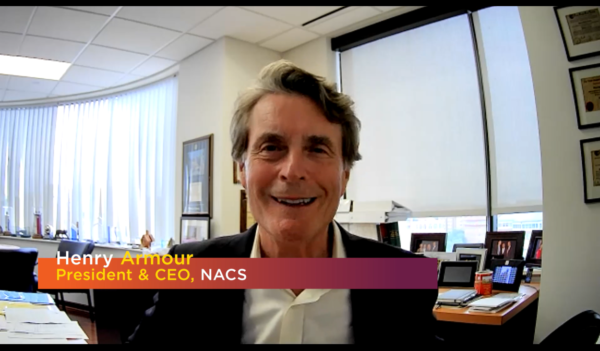
“If you are early in a lifecycle curve you can leap frog people in the middle and become more advanced rather quickly,” he said.
Armour shared a number of lifecycle curves including two most relevant to Asia: delivery and last mile and online to offline (O2O), each showcasing four different stages: infancy state, developing state, deployment state and mature state.
Mapping different countries, according to their evolution in last mile delivery, showed Asia was leading the way, Amour said. This is largely due to intense population density that enables delivery to be done on a more effective basis. It also explains why Asian countries with lower population densities – Australia and New Zealand – were least advanced on the last mile delivery lifecycle.
Asia is also leading the rest of the world in O2O but not exclusively as Canada and Brazil are also ahead. Here, evolution is being driven by advanced retail technology and to a certain extent population density, Armour said.
Vaughan Ryan from Nielsen followed on and reflected on the changes in consumer behaviour through Covid.
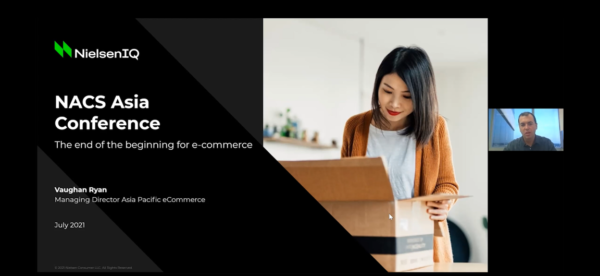
The pandemic had really fast tracked consumers into the e- commerce world, Ryan said. “Many consumers had not shopped online before but Covid meant they had to shop online by necessity and consumers adapted to e-commerce faster than anyone expected,” he said.
Online growth had enjoyed a huge spike in popularity during the lockdowns and it has not subsided – online is still recording strong growth.
“The true definition of convenience has changed and it’s not going back to the way it was,” Ryan told delegates.
He urged retailers to focus on three things to succeed in e-commerce (and also B&M retail): the right assortment, price and the shopper experience. Armour cited Frances Frei and suggested retailers should aim to be the best in one area and “good enough” at the others.
Angus McKay, CEO at 7-Eleven Australia, presented the changing behaviours in Australia during lockdowns. There was a big shift to local and proximity because people were closer to home, he said.
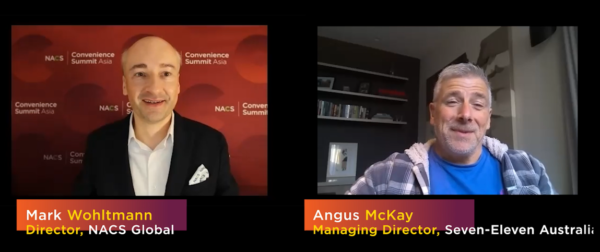
“Online shopping in Australia exponentially increased and the notion of convenience is being redefined,” he added.
McKay reported on an aggressive amount of format experimentation in Australia. This is really focused on the shopper experience and being a destination for certain shopping occasions, not just impulse, McKay revealed.
Despite the growth in online, face to face interaction is still key, however. “Humans want face to face and it’s a competitive advantage that our industry has,” he said.
McKay said companies have a variety of different stakeholder groups and advised businesses craft their communications in a bespoke way for each stakeholder group eg current customers, potential future customers, own employees etc.
He also suggested that the Covid era required much quicker decision making and that an organisation or culture which fostered empowerment allows that to happen more quickly than one with a hierarchical structure.
The pandemic had underscored the importance of agility and adaptability, McKay stressed.
The next session switched the focus onto sustainability and particularly plastic waste.

Brett Barclay from CMA told delegates that sustainability is a core value and demand for Gen Z and advised retailers to take that on board and respond since Gen Z is their future customer base.
“Many Gen Zs only want to work for organisations that have a commitment to sustainability,” he said.
Barclay recommended business focused on doing good and telling the story. “They are not options, they are necessities,” he said.
Covid had also provided a “light bulb moment”, Barclay claimed. It had shown that you can change the environment with thoughtful actions.
However, he highlighted the fact that plastics waste accounts for 76% of the 8.3bn tonnes of total waste every year and he shared a survey that revealed that businesses recognised their current efforts are not sufficient in this field.
Barclay summed up by highlighting the opportunities: that meaningful progress requires broad industry collaboration, the need for a circular waste economy ie re-using things, enhancing recycling capacity, containers from recycled material as well as embracing re-use containers plus broader efforts to support river and ocean programs.
It’s about moving from green to gold, Barclay concluded. “You can be more profitable and attract more customers from a thoughtful sustainability strategy,” he said.
Kevin Huang and John Hsu from 7-Eleven Taiwan showed what retailers are doing about sustainability and shared their plan with respect to plastics.
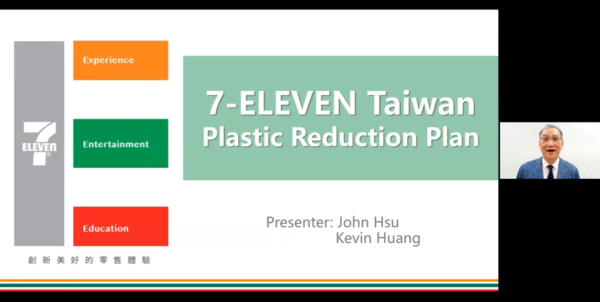
The retailer has implemented a comprehensive approach comprising strategies, task forces, action plans and stakeholder communications.
The retailer favours a circular waste economy, while its plastic reduction task forces spans eight departments ranging from coffee to supply chain to HR.
The business has also categorised packaging into four buckets: reusable, compostable, recyclable and single use, and has a different strategic approach for each type.
O2O in post-pandemic Asia was the theme of the next session with a presentation from Victor Paterno from 7-Eleven Philippines.
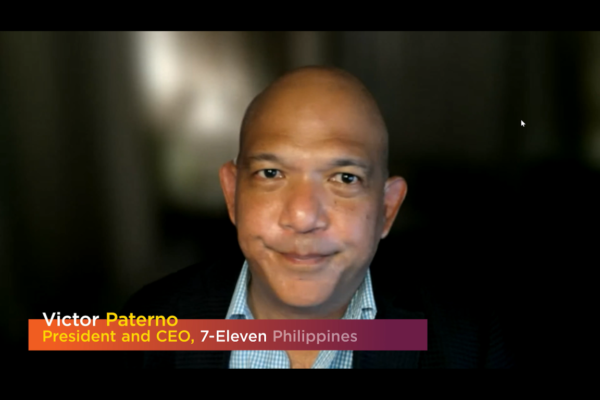
“The future is unknowable but we have to move/act or else we will fall behind,” Paterno said.
Paterno revealed the business was placing bets on big trends:
- Work from home will continue to some degree, which will mean limited shopping trips
- Convenience is losing ground to proximity but small format will win
- Home delivery
- Digitisation
Paterno said it was vital that business strategies were embedded with optionality. “That’s critical in an unknown world hence the need for adaptability and agility in optimising assortments,” he said.
The pandemic had also highlighted that supply chains are brittle and can’t change as fast retailers can. That will be a challenge moving forward, he added.
Paterno reported 7-Eleven Philippines is pursuing a “convenience plus model”, adding essentials in larger sizes at lower prices, driving click and collect ie buy online and pick up at 7-Eleven’s convenient locations plus expanded financial services.
Delivery and dark stores were off the table since research had shown the cost and scale made them prohibitive.
Paterno also emphasised the need for partnerships. “There’s just too much to do by ourselves,” he said.
Interviewed by Mark Wohltmann, director, NACS Global, Paterno admitted he felt more bullish about O2O pre-pandemic since store visits were down due to Covid and a lot of VC capital was being thrown at delivery.
“Off-line will always be our domain – it’s our footprint and real estate and we will be the last to be disrupted,” he said.
He also acknowledged that delivery was very expensive and only viable with a high population density.
“Pick up/collect is how we can best leverage our positioning,” he said.
Paterno revealed 7-Eleven Philippines is launching a recycling ATM strategy and becoming the local bank in certain locations.
And he emphasised the importance of going back to basics, executing what you do well in order to build basket spend.
CK Pak and Krystie Tang from Circle K Hong Kong presented the retailer’s O2O CX strategy with the OK Stamp It e-CRM platform, which has driven strong financial results.
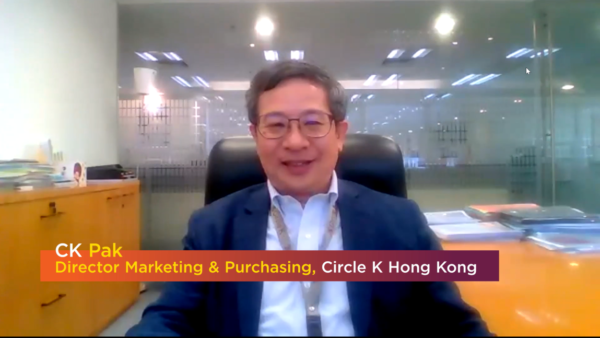

The duo highlighted the growing popularity of mobile with the growth rate of mobile subscribers being greater than population growth. “Customers are embracing O2O,” they said but warned that digitalisation waves have disrupted many industries and “we will be next, if we don’t act”.
According to Pak and Tang, Circle K Hong Kong is focused on mapping the customer’s journey to formulate strategies and actions for CX transformation. These include:
- East, fast and simple
- User friendly
- Personalisation to establish intimacy
- Engagement
The retailer is also unlocking the take home opportunities through O2O data leveraging. Like 7-Eleven Philippines, Circle K believes partnerships, reinvention and click and collect will be key.
“The journey requires us to get out of our comfort zone,” the retailer opined.
Craig Panter from Invenco and Sin Hin Wong from PDI discussed the evolving retail technologies and the role technology is playing in supporting c-stores’ businesses now and in the future.
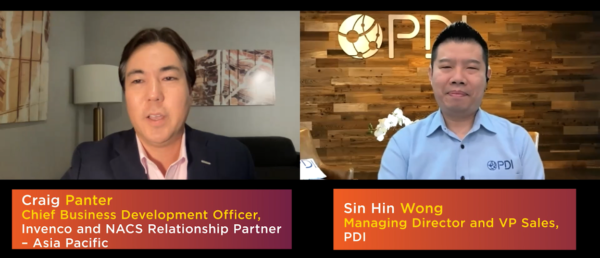
Panter talked about unmanned retail and the key learnings. There are a lot of challenges but not a lot of successes, he said. Unmanned retail has the best potential in high density locations. However, supply chain issues, especially in meeting fresh food expectations, hamper progress. Panter suggested a hybrid model of an unmanned c-store within a c-store could be the most viable going forward.
Panter highlighted the emergence of new payment technologies, which are embraced by the young but not so much by the old.
“Retailers have to support a lot of methods of payment and payment security is becoming more important,” he said.
Panter also tipped other advancing technologies such as 5G, IoT and APIs (so that businesses are not locked into legacy systems) but stressed the inter-connectiveness of online to offline was critical in order to provide a holistic view.
Wong from PDI said convenience and fuel retailing are under assault and suggested operators needed to leverage innovation and embrace new technology platforms to prevent being disrupted.
“Customer expectations are rising, new forms of payment are advancing and new fuels are emerging,” he said.
Wong suggested the original concept of O2O – finding customers online and bringing them into store – is now in reverse and encouraged retailers to adopt a multi-year platform approach to enable digital ability with a special emphasis on customer touch points.
The final presentation came from Tracey Malcolm of Willis Towers Watson and looked at the future of work.

Malcolm outlined the new reality with outlining events, accelerating technologies, evolving complexities and new expectations, which are forcing companies to adapt.
She recommended businesses reinvent jobs: deconstruct work, redistribute it, and reconstruct it.
Malcolm recommended businesses placed tasks in different buckets – repetitive versus variable, independent versus interdependent, physical versus mental – to enable them to cope with tasks in a more productive way eg redeploy labour to value added tasks versus no-value added tasks.
Future work-based opportunities lay with talent sharing and flexible working, she said; endorsing the Summit’s key themes of adaptability and agility once more.
CSA 2021 also featured the presentation of key NACS Awards.
The winners were:
- Best of the Best Asian Store Award, sponsored by Coca-Cola, Fook, China
- Asian Convenience Sustainability Award, sponsored by Coca-Cola, 7&i, Japan
- Asian Convenience Retail Technology Award, sponsored by Gilbarco, Petronas, Malaysia
- Asian Community Engagement & Support Award, sponsored by PepsiCo, Sinopec Easy Joy, China
