

California based Loop Neighborhood Market has two clear strategic directions

Loop Neighborhood Market, the 56-strong California convenience store chain, has two clear strategic directions: to differentiate from the competition through innovative and great tasting food and build community engagement by literally ‘looping’ into the neighbourhoods it serves.
The first Loop store was launched in 2013 by Au Energy, a joint venture between the family-owned Vintners Distributors and Shell.
Fremont-based Vintners Distributors had previously operated 30 sites but grew substantially in 2010, following the JV and acquisition with the oil giant.
To date, the business has converted the largest locations to the Loop format plus one smaller unit, Lil’Loop.
The team at Vintners Distributors, led by CEO Varish Goyal and Pervez Pir, president of Retail at Loop Neighborhood Market, developed the Loop branding. Stores were rebranded to the Loop format as the business began replacing certain assets such as underground storage tanks.
Pir recalls. “It was spotty. We needed a critical mass but we could not build it strategically so we slowly rebranded year by year,” he explains.
The total chain comprises 135 sites – 18 in Southern California and the rest in Northern California – with sites ranging in size from 1,200sq ft to 3,000sq ft. Ninety sites offer car wash while Vintners Distributors also supports a dealer network of about 70 stores.
Key differentiators

Loop has aimed to differentiate with food from the outset, says Pir. The former 7-Eleven executive also wanted the brand to bring in female customers, who appreciated a safe and clean refuelling environment.
As well as the strategic focus on food, Loop has created an inviting and safe retail environment with windows that stretch the full height of the store, smart subway-style tiles plus gondolas that are sited at eye level so customers can see right across the shop.
The branding and marketing, meanwhile, is whimsical and fun. Pir reports the company worked hard to find the right branding agency to highlight the businesses’s strengths and create the right personality for the brand. As such, there’s no mascot – the messaging creates the personality for the Loop brand.
Food and kitchens are a key focus at Loop, which has taken out product that didn’t sell and replaced it with better for you and healthier lines including a full salad bar. The fountain machines have been enhanced and freshness cues introduced around the store to to build customer trust on product quality, Pir explains.
Loop has also narrowed its confectionery assortment but introduced lines, such as seaweed and better for you chips, that you wouldn’t expect to find a in a c-store.
“We had chickpea chips back then when they were not popular but now they are popular,” Pir says.
“We are a c-store, which is open 24/7 and needs to serve the neighbourhood so we did not shake it all up but we did say ‘how do we differentiate?’ Thirty per cent of the offer is different across the store. We wanted to find other ways to bring people into the site,” Pir says.
Other early innovations included the introduction of ovens and warmers, which today are now widespread. “We were the first movers with a lot of equipment, which enabled us to make quality food but still grab and go,” Pir says.
Hello Tasty kitchen

Scroll forward and Loop is setting the pace once more with the launch of a new kitchen brand, Hello Tasty.
Opened a year ago at one larger location with an adjacent restaurant, Hello Tasty launched with an initial pizza offer but executed the Loop way with its own dough and sauces and unusual favours including Chicken Tikka Masala.
“We tried to find different pizzas. There is a lot of competition where we opened this so we knew what we going up against,” Pir says. “We also started seeing challenges with pizza not selling enough to justify the menu expense so we began creating new dishes including rice bowls and Spam Musubi,” he adds.
One year on and the trends are now looking favourable for the Hello Tasty format but it wasn’t profitable at the seven month stage, Pir reports.
The format is likely to be rolled out to other stores, which are under construction and have space for a kitchen.
“But we’ve got to make the kitchen work – it’s a huge differentiator. With grab and go warmers, 60% of the items others will sell. Then there’s proprietary items but many of those are me too, so the kitchen will help us.”
It will still be a challenge, however, as Pir explains.
“California is a beast to make food work in the c -store because the State is saturated with fast feeders offering combo meal price points. It’s hard to play it on price so you have to hook customers with the quality of the food,” he opines.
The introduction of steamers to produce produce Char Siu Bao has also helped Loop to stand out from the competition and attract a new type of customer, Pir adds.

In beverages, Loop offers bean to cup coffee and has worked with a partner to create the Loop brand. “It’s a blend the consumer would like,” says Pir. “To be honest, other c-stores have bean to cup, so the offer really relies on the quality of coffee. Our Loop blend is a proprietary brand and has been well received. “
Other private label lines which have performed well include Loop Delish water and two wine varietals. “They are doing well and we are trying to expand. This year we are working on snacks and candy – we are trying to do more private label,” Pir says.
Other concepts are also in test, he adds.
“We just love pushing the barrier and finding new things – we don’t mind failing fast but we prefer to do it rather than be too scared to do it.”
Loyalty drive

Alongside food, loyalty is another big differentiator at Loop. The retailer has 1.3 million Loop members who are offered discounts and incentives on products, fuel and car wash.
“It’s hard do loyalty as an independent operator but I would encourage people to jump onto it. I think we have done a great job – the program offers great incentives and helps vendors partner with us.”
Loop members also benefit from promotional prices versus non members and Pir reveals the retailer is considering offering Loop member rewards across the entire store and not just on promotions.
Community engagement
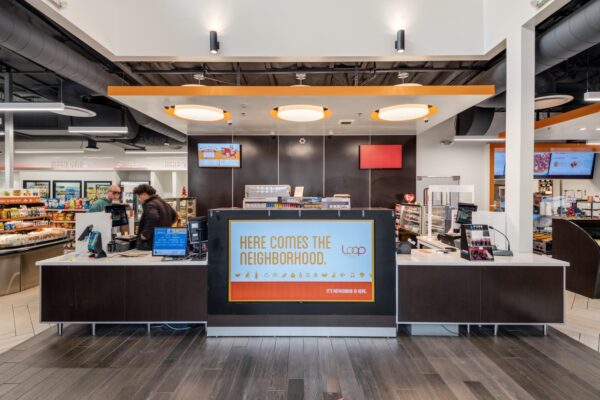
Community engagement is paramount at Loop. Pir credits his CEO for the company’s desire to “loop into the neighbourhood and give back to the community”.
Partly inspired by the Parks and Recreation TV show featuring the charity KaBOOM!, which builds playgrounds in locations all over the US, Loop decided to begin supporting different organisations but with the proviso that they were all local. “It’s about giving something back. It’s not fake – it’s altruistic and genuine. We are a family company that feels blessed and we want to help our own employees and communities,” Pir says.
Loop has selected a range of local organisations and will swap ones out to give others a chance, however, two – the California Fire Foundation and the Bay Area Deputy Sheriff’s Foundation – have been retained as constant key beneficiaries. Newer good causes Loop has partnered include the RotaCare Bay Area volunteer alliance of medical professionals who are dedicated to providing free primary, quality healthcare.
Loop has also supported a local high school to raise funds for a new soccer field by providing a percentage of sales from a gas station pump close to the school. And, at the end of last year, the retailer participated in a similar Shell program called the Giving Pump to raise money and support a student education initiative across California.
Pir reports the next phase of community involvement will be exploring how it can help its staff and team members by introducing internships for kids and encouraging third year students to apply for an eight to 10 week paid placement. “They will present a project to our executive team and we will make them a job offer. If it works, it will be a very successful way to motivate people in our community,” he says.
EV

Looking to the future, Loop has recently installed its first EV charger in partnership with FreeWire and is planning three to four more.
In Northern California the majority of electric cars are Tesla and they are present on every other driveway so it cannot be ignored, Pir says.
“We’ve not avoided it but we were reluctant initially since the size of our stores are not big enough or we do not have space for EV charging. Plus from a permitting standpoint, we need to have a certain number of parking spots if we have a kitchen or seating etc and, if you add an EV, that takes away the spot.”
The EV charging model Loop has opted to use is differentiated too. Rather than pull from the grid at peak times, the EV chargers have a big battery providing a 15 minute charge.
“And, because it’s a big battery, if the power went out in store, we could charge from the battery that’s already full,” Pir adds.
Loop is exploring other possible partnerships for EV charging and carefully considering the locations where they will be most relevant. The first has been at a destination station, near to where people work or need to charge. The next will be off the free way and on a route, Pir says.
Mixing it up again – with Loop you wouldn’t expect anything less.
