

Retailer Spotlight: Kostner Group 1947’s customer-driven energy transition in Italy
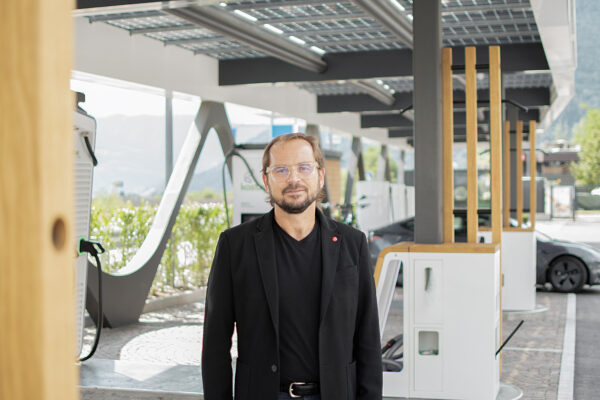
Andreas Kostner, CEO of the Kostner Group 1947
Kostner Group 1947, the family-owned and run energy group, which operates service stations in South Tyrol, Italy, has a service-oriented culture that sets it apart from the competition.
Rather than looking to develop a vast network of standardised service stations, the business is focused on developing a small regional network centred on high quality, customer-focused stations, which deliver for local circumstances, needs and partners.
The company’s strategy is epitomised in its service station in Vahrn, opened in 2012 and entered into Insight’s Best EV Hub in the World 2025 competition. Located on the busy transit route of the Brenner Axis, which connects Germany and Italy, and right by the motorway exit, Vahrn is Kostner’s first EV charging location, featuring 12 charging stations but also fuels, car wash, a bar, bistro, meeting room and parcel pick up point.
“With our strong service orientation, we continually update our service offerings at our stations to adapt to new needs and trends,” says Andreas Kostner, CEO of the Kostner Group 1947, whose grandfather, Peter, founded the business in the 1940s.
Initially a wooden barrel maker or ‘hooper’, Peter was forced to diversify as new materials, such as aluminium, emerged on the market and he needed an alternative income to feed his nine children, Kostner reports. In 1947 Peter began producing and selling firewood. Later, with the evolution of heating products and systems, he integrated coal and liquid products, including oil and kerosene, into his portfolio.
Kostner’s father, Hans, joined the business from secondary school in the 1960s and introduced liquid fuels for the motor sector, as well as a delivery service for business clients with private gas pumps.
He was subsequently joined by his two younger brothers, Peter Jr. and Toni.
They made a perfect trio, Kostner recalls. Hans was focused on product and services, Peter Jr. handled administration and accounts and Toni was the sales and marketing specialist.
“My father was very service-oriented, a value that has shaped our company to this day,” Kostner continues. In the 1980s, this saw Hans introduce environmental services such as tank cleaning and related waste treatment and disposal, for example.
Due to the late liberalisation of public petrol stations in Italy, as a result of national regulations, the Group only entered the service station market in 2009 with the acquisition of a small public petrol station but began to steadily acquire more regional stations and build its 10-strong network. An 11th station is planned for spring 2026.
Today, Kostner Group 1947 comprises four strongly interrelated companies:
- Kostner Energy Supply, the original energy supply business
- Kostner Service Stations, which manages the service stations
- Ekos Enviromental Service, which offers waste disposal and waste treatment services
- Ide2n Energy Systems and E-Mobility, the youngest company, founded two years ago, which supports customers in the energy transition, offering consultancy plus the delivery and installation of renewable energy systems and e-mobility equipment (hardware and software)
Green vision

Born into the family business in 1974, Kostner literally grew up in the company. He completed a Bachelor degree in business and management from the University of Bolzano in Italy and, acknowledging the growing importance of renewable energy sources, he went on to study for a Masters in renewable energy from the Technical University of Vienna, Austria.
In tandem with his studies, he worked across the company – starting with driving tank trucks for the delivery service and later on in various management positions.
In 2007, the Group separated the waste treatment and disposal business from the Kostner brand, establishing Ekos, and Kostner was appointed as CEO. Ekos remains a significant part of the Group, contributing one third of value creation.
In 2020, Kostner was appointed Group CEO and returned to the energy sector with a new mission.
“My personal vision is to transform our Group into a so-called ‘green’ company. I want to successfully guide our company through this energy transition,” he says.
Kostner recognises that it’s a big challenge for a company whose main focus is fossil fuels but he is open minded to new tech and does not fear change.
“Many petrol operators fear the ICE ban will end their business and have negative attitudes to electro mobility. My character a bit different – long before we had our first public charging unit at our stations, I started driving an electric car because I wanted to learn about that technology, experience electric car driving, and gain expertise in this field. Instead of viewing it as a significant risk to our fossil fuel business, I sought to identify opportunities for our future business,” he says.
Today, Kostner manages the Group alongside his cousin Philipp as CIO and the company remains 100% family-owned.
Service-oriented stations
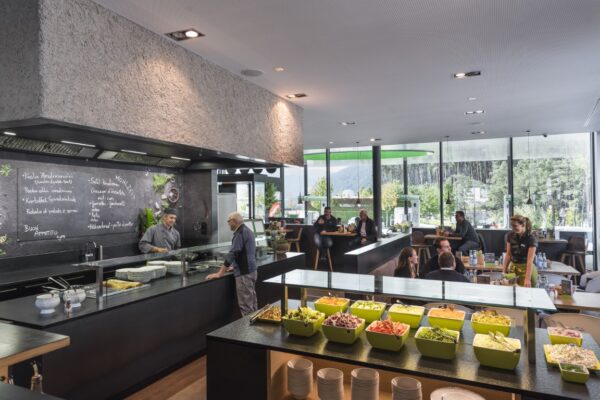
Kostner operates 10 service stations in South Tyrol but under various business models. Three sites have been newly built by the business and it has complete control but other sites have been taken over and are managed by private partners. For example, at one location, a local bakery operates the bar, bistro and shop and Kostner focuses solely on fuel and car wash.
In addition to the service-oriented strategy, Kostner aims to choose modern, welcoming architecture and high quality materials for the station builds to minimise their impact on the local landscape and economy, which is tourism led.
“We reside in a sensitive region so we consistently prioritise exceptional architecture that harmonises tradition with modern elements, both inside and out. The service station in Vahrn exemplifies this perfectly,” Kostner says.
Imbuing his father’s strong service orientation, Kostner Group 1947 continually looks to update and adapt to new needs and trends, he adds. This process is easier at its company-owned sites such as Vahrn.
“We are constantly experimenting with new offerings and, if they are successful, we implement at new service stations,” Kostner says.
New services, like EV charging, will not necessarily be viable at every location due to both economics and the local environments i.e. if there is simply insufficient space.
In keeping with its regional focus, Kostner’s loyalty programme is aimed at meeting the needs of local customers and business clients with personalised offers and rewards. Kostner reports the company is currently looking to replace the physical card with an app, integrating all of its services and loyalty products into one offer and to focus more on cross-selling.
Vahrn and the energy transition

E-mobility moved strongly onto the Kostner Group 1947 radar a few years ago as the company recognised it would be play a key role in the energy transition in the passenger vehicle sector. That led the Group to seriously consider e-mobility and the introduction of charging points at service stations.
“Although we are not a big player in the energy or automotive sectors with a budget of millions of Euros, but rather a small family business with limited financial resources, the installation of e-charge stations and the high risk of minimal financial returns posed a significant challenge for us and required considerable courage,” Kostner recalls.
“To limit the risk of a poor investment, we decided to build our first charging station at our service station in Vahrn, which is located on the north-south traffic route, the main connection between Germany and Italy, the so-called Brenner Axis, directly at the motorway exit, accommodating a correspondingly high volume of traffic. In a sense, we have established our first charging station at one of our locations with the greatest potential for success.
“The charging station in Vahrn opened in March 2024, almost one year ago, and, right from the start, we were surprised by its success and utilization. We are now even in the process of planning the expansion of the charging park in Vahrn,” Kostner says. The company plans to add four more Tesla chargers and four more of its own Kostner chargers to the site.
“Another important decision to reduce our financial risk and especially share the investment costs was to co-operate with a major player in e-charging, in our case with Tesla,” he adds. “Consequently, we installed Tesla charging stations in Vahrn alongside our own Kostner charging stations. In general, I am convinced that such multi-e-charging stations represent a promising business model for the future.”
With such a service-oriented culture, Kostner’s EV charging experience was always going to offer added value for customers and Vahrn does not disappoint. Working with a local designer, the company has developed a ‘fit and clean box’ with a pull-up bar, seating, vacuum, windscreen wiper, rubbish bin etc., which is installed alongside the charging unit.
In addition to EV, Vahrn offers traditional fuels but again there’s a push towards greener options.
“As conventional fuels continue to play a crucial role in our business, we are naturally striving to further develop our range toward sustainability in liquid fuels,” Kostner reports. “Since 2024, we have also been offering the sustainable fossil diesel substitute, fossil free HVO diesel, at all our stations. Additionally, we have already conducted a feasibility study for a hydrogen refueling station at our service station in Vahrn,” he says.
Looking ahead
Kostner Group 1947 is upbeat and has several new initiatives in the pipeline for 2025 and beyond but has a pragmatic approach.
“Like all companies in our sector, the energy transition presents a significant challenge, due to the dynamics and numerous uncertainties, which have already proven to be extremely demanding for us in the last few years,” Kostner says. “These dynamics and uncertainties, along with many other changes, will undoubtedly require considerable hard work from us also in the years to come.
“The continuous adapting of old strategies, while simultaneously developing new ones, has become critically important and is particularly challenging for small companies with limited resources such as ours. One advantage we have over larger companies, which we must capitalize on, is our flexibility and speed,” he says.
First up is a plan to expand the charging park in Vahrn, not only with passenger vehicle charging but the installation of mega watt charging station for lorries, which will also be suitable for cars with trailers – currently drivers need to unhitch in order to charge. “We have many tourists from northern Europe and we saw the need for this,” Kostner says.
The company plans to equip more of its stations with EV charging, where the locations allow. “The significant challenge here is that space at the existing stations is very limited. Given that we live in a mountainous landscape, space is constrained, and service stations cannot be easily expanded in terms of footprint,” Kostner explains.
Kostner’s gastronomy and shop concept will be revised too to cater for international guess with different requirements.
“We will further expand our range with to-go products and innovative snacks while continuing to utilize regional products,” Kostner says.
Spring 2026 will see the opening of a new service station – the 11th – in a side valley in South Tyrol with plans for a further two to three stations in the region over the next five years, Kostner reports.
Kostner also plans to expand to the south, outside its South Tyrol heartland.
“Over the next five years, we want to build one or two additional service stations along the Brenner axis and the associated motorway in the neighbouring regions of Trentino and Veneto,” Kostner reports.
The sites will be modelled on the Vahrn EV charging location but there’s absolutely no doubt that the services will be adapted to meet the latest consumer needs.
*Photo credits to Oliver Jaist and SWZ
