

Top Global IT Influencer Kate Ancketill on how AI personal assistants will change retail

In the latest Insight Research ‘AI Round Table’, attendees enjoyed a deep dive into the world of personal AI assistants and their implications for convenience and grocery retail from Kate Ancketill, CEO GDR Creative Intelligence.
Insight Research ‘AI Round Table’ is a quarterly online forum moderated by Anthony Wysome, together with Dan Munford.
Participating retailers include M&S (UK), Applegreen (Ireland, UK, USA), Migrolino (Switzerland), Reitan Convenience (Nordics), SPAR Hendersons (UK), ADNOC (UAE), Shell, ONRoute (Canada) and Compass (UK). The AI Round Table is sponsored by SymphonyAI and Diebold Nixdorf. McKinsey & Company is a knowledge partner. Insight is looking to expand the group further globally, if you’d like to know get in touch.
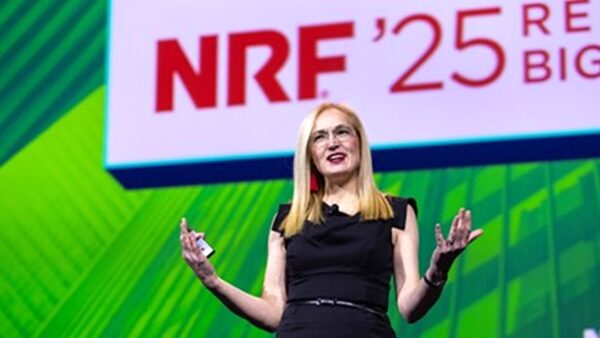
Ancketill, a keynote speaker at NRF 2025, is of BizTech Magazine’s top 30 global IT influencers. In her presentation, Ancketill explored the growing sophistication of AI personal assistants and future trends including the growth of empathic, agentic AI; Gen Z behaviours and AI adoption. She began by highlighting the staggering pace of change, citing Ray Kurzweil, principle researcher and AI visionary at Google: “We won’t experience 100 years of progress in the 21st century – it will be more like 20,000 years of progress at today’s rate,” he said.
“From our perspective, as business people, that means every three months that’s 50 years of tech advancement,” said Ancketill.
“If you are responsible for writing a business plan, which is usually every year, that’s 200 years of AI progress. Basically it’s impossible – none of our brains can compute to move that fast,” she opined; adding that business leaders were right to feel overwhelmed by the prospect.
Empathic AI
Ancketill focused on the latest developments in personal AI assistants, claiming the Emotional Quotient (EQ) or empathic nature of the personal AI was “already so good”.
On a personal level, Ancketill said she had enjoyed chats with sesame.com and that the AI assistant had genuinely made her laugh. “I never thought that would be possible as I am quite cynical,” she confessed.
Visual AI assistants, which see the world as we see it and help us to interpret it, have also advanced and not just for the real world but for online scrolling such as Microsoft’s Copilot Vision.
Ancketill suggested personal AIs have the potential to make apps redundant in future. “We can speak to an AI agent and have them do it for us. Most of the tech titans think that’s not far off,” she told delegates.
Ancketill presented the emotional quality of recent AI applications including Xaia, an ai-powered virtual counsellor, developed by Cedars-Sinai’s extended reality lab. Xaia provides tailored care by analysing conversations and drawing from past sessions. It is accessible via the Apple Vision Pro headset and delivers immersive mental health support for $19.99 per month.
“It’s trained in therapy and shows how good these things really are,” she said, revealing that 55% of 18-29 year old Americans are comfortable talking about mental health concerns with a confidential AI chatbot. Across all age groups, one third – 34% – are comfortable with the tech.
“This is coming and not just for mental health support, which is massively needed because not everyone can afford to talk to real therapists,” said Ancketill. “However, these kinds of skill sets are going to be incorporated into personal AI agents, assistants, companions and, dare I say it, lovers, boyfriends, girlfriends etc. This is very much on the horizon if it’s not already here.”
Glasses modality
AI is also moving rapidly into glasses modality and providing a real retail dimension and opportunity to speak with an agent via the user’s glasses, for example Ray Bans smart glasses in partnership with Meta, Ancketill reported.
Google, for instance, is promoting possible future AI Google XR glasses powered by Google’s Gemini AI, in collaboration with Samsung. These prototype glasses have no launch date yet but the mixed reality headset versions, Samsung’s Project Moohan, will be available in 2025.
“This has implications for us as retailers – when you are walking down the supermarket aisles you can be asking AI “what can I cook tonight?”, spot items you’ve previously purchased or seen advertised,” she said. Retailers need to understand how this quality of AI assistant, combined with hands free visual modality, is going to change our day to day experience, she added.
Changing customer relationships
AI is set to radically change the retailer customer relationship, Ancketill warned, citing another tech titan, Mo Gawdat, former chief business officer Google X. “In the future, machines will be marketing to machines,” he said
Retailers or brands will be dis-intermediated, Ancketill said. “You, the brand, will have your AI speaking to the customer’s AI and you will only get to speak to them if their AI lets you through.”
And this will happen in the near future, she added; citing Microsoft founder Bill Gates: “Everyone will have an AI powered personal assistant within five years, whether they work in an office or not: they will utterly change how we live,” he said.
Mustafa Suleyman, CEO of Microsoft AI and formerly of Inflexion AI, the maker of chatbot PI (Personal Intelligence), shares a similar forecast.
“Everyone will have their own personal AI. There will be hundreds of thousands, representing businesses and brands. Everything currently represented by a website or app will soon be represented by an interactive conversational intelligence service that represents that brand’s values or ideas of whatever organisation is out there,” he said.
“At the same time, everyone will want their own personal AI to be in their corner, help them be more organised and make sense of the world. It will function as a chief of staff – prioritising, planning, teaching, supporting you,” he added.
Ancketill recommended delegates on the Round Table get their own personal AI assistant and shared some of her own choices including PI, Perplexity, Claude Sonnet (for writing), Google Gemini Deep Research (for research), Google Notebook LM (to summarise content in podcast format – “I’m surprised more retailers are not using it for Ts&Cs etc), Synthesia (which creates an avatar for me and generates videos in multiple languages) and sesame.com (a conversational bot that will be trained to go into glasses in future).
Latest developments
Ancketill went on to highlight some of the latest developments in AI assistants.
In the US, Amazon Prime users have access to an upgraded Alexa: Alexa+. Amazon’s next generation digital assistant has been completely rebuilt with Al to be more conversational, personalised and agentic. It can use multiple LLMs (Large Language Models), AI programs designed to understand and generate human language, including Amazon’s Nova and Anthropic’s Claude. It remembers user preferences and can book reservations, order groceries, buy concert tickets. It costs $19.99 per month or is free with Amazon Prime but only available in the USA so far.
“It’s much better than the Alexa we are used to,” claimed Ancketill.
Also new is Google’s Ask for me, an Al voice assistant that speaks on behalf of users when contacting local shops to gather quotes and availability for services such as oil checks or nail appointments. After calling, users receive a summary of information gathered via email or text. Currently it is only available to US users to opt into via Google’s Search Labs.
Ancketill questioned whether businesses were getting ready to deal with these kind of AI automated calls, which have real customers behind them. Uber, for example, has incorporated it but others are not with the program, she said.
OpenAI’s Operator is also indicative of the future trends and truly agentic AI, Ancketill reported.
Operator autonomously types, clicks and scrolls the web and shops online (via Instacart), books restaurants (via Open Table) searches for concert tickets (on StubHub), plans travel, fills forms and manages tasks like updating LinkedIn profiles with minimal human intervention. It is included with ChatGPT Pro: $200 a month and is expanding to Plus, Team & Enterprise users in future.
Behind the scenes, supporting tech for personal AI assistants is being introduced too including Google’s Agent2Agent, a new open protocol that enables agents to be interoperable plus Mastercard Agent Pay, a new program to authenticate trusted Al agents so that they can undertake seamless transactions on the user’s behalf. It uses ‘agentic tokens’ which will allow payments to be initiated though conversational interfaces. Visa has a similar program, Visa Intelligent Commerce.
The new found scope of AI has been analysed by METR.org, which claimed: “The Al capability curve just found its “Moore’s Law” moment – with new research showing task completion abilities doubling every seven months since 2019.”
Ancketill suggested month-long projects could be carried out by AI by 2030 but that nobody was really ready for it just yet.
Health and nutrition and activism
Ancketill closed considering the impact of AI personal assistants on Gen Z, a group which over indexes on health & wellness and also radical transparency.
AI can be used to identify hypertension or type 2 diabetes through voice, for example.
“Al-driven self-diagnostics plus activism may challenge the grocery sector in future as consumers will start to demand transparency on the food they are eating,” she said.
Ancketill presented the French product scanning app Yuka and its groundbreaking ‘call-out feature, which enables users to directly challenge brands on harmful additives in food and cosmetics. The new feature allows consumers to send pre-drafted messages to manufacturers when scanning products containing 81 high-risk additives, targeting 3,100 frequently scanned brands.
“It’s having a real effect in France,” Ancketill said.
Summing up, Ancketill challenged retailers and brands to consider their ability to adapt to the new world of personal AIs.
“Are we ready to have AIs working as our customers’ proxy? Are we ready for assisted vision – glasses – which will change the way we navigate stores and consult to provide inspiration for dinner?,” she asked.
“If Gen Z tasks AIs to be nutritionists and activists, what are the implications for us and our suppliers eg those stores with lots of products with lot of additives?”
