

HVS set to transform trucking industry with hydrogen-electric HGVs
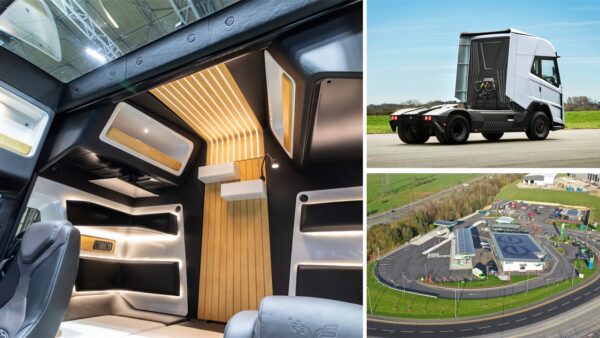 HVS (Hydrogen Vehicle Systems) is transforming the trucking industry with its hydrogen propulsion systems, which are helping the industry achieve its zero-emissions targets.
The Glasgow-based OEM has been on a strong growth trajectory since its launch in 2017 and in April this year it unveiled the UK’s first zero-emission hydrogen-electric HGV.
The new HGV grabbed a lot of headlines, while HVS itself has attracted grants and endorsements from the UK government, as well as private investment from EG Group. And, there’s a growing buzz around hydrogen as a game changer in decarbonisation, as Karen Preston, HVS sales and marketing director, acknowledges.
“There’s so much going on globally now – I’ve never seen as much activity for a single sector,” she says. “It’s intense from all areas of the globe: the US, Middle East, Far East, Australasia…There’s a huge amount of focus and excitement with hydrogen at the moment and the possibilities to provide a zero-emission option, which has really positive total cost of ownership implications for operators,” Preston says.
Regulatory framework for decarbonisation
The current activity around hydrogen in the UK market and globally is being driven by the regulatory framework for decarbonisation, as Daniel Musenga-Grant, head of sustainability at HVS, explains: “There’s the government bans on non-zero emission HGVs that were put in place in response to the Paris Agreement, which came out of COP 2021.
“In the global push to net zero, the transport industry has been putting stakes in the ground and saying “this is when we are going to ban the sale of non-zero emission vehicles.”
“For HGVs, that is 2035 for everything under 26 tonnes and by 2040, all HGVs that are sold will need to be zero-emission.”
Given that trucks have a lifetime of just upwards of seven years, operators need to start getting fleets transitioned now, Musenga-Grant says. “We need to make sure operators are getting used to these vehicles and that the infrastructure is in place. If we are going to have any chance of meeting net zero targets, including the interim one of halving our emissions by 2030, then we really do need to get moving quite quickly.”
According to Musenga-Grant, HVS was set up to provide an option for decarbonisation for HGVs. “We saw options for decarbonisation for other vehicles but when it comes to the heaviest vehicles on the road, HGVs which are working every day and keeping our economy going, there was no option for decarbonisation and pure battery-electric technology was not working for a lot of the use cases in these largest of vehicles and HGVs,” he says.
“It’s why we went for a hydrogen powertrain with its quick refuelling and long ranges and ability to keep those heavy payloads moving and get them into operation with minimal upheaval for the operators,” Musenga-Grant explains.
“We know there’s a big transition coming and there’s going to be changes across the whole of society, the economy and logistics industry. We wanted to make sure it could be as painless as possible for HGVs, while also achieving decarbonisation, which is a big challenge,” he adds.
Shortcomings of BEVs for HGVs
Preston reports there’s a growing interest in hydrogen solutions due to the shortcomings of (BEVs) Battery Electric Vehicles for HGVs. “A lot of the operators I’ve been speaking to have been early adopters and on this journey to net zero for a number of years,” she says.
The transition began in LCVs (Light Commercial Vehicles), where operators were able to implement zero-emission battery electric options for urban last mile deliveries because they were suitable for lighter payloads and shorter journeys plus provided regenerative braking through stop start in city environments.
However, many operators generally have mixed fleets and duty cycles and mixed use cases, Preston adds. “They have invested in battery electric technology but to transition to medium and then heavy fleet sizes is proving more difficult than they expected,” she says.
Furthermore, the grid capacity is not sufficient to sustain a larger transition to heavy duty vehicles, Preston says. “So operators are having to plan to try and upgrade the local grid or consider relocating depots altogether, which is really not an option for many logistics providers, who are located in logistics parks and unable to relocate. Battery electric is expensive and is not an option for longer journeys and heavier payloads so hydrogen is really the only solution for them.”
Downtime during charging is a lengthy process for HGVs and another obstacle to adoption.
“Uptime is the main priority for all of the operators in logistics,” Preston agrees. Operators cannot afford to take vehicles offline for 12 hours to charge overnight, she says. Plus, in many instances, trucks are double or triple shifted and continually on the road so, when one driver runs out of hours, another will hop on board. “This is the way the logistics industry is set up,” Preston says. “It’s very streamlined, with optimised routes and very tight margins. Operators are going to struggle to adapt battery electric to longer haul operations.”
In addition, operators are having to invest significant sums of money to install fast chargers. “Some only have the capacity to run five vehicles out of a depot, where they need 100,” Preston says. “They’re not going to make that work with battery electric technology.”
Government awareness and support

Hydrogen is beginning to win support at a governmental level. The UK Government, for instance, has recently unveiled a 17-strong shortlist of green hydrogen projects, totalling 262MW of capacity, which could receive funding.
“It was welcome news the government announced a UK net zero hydrogen fund,” Preston says. “They are trying to promote a cleaner energy future and see hydrogen as playing a key role.
“It’s a real step in the right direction but we need significant investment in renewables if we are to create and produce the amount of green hydrogen that we need to support not just the transport sector but the industrial sector including food manufacturing and high carbon emitting steel and glass production. It’s not just about transport but the other industrial sectors that need sufficient infrastructure to provide hydrogen,” Preston says.
Outside of the UK, hydrogen is winning traction in markets including Germany, Japan, Singapore, Australia and New Zealand, where governments are making significant policy decisions around hydrogen, Preston reports. There are also lots of projects underway in the Middle East and Saudi Arabia; while the US has announced a $11bn investment to advance clean energy across rural America,
“There’s a real focus on building out the infrastructure but it is very slow,” Preston says. “The UK strategy has been for battery electric but they now see the value of hydrogen to support those net-zero targets but we need a lot more focus and drive to meet those targets.”
Musenga-Grant emphasises another key benefit of hydrogen over battery electric.
“For battery electric vehicles, you need to have electricity there and then,” he says. “As we continue to rely more on renewable electricity, which comes when the sun shines or the wind blows, then having an energy storage system becomes vital. That can be done by large battery packs but hydrogen is a fuel so, if you are creating hydrogen, it will sit there in its container until you need to use. That’s why it’s quite good for transport methods and other use cases – it’s an energy store and you don’t need to be producing that electricity there and then.”
Baseline requirement for hydrogen refuelling hubs

HVS has conducted heat map analysis of the UK logistics road network to determine the baseline requirement for H2 refuelling hubs. “The big difference between the operation of private vehicles and HGVs is that HGVs follow set routes or operate on a back to base methods,” Musenga-Grant says. “Over 80% of their movement is on trunk roads ie the M1 and M6 and up to Scotland. The UK is a long, thin country so there’s a very good opportunity to set up a strategic hydrogen fuelling network. Our heat map analysis of HGV movement in the UK found that as little as seven stations could cover 80% of our truck movements because of the bias to trunk routes,” he says.
“So for HGVs, once you have that skeleton in place, it’s easy to see where the demand is and build out one or two stations and, before you know it, you have a very good network,” Musenga-Grant adds.
Private cars, by comparison, would require a hub round every corner, pretty much as they do with petrol stations, he says.
“There’s a real chance for HGVs to be the first hydrogen vehicles on the road because of this ability to have this strategic network and, once that’s built out, you can expand to medium vehicles. Then, as there are more stations, hydrogen becomes more applicable to other vehicles and even down to private cars,” Musenga-Grant says.
That goal is being facilitated by HVS’s strong relationship with its strategic investor, EG Group, which operates 1,000 forecourts across the UK, Musenga-Grant reports. “They have said that if you can get demand of 500kg of hydrogen a day, which represents only 10 trucks or 100 cars, it starts to become economically viable to put a station in that area.”
Through EG Group, HVS has also been able to build a good relationship with Asda and its fleets and is looking forward to working with the business on decarbonisation, Musenga-Grant says. “Although we are bringing the articulate tractor to market first, the medium, 26 tonne HGV is in our future and the collaboration has opened up a wealth of opportunities for HVS and a clear route to market,” he says.
The transition to hydrogen refuelling isn’t expected to require substantial developments, HVS maintains. Many businesses are ‘back to base operators’ – they have fuel on site and have been trialing gas vehicles, so the switch from CNG/LNG to hydrogen won’t be so huge.
The quick refuelling of hydrogen – 15-20 minutes – is also comparable to diesel, which is another plus, the company adds. That means each pump would be able refuel three to four HGVs every hour. Existing truck stops operate between eight to 16 pumps, so a similar sized operation would be good for hydrogen as well, HVS suggests.
Preston says there’s a great appetite to work collaboratively with investors like EG Group plus fleet operators to identify the most appropriate locations for Hydrogen Refuelling Stations (HRSs), as well as with the producers of hydrogen in order to understand where their renewable energy sites are going to be.
“We are having lots of conversations to build out a whole eco-system and not just in isolation with the truck,” Preston says. “We see ourselves as an enabler of the hydrogen economy to really drive this forward.
“The hydrogen sector is where EVs were 10-12 years ago,” she continues. “We are on this journey and making rapid progress. HGVs will enable the hydrogen economy to move forward but we need the support of government with policy, legislation and incentives and we are working with government to try and push though policy decisions on incentives to ensure net zero targets are achieved.”
Starting from scratch
HVS’s hydrogen-electric HGV journey has benefited by starting from scratch, Musenga-Grant says.
“We know we are not doing an evolution of the HGV but a revolution,” he says. “We started with a blank sheet of paper and began by asking “what does the HGV of the future look like?”,” he says.
“The first step was hydrogen as the fuel of choice but there was also an opportunity to redesign the HGV itself by looking at the newest legislation, rather than drawing from a legacy of older vehicles,” he says.
Those elements have influenced the physical design of the chassis, for example, as well as the packaging of onboard components.
However, another key consideration in the design brief was the operator in the cab as well as the fleet managers and buyers.
According to Musenga-Grant, HVS conducted research to make sure the cab was easier to get into. The tractor doesn’t have a large diesel engine, so the floor is lower meaning there’s one less step to get in, for instance. It also has wider doors and a comfortable and private rest area at the back of the cab. Studies found there was as a lack of facilities for female HGV drivers in Europe so HVS has enhanced the living space and, if possible, incorporates a toilet in the design.
“We took into consideration what a driver and a fleet manager would want, which feeds into our (HMI) Human Machine Interface or dashboard – what information does the driver need to operate the vehicle and what information in the background does the fleet manager need to increase their efficiency. We’ve done a lot of work because we had that blank slate to start from with the HGV design and from people who work with the HGV as well,” Musenga-Grant says.
Bright future

The future looks bright at HVS. The company has grown to 70 employees in six short years with the majority of the growth coming in the last 18 months. “We’ve got a lot of momentum behind our project with both government and private funding,” Musenga-Grant says.
“The launch of the demonstrator vehicle in April propelled the business from a powerpoint company to a company where you could go and feel and touch and kick the tyres,” he smiles. “We’ve seen huge growth and that’s set to continue.
“The really exciting thing for me is potential for decarbonisation these vehicles offer. The long haul diesel HGVs on the road are releasing an average of 104 tonnes of CO2 a year every year – so it doesn’t take too many of those to be replaced or displaced to make a real difference.
“But it’s important to remember a hydrogen vehicle is an electric vehicle, it’s just you are producing electricity on board instead of having to take it from the grid. The need is to push against fossil fuels and continued use of diesel and petrol and find the use cases where different types of electric vehicle work for decarbonisation,” he says.
