

Former M&S executive leverages food experience at David Jones, Australia
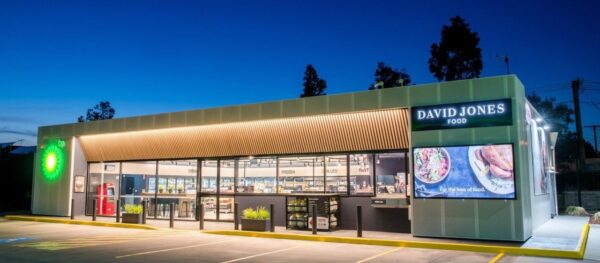 There is some neat symmetry in Paul Horwell’s retail career. The former head of UK franchise at Marks & Spencer, who helped take the Simply Food convenience retail brand onto the forecourt in a partnership with BP, is now delivering a similar role as head of food buying at Australia’s premium department store, David Jones, and its expanding tie up with the fuel retailer ‘down under’.
The novelty is that now Horwell is responsible for long life products whereas, in his 26-year tenure at M&S, the focus was largely on chilled.
“It’s been quite a journey,” he smiles. “I spent an awful long time working with M&S in the UK, starting off pretty much on the shop floor and moving myself up through the ranks into an office environment. A lot of what I learnt back in my days at M&S was about basic retailing skills – making sure you have got good quality product and that you have a vision about what you are trying to achieve.
“One of my later roles at M&S was working with a great couple of people, including Jill Bruce, Matthew Knowles and David Stevens to set up Simply Food, which was the M&S convenience store network.
Establishing M&S Simply Food
 “Jill, Matthew, David and I worked very hard to try and establish Simply Food as a business and really make sure we could take the very best of Marks & Spencer into the convenience market.”
The first M&S Simply Food shops were located on high streets and at London railway stations and were opened to great success, Horwell recalls. As part of the expansion programme, Horwell concentrated on the franchising of the Simply Food business, while Bruce and Knowles worked to establish it from a company-owned perspective across the rest of the country.
“We were very fortunate to be working with an extremely popular brand and fantastic product offer and we were working to try and make sure we could take it to the best locations for people to access,” Horwell says.
The trio were also blessed to be working for M&S’s then head of food, Justin King.
“He was a great visionary leader in terms of retail, who was extremely supportive in that programme and in helping to establish Simply Food as another arm to the M&S Food business,” Horwell says.
The move onto BP forecourts was part of the brand’s evolution, he maintains.
“Marks & Spencer has got a very special place in people’s hearts. Once we had taken the brand into railway stations and continued into motorways, we found that it was resonating with customers. When we were approached to work with BP it seemed a logical step, although we needed to ensure that the brand execution worked in that new environment, because it was revolutionising retail in the forecourt market, which the UK had not really seen 20 years ago,” Horwell says.
Bringing experience ‘down under’
Horwell headed up the M&S Simply Food franchise operations for 12 years, taking the brand to travel locations but also into hospitals and latterly establishing stores in Paris in partnership with Lagardere; as well as a trial of the concept in the Netherlands.
In 2014 Horwell was head hunted by Stuart Machin, the current managing director of Marks & Spencer Food, who was working for the Australian conglomerate Wesfarmers at the time.
Machin headed up the Target chain and poached Horwell to create a private label food business for Target Australia. There, Horwell created a new brand, The Fabulous Food Company, offering a range of own label products including confectionery, tea and coffee plus seasonal lines for Christmas and Easter.
“Target as a business really wanted to get a foothold into food,” Horwell recalls. Predominantly a general merchandise retailer majoring on home and clothing, Target occupied a great heritage spot in the Australian market. Managing a heritage brand in that respect drew further parallels with Horwell’s M&S experience.
Horwell on the Australian Market
“Australia is a vast country and as you would expect retail over the last century has made the most of this by continually building more retail emporia, shops and outlets. The population has been growing fairly constantly, with people arriving and moving around like shifting sands following opportunities to trade and create wealth.
However, shopping habits have shifted significantly further. No-one could have envisaged an Australian CBD in April 2021 being empty – completely devoid of customers with all businesses closed. But innovation thrives in times of uncertainty, and retail in Australia has pushed the boundaries to provide to customers what they want, when they want it. Melbourne suffered with strict curfews and restrictions on trading, but COVID-19 has accelerated how to sell to people in more convenient ways. Of course, online sales and click’n’collect have prospered, but they have also seen an accelerated return to shopping “local”.
This was already a notable convenience trend in Europe, as all major supermarket retailers have embarked on small high street and forecourt strategies and have been reducing big box construction. Australia over the last five years has been following this trend and expanding and developing convenience stores in high streets and roadside locations apace, and co-incidentally just in time for the world pandemic.
The Australian consumer is smart, they are well travelled, accustomed to multiple cuisines, and are price conscious. Restaurant quality is high, take-away options are varied and good value for money. They are savvy, expect good quality, and great service – Australia is a complex market to navigate. There have been few recent international entrants, but local innovation is thriving.
Food Retail in Australia

Not surprisingly food retail has outperformed the overall retail market, with not only the major Australian supermarket chains, Woolworths and Coles, performing well, but many independent “local” convenience stores too. Gum Tree Good Food is a good local convenience store example. They operate three stores in Melbourne suburbs and found customer loyalty earnt over many years of trading, further increased during COVID, and has maintained after lock-down ended, a theme seen by many smaller businesses catering to their local market. But the tenets of retail are really simple; give the customer what they want, when they want it at, in a convenient way, at a competitive price.
Forecourt retailers in Australia particularly suffered significant reductions in fuel volumes in lockdown areas but have also been the drivers in working to mitigate this with digital initiatives. BP with UBER, and 7-Eleven with Tipple are great examples. But the real key is giving the customer a compelling offer, an inviting shopping environment, a strong differentiated product mix of reputable brands, all at a competitive price. Location cannot be over-looked, new roads, by-passes, and changes to the travel flow of the consumer is ever fluctuating. Getting this full mix right is the key to winning.
Convenience is a dynamic market, and as Sir Stuart Rose said, you need to be half a step ahead of the customer; if you are too far in front they may not catch up with you! Being just ahead of the market is difficult, but I have never known retailing to be straight forward. A crystal ball may help, but retail basics will give you a strong foundation for success.”
The move to David Jones
Horwell spent two years at Target before moving into his current role at David Jones. One of the oldest department stores in the world, David Jones had been acquired by Woolworths South Africa in 2014, a business that coincidentally has a very close relationship with M&S in the UK.
David Jones also boasted lots of heritage customers but was looking to modernise and grow its food business, Horwell says. There he looks after long life areas including Christmas, Easter, BWS and grocery and across a mix of branded and private label lines.
Restrictions on travel due to the Covid-19 pandemic has meant Australians have treated themselves to good quality food over the last year, Horwell reports.
“The whole Australian supermarket sector has performed well during the pandemic. The fact that people are stuck at home has meant there’s more customers to serve,” he says.
The Australian market also boasts some of the best food in the world, Horwell adds. “The produce is stunning and Australians have extremely diverse palates – they totally understand what quality is,” he says.
While Melbourne, home to David Jones’s HQ, was subjected to one of the world’s strictest and longest lockdowns last year, life is pretty much back on track, Horwell reports.
“Compared to Europe we have managed to contain the virus and life is as relatively normal as possible but with the wearing of masks. We don’t want to go back to that place, so people are voluntarily wearing masks outside,” he says.
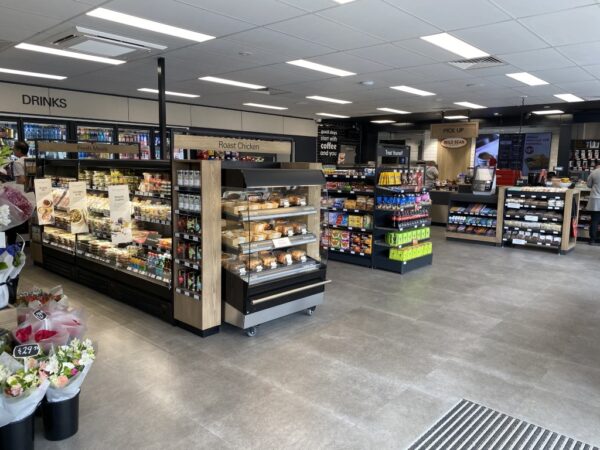
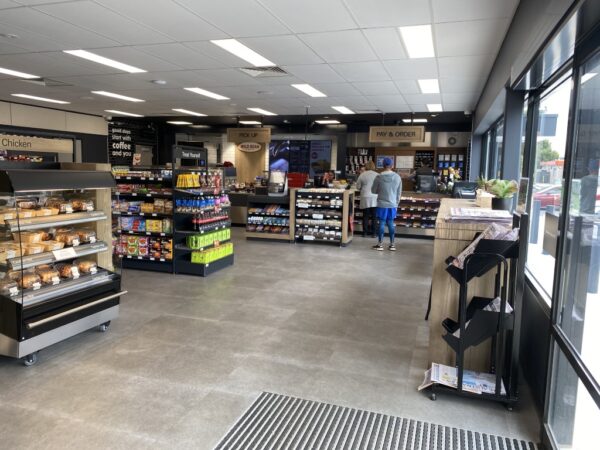
David Jones comprises 48 department stores of which 46 offer food, plus a transactional website. There’s a strong emphasis on gifting such as biscuits and teas and the retailer has exclusivity on the Fortnum & Mason brand, which is one of the most popular ranges. Fresh food is retailed from two locations plus 35 forecourt sites operated in partnership with BP. Products include sandwiches, salads, ready meals, fresh produce, fresh meat plus cheese counters in bigger stores.
David Jones and BP
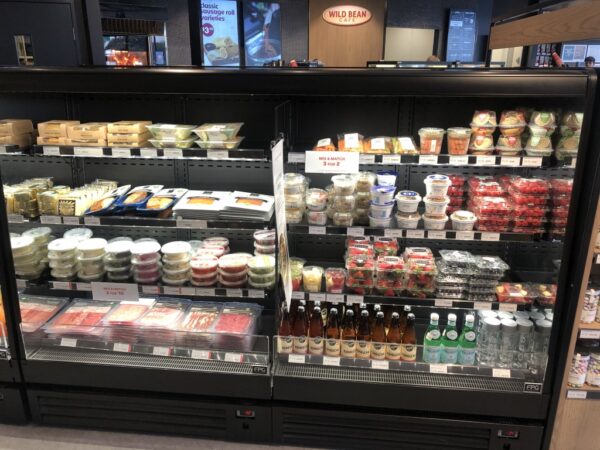
On BP sites, there is a combination of food for now and food for later, targeted to the forecourt sector.
David Jones struck up the BP partnership in 2018 when talks with BP and Woolworths Australia collapsed.
BP operates 1,400 branded retail fuel sites across the country, of which approximately 350 are company owned and more than 1,000 are owned and operated by independent business partners.
Prior to the partnership, BP’s offer was akin to a traditional CTN offer within a forecourt network. And, while Coles and Woolworths both operate forecourt formats that are closer to what you would recognise in the UK, the sector is underdeveloped, Horwell says.
The first dual sites were opened at the close of 2018 with an initial 10-store trial, expanded to 35 sites by the end of last year.
The aim is to deliver fresh, high quality products and innovative convenience and shape the way Australian consumers shop for food.
The David Jones name sits above the door, although the forecourt is branded as BP. “We try to give a sense to customers that they are in a corner of a David Jones food store,” Horwell says.
In terms of customer acceptance of the offer, Horwell reveals that the “customer has approached the partnership in a positive way”.
All partner sites also have a select range of the David Jones Food offering available to order on Uber Eats, a welcome service when Australian consumers were forced to restrict their movements.
“BP has a relationship with Uber Eats and offering David Jones products as part of that offer has been looked at favourably by customers,” Horwell says; adding that the pandemic has forced people to rethink how they operate in many respects.
As for Horwell’s next move, the retail executive remains driven. “Certainly there’s a lot of opportunity to further develop the David Jones Food business,” he says. “Customers have a loyalty to the business, and love food, so it’s about making sure we have got great products that are convenient and available for customers to buy.”
