

The Convenience Store Market in Thailand
In the heart of South-East Asia, Thailand is renowned as one of the world’s favourite tourist destinations, with its stunning beaches in the South and mountainous areas in the North of the country. Tourism is very important to the Thai economy, prior to COVID it was attracting nearly 40 million tourists a year, contributing nearly 20% of the country’s GDP.
Over the last 40 years Thailand’s 70 million population have benefited from consistent economic growth moving from a low-income to an upper middle-income country with an average household income per capita of just under $4,000.
This economic dynamism has been matched by a rapidly developing retail trade. The industry changed significantly in the late 1990’s following the Asian Economic Crisis when large Thai conglomerates sold off their valuable retail assets to leading global retailers. Ahold led the way followed be Carrefour, Casino and Tesco. This influx of retailers helped accelerate development and professionalism within the industry and allowed it to leap ahead of many of its neighbouring markets.

The market has now moved full circle, as with nearly every Asian market, and the international retailers have sold up and local companies now dominate the market. These are led by CP All – owners of 7-Eleven, Tesco Lotus and Makro, Central Retail– owners of TOPS, TOPS Daily and Familymart and BJC owners of Big C and Mini-Big C.
The 2000’s saw rapid development of Hypermarkets, Supermarkets, Personal Care stores as well as Convenience Stores. While Hypermarkets were the dominant channel early on, the last decade has seen a dramatic rise in the importance of the Convenience channel, which now boasts around 20,000 stores, spread throughout the country.
Convenience stores in Thailand have one of the highest shares of the packaged grocery market of any country globally with over 1/3rd of all sales going through the channel. The shift has occurred as shoppers in urban areas moved to an on-the-go lifestyle looking for quick solutions to save them time. Increased traffic congestion in major cities has also helped push proximity retail as shoppers do more top up shopping to meet their daily needs.
Nearly all Thais regularly use Convenience stores, and they visit them frequently, often 4 or 5 trips per week, a frequency only matched by shoppers in Taiwan.
Thai shoppers have a lot of proximity formats to choose from. As well as the modern trade there is still a very strong traditional trade with over 400,000 mom & pops stores. These stores provide the most convenient location for shoppers to buy impulse products and some daily necessities particularly in upcountry rural locations.
Within the modern self-service convenience channel standalone traditional CVS stores lead the way headed by 7-Eleven and FamilyMart.
7-Eleven is the dominant market player with 12,740 stores and plans for a further expansion of 700 stores in the next 12 months, despite the impact of COVID. It was the first convenience chain in Thailand, opening its first store in 1988. Today its store portfolio serves over 11 million customers a day. While current sales are split 70:30 between food/beverage and non-food products the chain is now focusing on how to develop from a convenience food store to an ‘all’ convenience store through leveraging online channels.
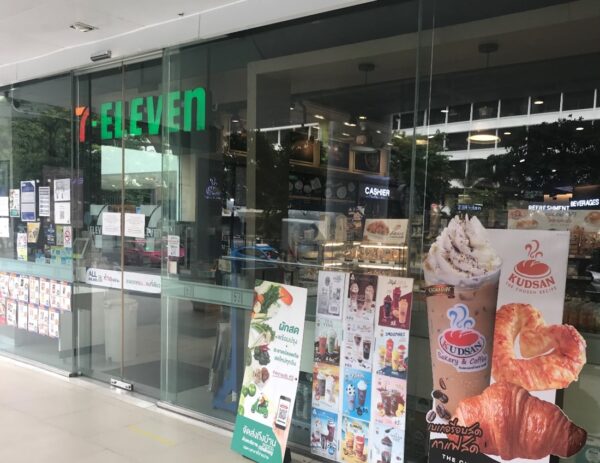
7-Eleven has driven innovation in the Thailand market, launching its Thai Smart Card (Loyalty) in 2001 and Smart Purse Payment Card in 2006. Its digital presence has developed since 2014 including its All Online 7-Eleven site and 7-Eleven mobile app. It now has a combined 40 million online accounts across all its online channels.
It is also one of the strongest brands in Thailand winning “Thailand’s Most Admired Brand & Why We Buy” in 2020 for the 8th consecutive year.
FamilyMart has been in Thailand for nearly 20 years, originally operated by FamilyMart Japan before selling 51% to Central Retail in 2012 and eventually 100% in 2020. Currently there are over 900 stores focused on meeting customers daily food and other needs from stores between 100-150 Sq.M. The chain is primarily focused on Bangkok and key tourist destinations compared to 7-Eleven which operates nationally.
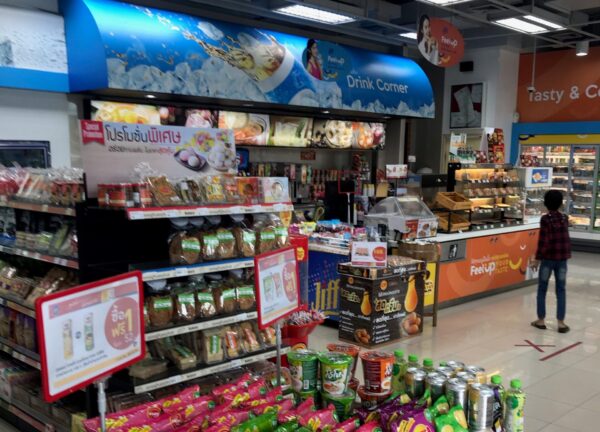
As well as standalone convenience stores there are also over 4,000 petrol convenience outlets including both the leading chains as well as specialist fuel chains such as Jiffy, owned by PTT the largest operator of petrol stations, Shell Select, TigerMart and others.
The typical highway petrol station in Thailand usually has a wide array of food and beverage outlets as well as a convenience store, providing significant competition for food on the go shopping missions.
It’s not just at petrol stations that convenience stores face this level of competition. Everywhere you look on Thai streets there are opportunities to purchase food/drink, from street vendors selling fruit or sweet Thai desserts to pavement restaurants as well as a wide array of fast-food outlets. Often vendors can be seen selling their products right on the store’s doorstep. Despite this food service has seen rapid development over the last 5 years, with some stores now preparing food on-site, benefiting from Thai’s love of food and snacking at all times of the day!
Thailand has also seen significant growth from another convenient format, the mini-market, or proximity grocery store, which is primarily focused on meeting everyday grocery needs including fresh food but also targeting on-the-go shopping missions.
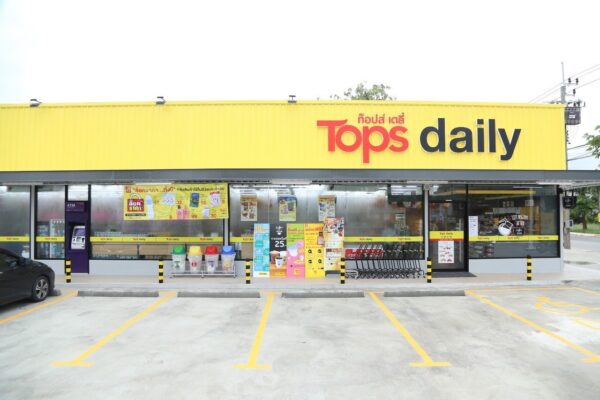
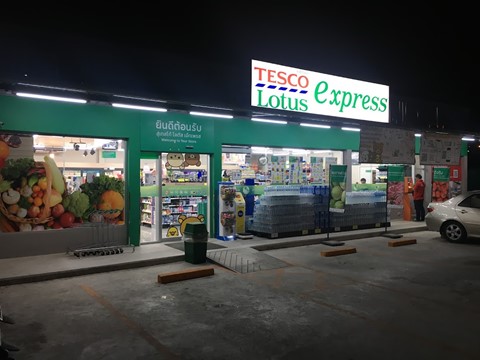
The leading chains are Tesco Lotus Express with over 1,600 stores typically sized between 150-250 sq.m , Mini-Big C, TOPS Daily and the rapidly expanding CJ Express (500+ stores), part of the Carabao Group producers of Energy Drinks.
These formats continue to innovate with new customer offers, for example TOPS Daily has been introducing ready-made meals, coffee bars and even co-working spaces to their stores
COVID has significantly impacted the Thailand retail market with several lockdowns and curfews over the last 18 months as well as the loss of tourism causing the economy to contract by 6% in 2020. This has led to household debt increasing to an 18 year high at 90.5% of GBP up from 85% in Q4 2020.
With many people working from home, store opening hours being limited by the overnight curfews and interprovincial travel being discouraged customer traffic has been significantly impacted, which has led to store closures at least for the short term. While convenience stores have benefited from their proximity to shoppers a restricted range of everyday essentials has limited that benefit. Most convenience stores have leveraged online services and use of delivery bikes to respond to the market challenges.
In the longer term the outlook for the Convenience channel continues to look positive particularly as it further leverages the opportunities from digital commerce that has been developed over the last 18 months.
Peter Gale is a Retail Analytics Consultant and NACS’ Relationship Partner, Asia based in Bangkok, Thailand.
