

Circle K wins the customer with gamified training program
Large retailers are always eager to create a consistent customer experience across teams and geographies. They constantly chase the best way to train and engage broad target groups, while creating an impact on sales, and getting value for money. To reach the young, they typically need to make it fun.
Circle K has successfully engaged colleagues in a holistic gamified training program called Customer Star, designed to win the customer, and achieve its mission of “making customers’ lives a little bit easier every single day”.
The Customer Star concept engaged 14,000 colleagues in 414,000 playful training sessions. It spanned eight Circle K markets: all the Scandinavian countries, the Baltic countries (Estonia, Latvia, and Lithuania), Poland and Ireland.
Jens Rye, Director People Development for Circle K Europe, explains the genesis for Customer Star: “At Circle K, we aim to win the customer. We want to make sure that our people are equipped to handle every single customer interaction. We have a lot of different customers, a lot of different team members, so we need to invest in training our people to make sure we succeed in making our customers’ lives a little easier every day,” he says.
Global and local approach

Leading a team that works across all Circle K countries in Europe, it was imperative the gaming solution was made to feel that it had been developed for each individual market, Rye says.
That meant adopting a global and local approach at the same time, he adds. “I think that’s possible because the challenges across markets are quite similar, but we also wanted to be super local for them and that they would feel we really see what challenges they have every day. ‘Made for me’, helps with that engagement,” Rye says.
As a result, the game was produced as a standard version in English and then translated and customised in collaboration with each participating country.
Staff had an option to use in-store tablets or their own devices. The majority – 90 per cent – chose the latter.
“Adoption and engagement became quite crazy and, because our people wanted to take the game to other locations other than workplace, they clearly preferred to use their own device,” Rye explains.
How to engage

In order to engage, Circle K needed to ‘obsess with end user needs’ and develop a training solution that would meet colleagues ‘where they are’ and on their own terms.
Firstly, since 70 per cent of the Circle K store teams are aged 19-25, a gaming solution was ideal. “It’s typically what that age group finds exciting – it’s the way most young people prefer to do training,” Rye says.
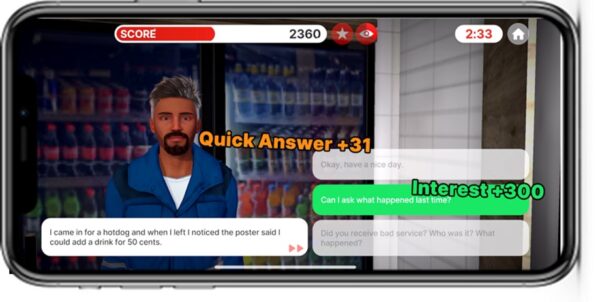
Secondly, it was critical that the game was both realistic and fun so that colleagues would be able relate to the challenges they meet every day. Building on real-life situations from the local markets also helped to drive engagement.
Thirdly, the game incorporated a competition element called “Beat Your Boss”. All participants were challenged to beat their boss for the top score on the leaderboard. Country and store leaders were able to try out the game four weeks ahead of its launch to give staff a benchmark of how they had performed. “Making it an engaging competition where everyone could aim to beat their boss really took the engagement to the next level,” Rye says.
Dedicated time was set aside in-store for training sessions, but Circle K quickly found the concept was so relevant and engaging that colleagues were voluntary playing the game out of work.
“It became a collective team effort at store to see if together they could beat their boss,” Rye reports. “Teams took ownership, and it became the talk of the town across our markets.”
The game mechanic

The Customer Star game was composed of five mini modules, each one dedicated to winning the customer across different areas and scenarios.
They included “Shining on the till” – opportunities for tailored recommendations in the sales cycle; “Working in store” – focused on service fundamentals and maintaining a pristine store and “Feeling the pressure” – preparing store teams to deal with a lot of customers at rush hour. Each module was five minutes in length enabling staff to complete the training program in a total of 25 minutes.
“A two-hour passive training session doesn’t match the habits of our great people at store. We need to meet them on their terms, but with content that supports our overall strategy and vision,” Rye says.
The games rewarded staff with higher points for best practice. The competitive element was especially strong: at store level, between stations and at a country level with leader boards created for the top 10 sites in each market.
“Retail is competitive by nature but having fun and linking scores to beating your boss made Customer Star a hyper-engaging training concept,” Rye says.
Recognition was a key element too. At the end of the four-week competition period, all participants who had beaten their boss received a personalized prize – a diploma signed and presented in store by their store manager confirming that they beat their boss alongside smaller prizes.
Customer Star 2.0
Given the success and popularity of Customer Star, Circle K is keen to elevate the concept and develop a 2.0 version, comprising three key elements, Rye reports.
Firstly, there will be a continued focus on winning the customer and driving great customer meetings. “We will never rest in our quest to win the customer,” Rye says.
Secondly, it will be more closely aligned to the company’s strategy with topics linked to those areas where it wants store teams to develop in promoting food, thirst and loyalty.
Thirdly, Circle K wants to be bolder and infuse AI technology into the concept to create an even more tailored learning experience for store teams. For example, if a store team does well in one area of the game but not as well in another, it will recognise strengths but also recommend areas where more training is required. Customer Star will also be expanded to other Circle K countries going forward.
Development journey
The development process has been a strong feature of the game’s success, Rye reports. Customer Star was developed in close collaboration between Circle K and its partner Attensi.
Representatives from all the eight participating countries were involved in the thought processes and ideas to determine the five modules.
“It would be of no use if Ireland thinks it’s great but Poland finds it irrelevant,” he explains. “That’s the challenge of a global company, you need to feel that the training is made for you, so we spent quite a bit of time in developing it and adapting scenarios locally.”
Company-wide engagement is also key, he adds: “You can’t just plug and play and expect that people will follow. It’s super important to bring everybody on board.”
The results

Customer Star engaged 86% of people at stores across Europe, and in the Baltics an absolute 100% completed the training. Results from Circle K’s in-game survey show that 96.4% of players have a better understanding of how to interact with customers while being on the store floor, and 97.3% have a better understanding of the different kinds of customers and how to attend their needs. Further, Circle K found there was a positive correlation with the percentage of certified colleagues in store and increased customer satisfaction and sales.
“We are being a bit bold and explicit about what makes great customer service and making it easier for our teams to apply it on an everyday basis. We want to make sure our customers really feel seen and valued when they come into our stores. Winning in retail means winning the customer!” Rye says.
A lot of effort was aimed at engaging young team members, but gamified training also resonated well with the retailer’s older colleagues. “The hypothesis that gaming is mostly applicable to the younger age group was wrong. We had full insight into the age demographics and there was actually no difference in participation,” Rye reports.
Next steps
Circle K is adamant the Customer Star gamified training program is not a cost but a good investment. “We think it’s the latter – investing in store teams makes a lot of good sense,” Rye says.
In a high turnover sector, people may argue it’s not wise to spend money on teams who may then leave the business. Rye thinks differently. “What would happen if we don’t invest, and they stay with us? Are we able to win the customer? Probably not. We need to look at it that way.”
“We are super happy about how this has played out. We have been able to mobilise and engage 14,000 colleagues. We are on a journey to winning the customer – it does not happen overnight, but we can only win the customer by having great people in our stores.
“We need to continue making our customer lives a little easier every day and, when we succeed, we will become the world’s preferred destination for convenience and mobility,” Rye says.
