

Beyond the oil price: How South Korea’s service stations are reinventing themselves
With geopolitical tensions driving fuel price volatility, Korea’s forecourt operators face a challenge that runs far deeper than the pump price. The real story is structural transformation.
NOAH KIM, editor-in-Chief of the THE E-STATION magazine in South Korea
In May 2026, the dominant topic in South Korea’s energy market is the Iran War — the military tensions centred on the Strait of Hormuz that have sent crude oil prices on a historic rollercoaster. Petrol and diesel prices at Korean forecourts have climbed sharply. Consumer outrage is focused on the pump. Operators, meanwhile, are dealing with a painful paradox: higher prices, but falling volumes and squeezed margins.
Yet to frame Korea’s service station crisis purely as an oil price problem is to miss the bigger picture. The country’s forecourt sector is undergoing a structural transformation that would be happening regardless of events in the Middle East. The traditional petrol-only model has reached the end of its road. In its place, a new generation of multi-energy, multi-service stations is taking shape — driven by government policy, EV adoption, and the urgent need to generate revenue beyond the pump.
A Market Under Pressure
South Korea’s service station network is contracting. A combination of shifting mobility patterns, rising minimum wages, and relentless price competition has pushed marginal operators toward closure. The era of growth by station count alone is over. What remains is a market defined by location quality and capital strength.
The market divides broadly into two categories: company-operated stations (directly managed by the four major refiners) and independently owned and operated sites. Independent operators make up the overwhelming majority, but they are also the most exposed to today’s pressures — limited capital, thin margins, and restricted capacity to invest in transformation.
The four major refining companies — SK Energy, GS Caltex, HD Hyundai Oilbank, and S-Oil — hold a firm oligopoly over branded forecourt networks. South Korea produces no crude oil domestically, but its refiners are world-class. They process imported Middle Eastern crude and have developed upgrading technology that converts cheap residual fuels into high-value diesel and petrol. Petroleum products rank third in South Korea’s export portfolio, behind semiconductors and automobiles.
However, the export refining margin and the domestic forecourt retail margin are entirely decoupled. At the pump, operating profit margins have languished at just one to two per cent. The four refiners are no longer racing to expand their station count. Instead, they are concentrating resources on strategically located sites — converting them into next-generation mobility and energy hubs.
Oil Price Shock, but the Wound Runs Deeper
The Iran War has intensified pressure on Korean forecourts. As crude import costs rose, station operators found themselves locked in an increasingly brutal pricing war — competing with nearby rivals on price differences of just one to two Korean won per litre. In an environment of high consumer price sensitivity, the result is clear: even when sales volumes hold up, operating profit deteriorates.
But managing through oil price cycles alone is no longer viable. The real challenge is structural. Electric vehicle (EV) and hydrogen fuel cell vehicle (FCEV) penetration is rising steadily. Demand for internal combustion engine (ICE) fuels is on a long-term structural decline. Operators who remain dependent on fuel margin face a threat that extends well beyond today’s geopolitical volatility.
The industry’s strategic response centres on one key concept: redefining what a service station is for. The question is no longer ‘how do we sell more litres?’ but ‘how do we monetise the time a customer spends on our forecourt?’
Energy Super Stations : From Consumer to Producer

The most significant structural change underway in Korean forecourts is the shift from energy consumer to energy producer — the concept of the “Energy Super Station.”
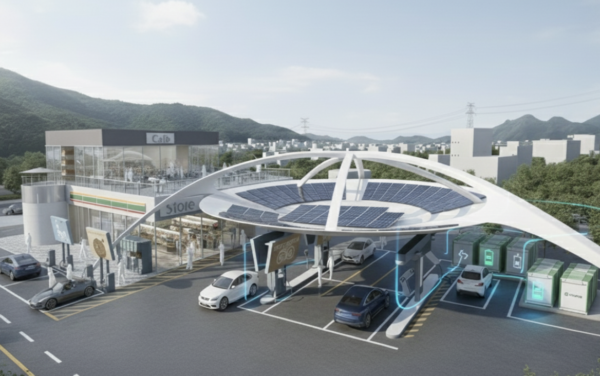
Historically, a Korean service station was a consumption point: it stored fuel underground and dispensed it into vehicles, and later installed EV chargers by purchasing electricity from the national grid (KEPCO). The new model inverts this logic. Stations are installing solar panels on rooftops and hydrogen fuel cells on unused land to generate their own electricity on-site, then feeding it directly into rapid EV chargers.
The government’s Ministry of Trade, Industry and Energy has been the driving force. Through a regulatory sandbox pilot programme, the ministry validated the safety of on-site fuel cell installations at service stations, and subsequently revised the Hazardous Materials Safety Management detailed standards to provide a legal framework for these hybrid energy facilities.
Regulatory change has accompanied this shift. From February 1, 2026, the government prohibited new permits for fossil-fuel-only service stations in major urban areas including central Seoul, and is actively encouraging existing stations to convert to the Energy Super Station format.
EV subsidy policy is also accelerating the transition. In 2026, the Korean government increased its EV subsidy budget by approximately 20 per cent year-on-year to KRW 936 billion (approximately USD 693 million), partly in response to US tariff pressures on imported vehicles. The maximum national subsidy for a passenger EV now stands at KRW 6.8 million (approximately USD 5,037) — including a KRW 1 million conversion incentive for owners who scrap or sell an ICE vehicle of three years or older before switching to electric.
These policy levers are driving rapid growth in EV adoption — and with it, growing demand for the rapid charging and self-generating infrastructure that only an Energy Super Station can provide.
Food, Coffee, and Premium Car Care

The second major transformation is the rise of non-fuel revenue streams — particularly food and beverage (F&B) and premium car care services.
The economics are straightforward. Fuel retail margins sit at one to two per cent. A cup of coffee from a branded franchise can deliver margins many times higher. Crucially, the shift to EVs has created a new captive audience: a driver waiting 30 to 40 minutes for a rapid charge is a customer with time to fill.
Korea’s refiners have moved well beyond the traditional forecourt convenience counter. S-Oil — which has topped the service station category of the National Industry Award for six consecutive years — has partnered with Mega Coffee, one of Korea’s fastest-growing large-format coffee chains, and convenience retailer emart24. The goal is to transform petrol stations into multi-purpose destinations where customers choose to linger.
HD Hyundai Oilbank has taken a different route, targeting the premium car care market with its specialist brand “Kashakshak.” The Korean premium car wash market is estimated at KRW 3.7 trillion (approximately USD 2.7 billion). Rather than relying on a single automated wash machine, Hyundai Oilbank has turned its company-operated station network into a platform for specialist SME partners — offering hand-wash, pickup-and-return, and detailing services that justify a premium price. As vehicles have become more valuable and customers more discerning, the forecourt car care offer has evolved from a convenience add-on into a destination business.
Regulatory Walls and Consumer Resistance
The push to transform Korean service stations into lifestyle destinations faces two significant obstacles: strict fire safety regulations and entrenched consumer attitudes.
Under South Korea’s Hazardous Materials Safety Management Act — tightened further in 2024 and 2025 — service stations are classified as high-risk facilities handling large volumes of flammable material. Smoking outside designated areas is now prohibited, with fines of up to KRW 5 million. More significantly for F&B operators, any on-site cooking using open flame or direct heat is effectively barred under fire authority guidelines.
This rules out the full hot kitchen that is standard at large truck stops in the United States. Korean operators have developed workarounds: selling factory-prepared, retort-packaged meals heated on-site, or constructing entirely separate buildings — physically isolated from the fuel infrastructure by fire barriers — to accommodate drive-through fast food outlets. It is a costly and space-intensive solution that limits the range of F&B concepts viable at a forecourt.
Consumer psychology presents an equally stubborn challenge. Korean consumers have historically treated service stations as a stop for fuel and nothing more. Survey data from the Korea Energy Economics Institute, covering 8,650 respondents, confirmed that Korean consumers once evaluated service stations almost exclusively on price and proximity, with very low preference for extended dwell time or on-site dining. The instinctive association between petroleum odours and food preparation — an assumption of contamination — is deeply embedded. Refiners are investing heavily in premium interior design and physical separation of food areas from fuel infrastructure specifically to address this barrier.
The Big Four’s Battle Plans
Against this backdrop, each of Korea’s four major refiners is executing a distinct strategy.
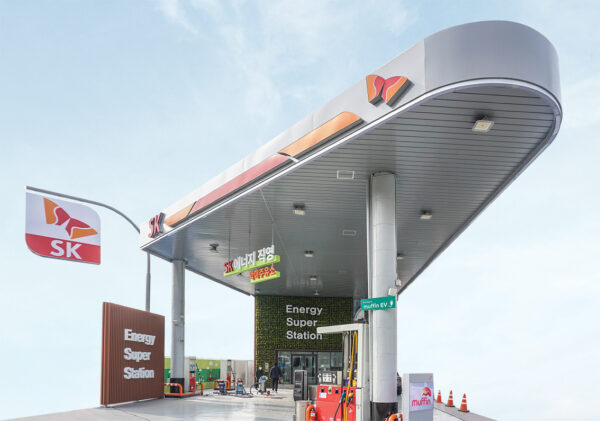
SK Energy — Korea’s largest station network, with approximately 2,000 branded sites — is deploying the Energy Super Station model at scale. The company opened its first Energy Super Station at Bakmi station in Seoul’s Geumcheon district, and has cleared the regulatory sandbox hurdles to roll the concept out nationally. The target: convert the full network into on-site electricity-generating, EV-charging eco hubs.
GS Caltex has created a dedicated consumer brand, “Energy Plus,” with its flagship “Energy Plus Hub” format. Starting with the opening of Energy Plus Hub Sambang in Seoul’s Seocho district, the network now encompasses 49 locations nationwide — including 18 in Seoul and 10 in Gyeonggi province — each equipped with ultra-rapid chargers of 100 kW or above. GS Caltex has also developed what it claims is the first multi-fuel complex in the Seoul metropolitan area capable of supplying petrol, diesel, LPG, electricity, and hydrogen from a single site.
HD Hyundai Oilbank, which operates the largest company-managed station network among the four, is pursuing a platform strategy. Its Kashakshak premium car wash brand is the flagship initiative, with a roster of SME partners delivering specialist wash, detailing, and pickup-and-return services. The thesis: as vehicles appreciate in value, customers will pay willingly for specialist care — and the forecourt is the natural venue.
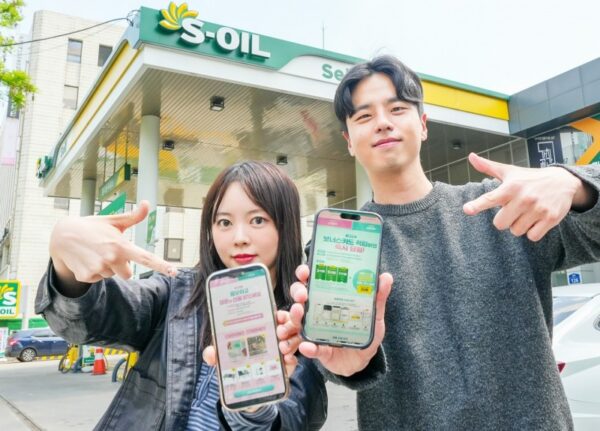
S-Oil has built its competitive position on brand affinity and lifestyle integration. Its “GooDoil” character-based marketing campaign, combined with the MY S-OIL mobile loyalty app, has created one of Korea’s most recognisable forecourt brands. Its partnership strategy — bringing in Mega Coffee, emart24, and its own no-brush automatic car wash brand “Washing Day” — positions its stations as clean, welcoming, multi-service destinations. S-Oil’s seven consecutive years at the top of the National Industry Award brand strategy ranking reflect the strength of this approach.
Survival of the Fittest
The Iran War has brought Korean service stations into sharp public focus. But the real battle being fought at Korea’s forecourts in 2026 is not about today’s pump price. It is about whether operators can complete the transition from single-function fuel retailers to multi-service energy and lifestyle hubs before their margins erode entirely.
For independently owned stations without the capital or scale to invest in EV infrastructure, premium car care, or branded F&B partnerships, the outlook is increasingly difficult. The ban on new fossil-fuel-only station permits in central Seoul is accelerating the attrition among operators who cannot or will not adapt.
For the four major refiners, the transformation is already underway. Energy Super Stations are generating their own electricity. Ultra-rapid chargers are being installed at premium urban locations. Coffee brands and car care specialists are moving onto forecourts. The identity of the Korean service station is changing — not gradually, but at speed.
The operators who successfully monetise EV dwell time, navigate fire safety regulations with creative architectural solutions, and overcome consumer resistance with compelling brand environments will define the next era of Korean forecourt retail. The pump price will remain in the headlines. The real story is what is being built behind it.
By Noah Kim, Editor-in-Chief at The E-Station.
